The detailed comparison
A closer look at the daily routine, the tools and the limits of each product.
Choose a section
Pause at the moment your exit rule changes
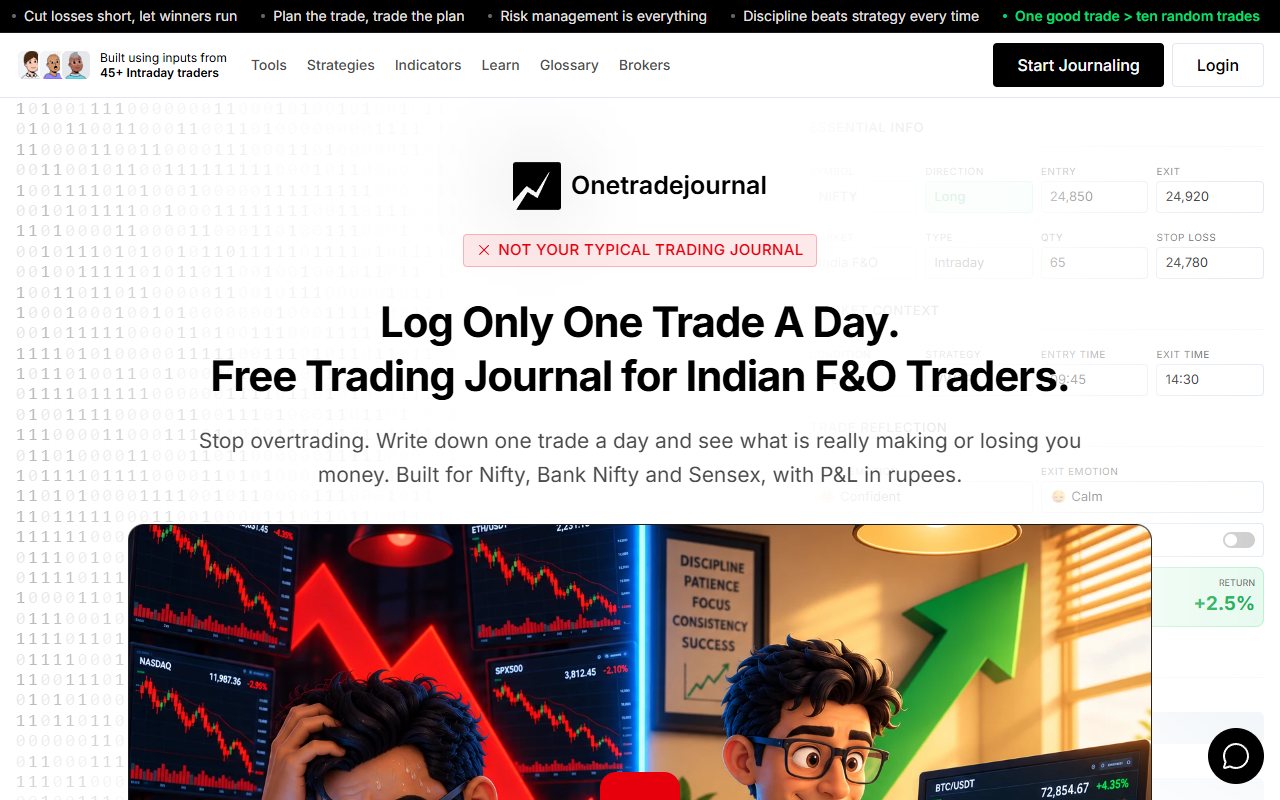
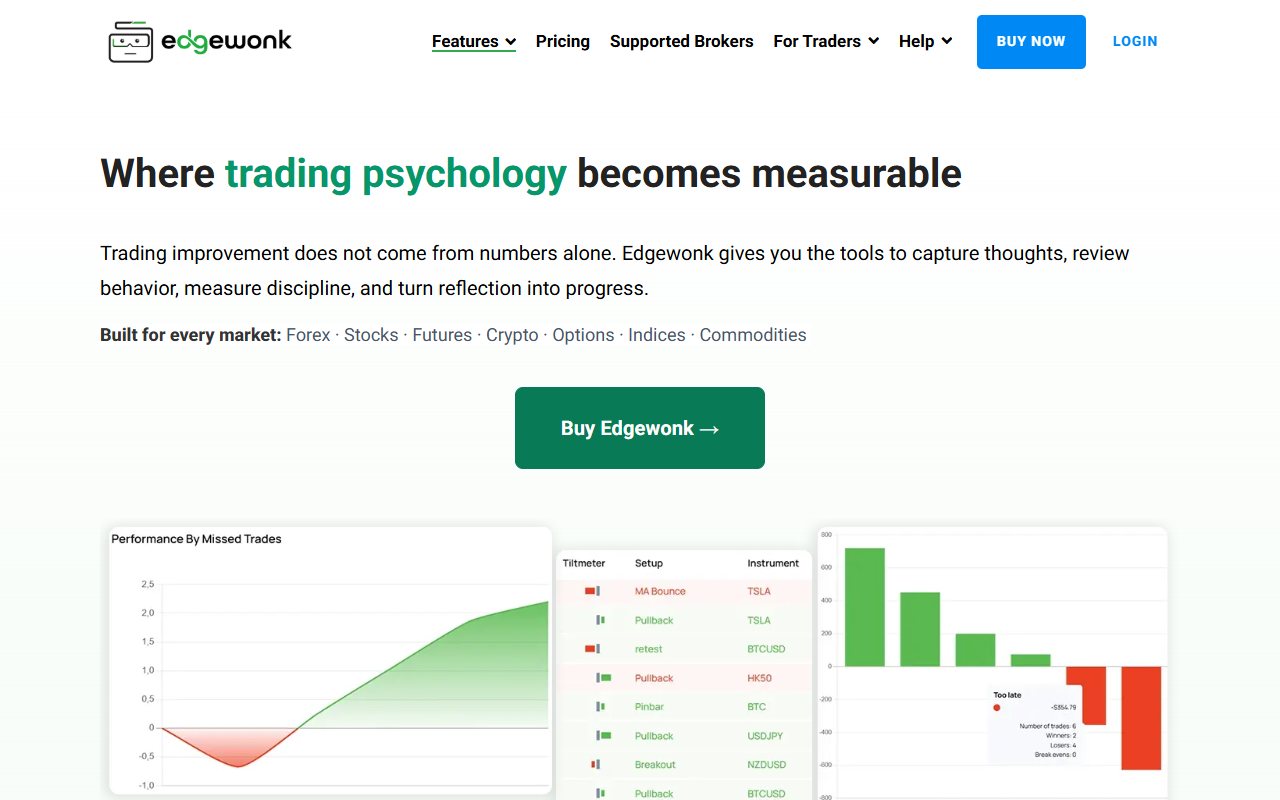
You planned an exit, but the open position feels uncomfortable. You close early, then spend the afternoon looking for another trade to make up for it. A profit chart shows the result. The daily note needs to show what changed in your thinking. OTJ uses one planned trade as the focus of a manual writing habit. You enter it yourself and name the hesitation, fear or recovery urge. This pause is meant to help you notice overtrading and repeated costly mistakes. It does not promise that staying with one trade will produce a profit. Free permits one trade per day per market. Paid subscriptions allow more entries. The daily focus is a habit you choose to practise, not a limit placed on your broker account. If you took several trades, keep their full financial record too. Edgewonk is a serious comparison for this need. Its psychology page describes decision comments, mental tags, session reviews, a notebook and Tiltmeter. It already helps traders reflect. OTJ's appeal is a small daily routine with clear questions and Indian F&O fields, rather than an exclusive claim to trading psychology. ## Keep entry hesitation separate from exit fear
The app's feelings tools support custom mental statistics and tags. That is attractive if you already know the factors you want to observe, such as focus, confidence or a particular trigger. You can design a review around your own meanings. OTJ supplies fields for entry and exit feelings, stress, confidence, impulse reason, plan change, satisfaction and mistakes. This can help a trader who otherwise opens an empty notes box and does not know where to start. The form gives them concrete questions. For a made-up Bank Nifty trader, the important distinction might be hesitation at entry versus panic at exit. Those are different events. Write what was happening at each point rather than tagging the whole trade anxious because the outcome was uncomfortable. Your own labels help when they make these differences clear. It becomes less useful when you create twenty overlapping labels and cannot apply them in the same way. Set questions help when you answer honestly. They help less if you rush each answer to finish the form. Choose a way of writing that you can use the same way each week. Read a record a month later. Can you tell what confidence or a plan change meant? You should not need to rebuild the story from memory. The daily habit works best when you keep the description small and specific. Write the original exit rule and the point at which discomfort changed it. At the next review, use free Behaviour analytics to find saved entries with a similar feeling, then read their notes. Do not call that feeling the cause of every result. Edgewonk's custom tags and notebook can hold that detail too. Raw execution prices do not establish the private reason, whether you type the trade or import it. Writing is not the only route to reflection. OTJ makes the act of writing a daily starting point, so you have something honest to revisit before another rushed entry becomes a familiar mistake. ## Let the score point back to a real decision
The app's Tiltmeter description links recorded habits with the equity curve. That is useful context for a trader who wants to examine whether execution and results are moving together. It still needs meaningful input. OTJ's Behaviour analytics is free. It reviews saved emotions and habits beside the results you enter, with habit flags and discipline reports. Paid AI behaviour review is separate. Flags can draw attention to a size increase, closely spaced trades or other possible patterns. These flags use simple rules and can be wrong. They cannot prove why you traded or stop broker orders. Imagine a made-up trader who followed the plan on Monday and lost, then broke a rule on Tuesday and won. A score should help them inspect those two choices without treating Tuesday's profit as proof that the rule was unnecessary. Read the underlying entries. Was the rule clear before the trade? Was the same standard used on both days? Did the trader record the violation only because Monday hurt more? These questions are more valuable than trying to make every day display a high discipline number. A score is useful when it points to a choice you can read and explain. If you cannot link a score to the trades, ask how it works. Check that before using it to judge progress. ## India support includes some listed file support
The app has Indian broker names in its official import list, including Dhan and ICICI Direct. It would be wrong to dismiss the product as having no Indian broker support. The page separately describes MetaTrader auto-sync; Indian file support should not be promoted as the same connection method. A listing is a useful lead, but it does not answer every F&O question. Confirm the expected export and market segment for your account. Check a Nifty option, a partial exit and a position held across dates. Make sure the resulting record matches the broker's quantities, prices and fees. OTJ uses manual entry and does not offer CSV import or broker sync. Indian F&O fields, expiry selection and lot-size hints can make that entry more familiar. Brokerage and other required charges are estimated, and those estimates should be compared with your broker statement. This produces a practical split. A Dhan user who wants a large archive has a listed Edgewonk import path to investigate. OTJ begins with your own manual entry. Writing the contract and risk rule is part of the reflection. There is no bulk file importer or broker connection, so a large archive still takes manual work. A longer broker list does not mean the notes are more honest. Imports collect trades and numbers. The reason for changing a stop or chasing a missed move still needs to come from the trader. ## A weekly scan still needs your daily context
The app offers Edge Finder, described as a journal scan every Sunday, with AI helping the analysis. Its public page presents results and mistake patterns. This is a real automated analysis tool and should receive credit. OTJ's paid tools include Ask Your Journal, Trading Mentor, chart screenshot analysis and pattern feedback. A question in chat and a weekly scan are different ways to start a review. Choose the way you prefer to start. Do you want a weekly report or an answer to a small question? For example, a trader may want to ask why a certain recorded setup was repeatedly entered late. OTJ's assistant can help explore the logged notes. Another trader may prefer opening the week's automated report and then reading the trades behind its patterns. Edge Finder's stated workflow is relevant to that preference. Neither format guarantees accurate claims or profitable changes. Check the original records and the size of the relevant sample. If the data includes only the trades you liked enough to log, an automated weekly scan cannot discover the missing history. A good review combines a prompt with evidence. Let the tool suggest a question, then confirm whether the records support it. A report may name your strongest hour. Read the trades first. Were the setups or market conditions different at that time? ## Check the current annual offer before paying
The official pricing page, rechecked on 12 October 2026, lists a standard plan of $197 for twelve months and a fourteen-day money-back guarantee when checked. The same page also contained $169 promotional copy and an offer countdown showing zero. The amounts disagree. Confirm the total at payment. The page says its paid plan is annual and includes all features rather than separate feature tiers. That may appeal to a trader who wants the full review environment without comparing several plans. A money-back policy is different from a free ongoing journal allowance. OTJ has a continuing free plan capped at one trade per day per market. Paid India options are ₹499 monthly, ₹1,299 quarterly and ₹3,499 yearly. Behaviour analytics is free. Paid features include extra trades, power mode, in-app AI and limited voice fill. The paid plan page gives the relevant purchase options. The important budget choice is commitment and use. If you are unsure whether you will write a daily record, OTJ's free allowance lets you practise that habit within its cap. If you already keep a complete journal and need Edgewonk's listed tools, an annual product may be a reasonable fit. Compare the actual payable amount and the features you intend to use. A dollar price is not a fixed rupee bill. A stopped offer timer does not confirm a current discount. ## A useful four-week comparison project
Consider this made-up project for an Indian F&O trader who regularly changes exits. It is a review exercise, not a forecast or a reported customer result. The trader's goal is to understand what happens between the initial plan and the eventual exit. During the first week, use a stable description of the planned exit. Record the target and what would invalidate the setup. At exit, note whether the plan changed and why. Save that first plan rather than replacing it with what looks sensible after the chart is complete. In the second week, read the entries with plan changes. Separate an adjustment triggered by the original rules from an adjustment triggered by discomfort. Both can produce wins or losses. The point is to understand the choice, not to force every exit into a moral label. In the third week, inspect a comparable set of trades with no plan change. Use the same strategy meaning and market session. If the groups differ in other ways, write that down. Do not assume every result came from following or breaking a rule. In the fourth week, write one note you can check going forward. It might be that the reason for moving a stop is often missing. The first change could simply be recording that reason at the time. A journal can support that process even when you have too few trades to make a broad claim. OTJ's daily writing habit supports the direct recording part of this exercise. The app's listed session reviews, tags and automated scans offer another way to organise it. Pick the workflow that makes the questions and underlying examples easiest for you to revisit. ## Check the saved target and past prices separately
OTJ's exit efficiency compares the exit with your entered target. Risk multiple depends on a valid planned stop. Those measures can help examine your intended risk and exit plan, but they do not reconstruct historical market highs and lows. The app's pricing feature list includes MAE/MFE reports and trade management analysis. MAE is the largest move against a position while it was open. MFE is the largest move in its favour. If those reports are central to your needs, verify how the relevant values are obtained for your instruments and imported data. A feature list does not prove that every Indian option has the needed price data. For an early exit, the two approaches can answer different questions. Did you abandon your own planned target? How did the position move while you held it? Keep those questions separate so a hindsight chart does not silently rewrite the plan. The same care applies to charge estimates. A journal total is a review tool, while the broker statement is the money reference. Match an example before using journal numbers to compare strategies that have very different turnover or execution patterns. ## Start with the exit you want to understand
OTJ suits an Indian options trader who wants to slow down after a planned trade and write what happened. The entry and exit questions help you keep fear, patience and changes to the plan separate. Free Behaviour review gives you a way to return to those records without buying AI tools. Edgewonk deserves attention if you want custom mental tags, a notebook, session reviews and a weekly scan. Its listed Indian file imports may also matter for a busy account. These are meaningful strengths. The price conflict and exact contract handling still need checking before a purchase. For your first reflection, use a trade you have already taken. Write the planned exit, the action you took and the reason for changing it. Read it again later as if you did not remember the session. A note that makes sense then is more useful than a high score with no clear explanation. Do not place a trade to maintain the habit. Waiting for the setup can be the disciplined decision. Neither OTJ nor a psychology score forces your next order or guarantees fewer losses. The daily practice helps you inspect a mistake you may otherwise repeat, while risk and execution remain your responsibility.
Sources and limits
We checked these public product pages and OneTradeJournal’s current product on 12 October 2026. We did not test a private Edgewonk account, broker import, payment or AI answer. Check current plans and limits before paying.
- Edgewonk pricing and annual subscription · Checked 12 October 2026
- Edgewonk supported imports · Checked 12 October 2026
- Edgewonk feelings and habit tools · Checked 12 October 2026
- Edgewonk Edge Finder weekly review · Checked 12 October 2026
A journal cannot promise trading profits. AI answers and fee estimates can be wrong. Check trades and charges against broker records. This page does not give trading, investment or tax advice. Competitor names and website pictures do not imply a partnership or endorsement. Any example is an explanation, not a private account screenshot or a real customer result.