
The detailed comparison
A closer look at the daily routine, the tools and the limits of each product.
Choose a section
A trading rule needs a daily habit behind it
You can write a rule against chasing a loss and still break it ten minutes later. The useful review asks what you felt at that moment and why you ignored the rule. OneTradeJournal makes that daily writing habit its starting point: one planned trade, your reason, your emotions and an honest review. The aim is to notice the urge before you repeat an avoidable mistake. OTJ does not stop orders at your broker or promise that one trade will be profitable. Free allows one saved trade per day per market. Paid plans allow extra entries, so the product's daily focus should not be used to hide other trades you took. TJL Pro also takes rules and mistakes seriously. Its features page describes rule tools, Indian shares, futures and options, broker files and AI Coach. Futures and options are often called F&O. The fair comparison is how you keep the routine, not which product is the only one that cares about psychology. OTJ starts with writing the trade yourself. TJL Pro can start from a supported broker file, then add rules and notes. A file saves typing, but your private reason still needs your input. For a trader who rushes back in after a loss, that reason may be the most useful part of the next review. We checked public pages and OTJ code, without testing a TJL Pro account. Its pages disagree about some offers and tools. Those limits stay visible below. ## Write one rule you can review tomorrow
A broad rule such as “stay disciplined” is hard to test. A specific rule gives you a choice to inspect. For example, a made-up index options trader could write, “Do not increase quantity to recover a stopped trade.”
TJL Pro's rule and mistake tools let traders define rules and record whether they followed them. Those tools can support a psychology review when you record the reason as well as the result. In OTJ, the stop, target, plan change and impulse reason help explain what happened. A planned increase in risk and an angry increase in quantity may look the same in a profit chart. The written context can show the difference. Imagine two trades. The first follows the plan and loses at the stop. The second breaks the size rule and wins. This is an illustration, not real trading advice. The winning result does not make the broken rule sensible, and the planned loss does not automatically make the first trade a mistake. Review the choice separately from the money result. Ask which detail you knew before entering, and which detail you added after seeing the outcome. This helps avoid rewriting the plan to fit the result. OTJ's ordinary behaviour analytics are available on Free. They compare recorded habits and emotions with the results. OTJ can also flag possible revenge trades, size jumps and excess trading from the saved sample. These are rough checks, not diagnoses. They do not block broker orders. TJL Pro's pricing mentions Challenge Mode. We did not test its controls. A rule shown inside a journal should not be treated as a broker order block unless that link and behavior are clearly confirmed. ## A monthly cap and a daily cap are different
The TJL Pro pricing page lists a free plan with one account, 50 trades a month, two rule cards and five mistake entries. It also advertises seven days of Pro access. That first week is not proof that all the same tools stay free later. OTJ's free plan allows one trade a day per market. It is a continuing free plan rather than a paid-plan trial. If you need to enter more trades on the same day, you need paid access. Unused days do not add extra entries to tomorrow's allowance. Picture a made-up Nifty trader who takes three trades on Monday, then none for several days. A monthly cap may suit that pattern better. A trader who takes one planned position most days may find OTJ's daily allowance easier to live with. The important check is whether every trade fits, including the mistakes. Do not keep only the best trade from a busy day. That leaves a false sample for later review. TJL Pro's mistake limit also needs a check. Ask whether it counts saved mistakes, types of mistake or another unit. We did not test how the account applies the limit. A public number can tell you the allowance without showing exactly how the product counts it. Write down your normal number of trades before comparing plans. Include unusual busy days. Then decide whether the free plan can hold a complete record after any introductory access ends. ## A broker file cannot explain a private decision
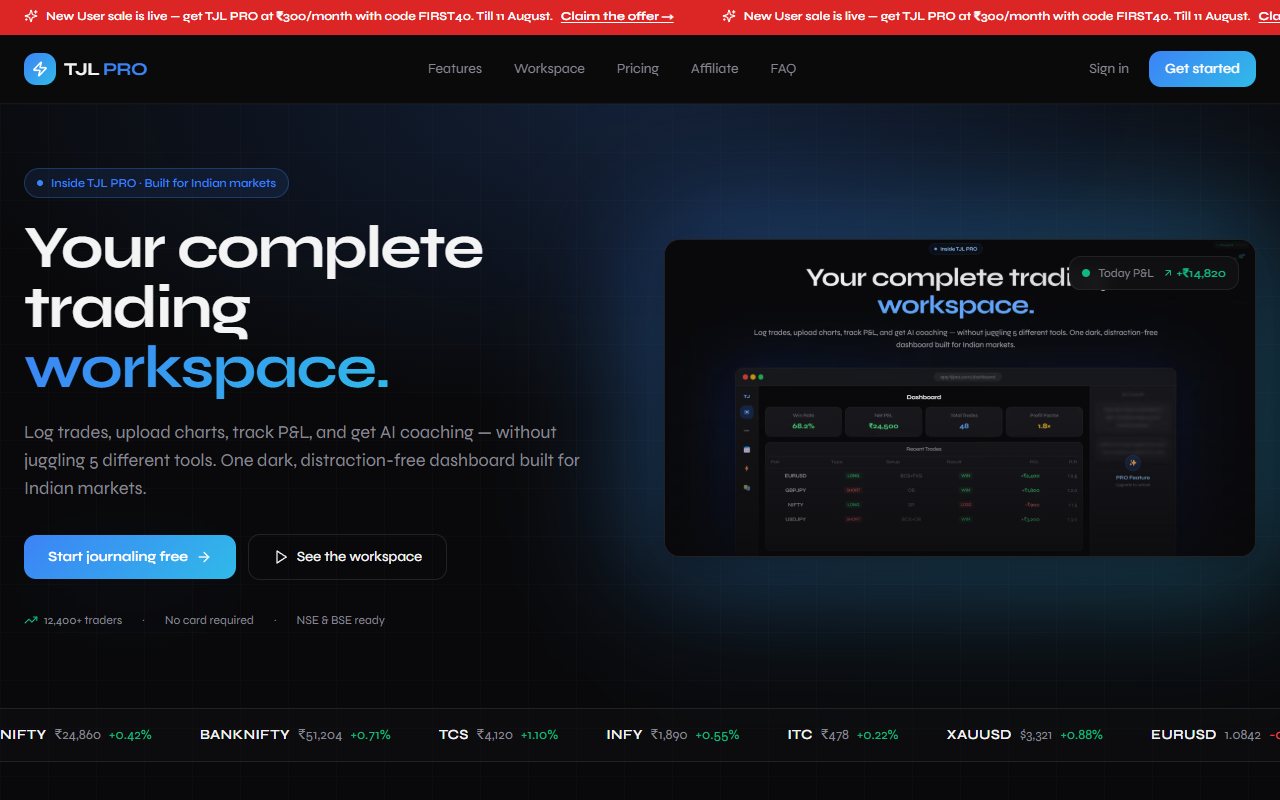
TJL Pro's features page documents Zerodha, Upstox and Angel One CSV files. A CSV is a file made of rows and columns. The homepage also names Groww and Dhan and says API connections are rolling out. An API connection lets software exchange data; rollout wording does not prove that your account can use it today. Start with the documented file route for your broker. Check dates, segment, symbol and quantity. A file that uploads without an error can still contain records grouped in a way you did not expect. Suppose a Bank Nifty trader enters in two parts and exits in three parts. These are separate fills, or executions. Check how the journal joins them into a trade. Also inspect a contract traded twice on the same day. This is a suggested check, not a result from our own import test. The file can save the numbers. It cannot know whether the trader raised quantity after a loss because of a fresh plan or a wish to recover money. That reason needs to come from the trader. OTJ saves entry and exit emotions, stress, confidence, impulse reason, plan change, mistake, satisfaction and notes. You can keep these details beside the stop, target and result. Writing those details is part of OTJ's daily practice. It helps you name an urge or a broken rule while you still remember it. Manual entry is also a real cost. If you have many fills, entering history by hand may be too much work. OTJ has no bulk shortcut for that job. Judge the effort on a tired evening, not only on the first day when a new journal feels exciting. ## AI review needs your notes
TJL Pro's FAQ describes AI Coach as a paid feature. It reviews entries, setups, mistakes and notes. The stated purpose is to examine past trading behavior, not predict the market. OTJ also has paid AI tools. Ask Your Journal, Trading Mentor with chart image review, and pattern feedback use the information you have saved. AI can make errors. It does not know about a trade you left out or an emotion you did not record. A useful question might be, “Which plan changes repeat when I mark high stress?” Check the entries behind the answer. Did you use the same meaning for high stress each week? Did you record all the relevant trades? Avoid mixing two kinds of statement. “The later positions were larger” is a fact you can check against quantity. “You wanted revenge” is a reason that needs your own account of the decision. A confident AI sentence does not supply that missing evidence. If you use setup labels, keep them clear. A setup is the set of conditions you wanted before entering. Do not use one label for several different ideas, then expect a report to separate them. The best review question is small enough to check. Asking for tomorrow's winning option is outside what a record of past choices can prove. Treat both products' AI as help for reading a record, not a guarantee of better returns. ## The visible price still needs a checkout check
The TJL Pro pricing page shows ₹300 a month before GST and ₹354 including GST. Its banner still says the offer ends on 11 August. We checked on 12 October 2026, so this article does not promise that the dated offer will be honored. The same page offers an annual billing control. The FAQ says annual billing is coming soon. Its feature page also differs about which advanced tools stay free. These are current public conflicts, not evidence that we tested the account and found a broken feature. Before paying, confirm the plan, billing period and full amount. Check which tools remain after the introductory week. Keep the checkout terms if they differ from the page you first read. OTJ's India plans are ₹499 monthly, ₹1,299 quarterly and ₹3,499 yearly. Paid plans allow extra trade entries. AI and voice fill require paid access. No lifetime plan is currently sold. TJL Pro's displayed monthly amount including GST is below OTJ's monthly price. OTJ is therefore not the automatic cheaper choice. The current promotion is still uncertain, and a yearly control is not enough to confirm a yearly purchase. Compare the plan needed for your normal work. Paying for AI makes little sense if you do not save the notes it needs. Paying for many accounts adds little if you only use one. A clear list of needs is more useful than a crossed-out price. ## Test the way you can take records out
Your notes can become valuable after months of use. Check export before putting a long history into a tool. You may later want to read the records elsewhere or keep a separate copy. OTJ exports CSV, JSON and text reports. CSV works as rows and columns. JSON keeps structured fields in a data file. A text report is easier to read as plain writing. These exports do not create an import route back into OTJ. TJL Pro's public export descriptions still disagree. Its FAQ says a full CSV export is planned. Its homepage says the journal stays exportable. We did not find an account test that settles the difference. If export matters to you, download a small sample inside the product before committing. Check whether notes, rules, mistakes and dates are included. A dashboard screenshot may preserve a view, but it is not the same as reusable records. OTJ's confirmed formats are a useful, specific advantage in this comparison. They do not prove stronger security or better data ownership in every sense. Keep separate copies and check what each file contains. ## Use the trade that is hardest to explain
Take an ordinary trade you handled poorly. For example, a made-up Nifty trader follows a stop, then takes a larger unplanned entry. Keep the broker record beside you so the review stays tied to the actual numbers. In OTJ, check whether the form helps you separate the first trade's planned loss from the second trade's broken rule. Save the emotion and reason as well as the money result. End the review with one action you can check next week. In TJL Pro, test your broker file, then inspect the rule and mistake tools on the plan you expect to keep. Confirm price and export details while the history is still small. Do not assume the first week's access is the permanent free plan. Choose OTJ if you want a daily pause to write your planned trade and watch the urge to break a rule. Its export formats give you a way to keep those notes. Choose TJL Pro if its supported files, monthly allowance and rule cards fit the way you review a busier history. Both need personal context; neither can control your next order or promise a profit.
Sources and limits
We checked these public product pages and OneTradeJournal’s current product on 12 October 2026. We did not test a private TJL Pro account, broker import, payment or AI answer. Check current plans and limits before paying.
- TJL Pro features and broker files · Checked 12 October 2026
- TJL Pro prices and plan limits · Checked 12 October 2026
- TJL Pro FAQ · Checked 12 October 2026
- TJL Pro homepage · Checked 12 October 2026
A journal cannot promise trading profits. AI answers and fee estimates can be wrong. Check trades and charges against broker records. This page does not give trading, investment or tax advice. Competitor names and website pictures do not imply a partnership or endorsement. Any example is an explanation, not a private account screenshot or a real customer result.