The detailed comparison
A closer look at the daily routine, the tools and the limits of each product.
Choose a section
Finishing the planned trade is a moment to reflect
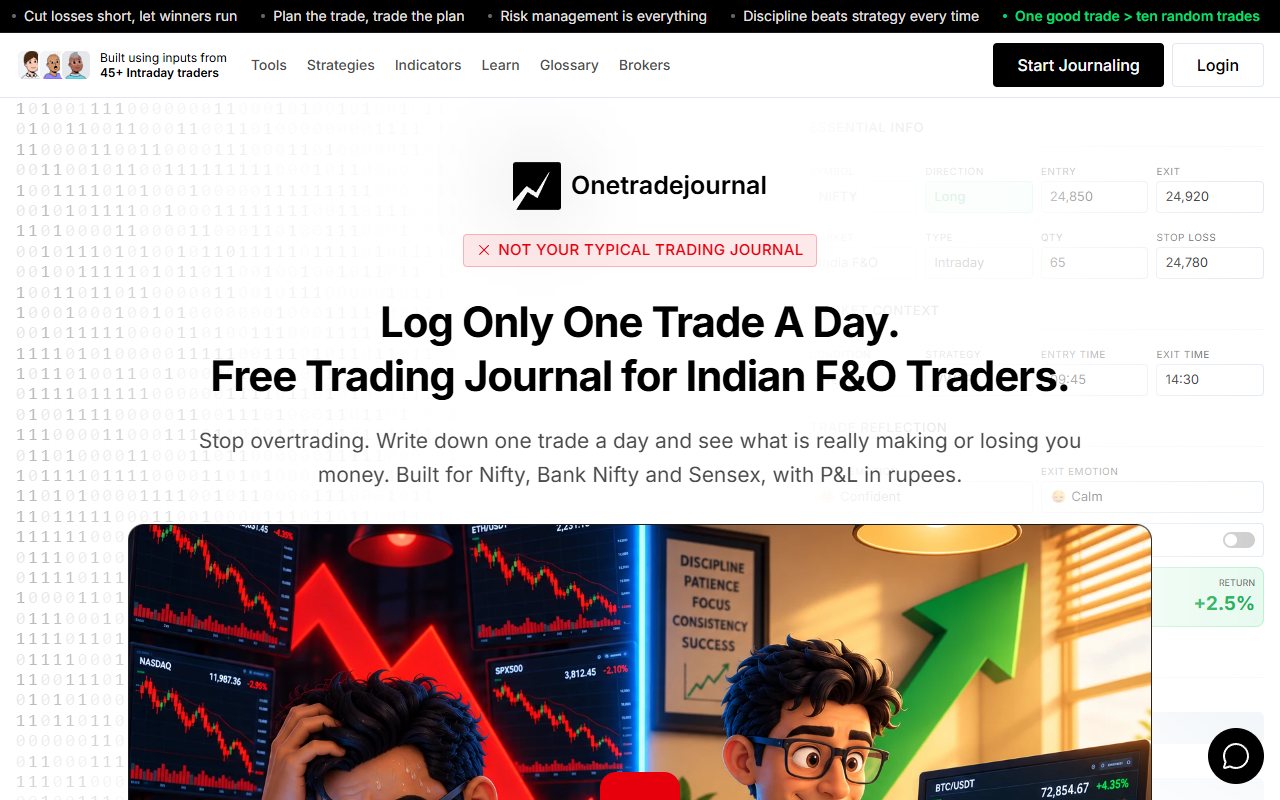
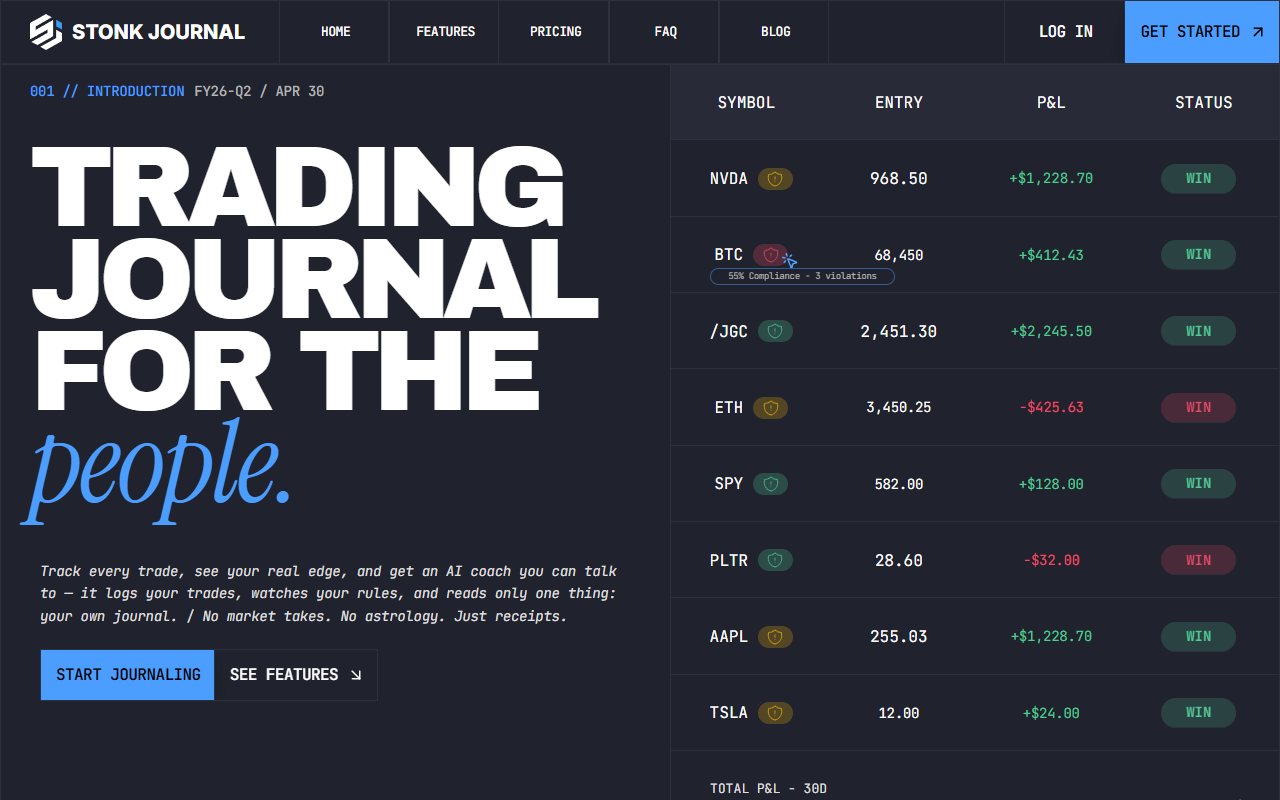
You followed the stop on the morning trade. The loss felt uncomfortable, so you entered twice more without the setup. The day finished green. A profit total can hide the habit that put more money at risk. OTJ's starting point is a deliberate daily reflection around one planned trade. Enter the trade yourself, write the recovery urge and keep the original rule beside what you did. The aim is to help you notice overtrading and repeated costly mistakes before you make the same excuse at the next review. Free allows one trade per day per market and includes Behaviour analytics. Paid subscriptions allow more entries. The habit is voluntary, and the journal does not restrict your broker orders. Do not place a trade just to keep the diary active. Stonk Journal also takes discipline seriously. Its risk rules review rule following, and its Free plan permits unlimited manual trades and accounts. That is a clear strength for a busy journal. OTJ's case is the focused Indian daily reflection, not a claim to offer the widest free capacity. ## Keep the reflection short enough for a tired day
A good test is an ordinary session when you are tired and do not feel like writing. Choose one normal trade and try to save the plan, action and reason in a few minutes. This exercise is made-up; no account testing is claimed here. In OTJ, write one planned trade and use the entry and exit feeling fields to save a distinction you might otherwise skip. You might have been confident at entry and impatient at exit. Write that difference and connect it to the action you took. In the app, check whether the rule setup and compliance workflow captures the same choice in language you understand. If you need imports or the AI Coach, check them at the plan that includes them, not by assuming every homepage feature is free. After a week, read the records without looking at the final P&L first. Can you identify why you entered and why you exited? If the notes are too vague, simplify the questions. A sustainable short record can be more useful than a detailed format you abandon after three days. At review time, free Behaviour analytics can help you find entries to read more closely. Name the action beside the emotion: moving the stop, increasing size or entering without the rule. A stress label alone does not prove why a trade lost. Keep the words specific enough that you can recognise the moment next time. Stonk's day notes, tags and rule checks can also support a routine. Importing or recording a fill does not supply an unwritten recovery urge. OTJ makes that personal reflection the daily starting point. Manual writing is a useful option, not the only way a trader can reflect honestly. ## Write a rule you can check
The app's risk-management page lists ten rule types and checks while you build a trade record. Its score measures how closely you followed those rules. Some rules have more weight in that score. It explicitly distinguishes journal tracking from broker enforcement. The score reviews a saved choice. It cannot stop an order at the broker. OTJ's daily entry records stops, targets, strategies, plan changes and habit context. Behaviour analytics is free; paid AI analysis is separate. Its flags may draw attention to possible revenge trading, size increases or repeated activity. They are prompts based on the logged sample, not controls over broker orders. A rule such as avoid impulsive trades is difficult to check without a meaning. A clearer rule might ask you to name the entry condition. Did it appear before you acted? The journal can then save the answer rather than only the trader's mood about the outcome. In a made-up week, a trader breaks a size rule but still makes money. A compliance record helps keep that fact visible. Keep the rule's meaning fixed. Do not call every winner correct and every loser a mistake. For either product, test whether you understand how a flagged record relates to the rule you intended. A score is useful when it guides you to inspect a specific choice. It is less useful if it becomes a number you try to improve by editing uncomfortable notes. ## A made-up recovery day can hide broken rules
Imagine an Indian options trader who planned one morning trade and followed its stop. After a loss, they entered two more positions with no clear setup and recovered the money. The account ended green. This is a made-up scenario for review, not a claimed product result. If the trader uses OTJ Free and logs only the planned trade, the recovery sequence is absent. The journal's daily cap does not make those other choices disappear from reality. A full day in the same market needs paid OTJ access. If you save only selected trades, label the review that way. The app's unlimited free manual allowance gives a different option: record all the trades without that cap. This is a real advantage for a trader whose review depends on the complete sequence. Correct Indian contract recording still needs to be shown. The habit detail matters in both records. Write that the later entries were attempts to recover the first loss, if that was the actual reason. Record the larger size, missing plan and feelings. A green total can otherwise hide exactly the habit the trader wanted to study. At the weekly review, ask if those choices followed the plan. Did the same urge to recover a loss keep appearing? One day's result cannot settle that question for every trade. Reading the records makes that distinction possible without turning one day into a general trading rule. ## A generous free plan helps keep the full day
The app deserves a fair comparison because its free allowance is generous. The official homepage advertises unlimited trades and accounts on Free, with Pro at $10 per month. OTJ's free allowance is one trade per day per market, so it should not be described as the more generous free journal here. OTJ's useful role is its Indian futures and options forms and questions about each choice. It suits someone who wants familiar Nifty, Bank Nifty or Sensex fields and questions about the choices around each trade. If you need many free entries, look closely at the app. Both products can support a discipline review. The app documents risk rules, compliance tracking and AI on its paid plan. A trader focused on discipline should take those tools seriously. Both products require useful input and review time. An unlimited empty journal does not explain your choices, and a capped journal containing only your favourite trade does not describe the full account. Keep the actual sequence visible even if your daily reflection focuses on one planned trade. ## Check the exact Indian contract
The app lists several market types. We did not confirm NSE or BSE contract handling from these public pages. An Indian broker file route was not confirmed either. This is an evidence limit, not proof that an Indian symbol cannot be recorded. Its trade import page describes file uploads and custom formats, with examples including Schwab, Fidelity, E*TRADE, Webull, Robinhood and Interactive Brokers. The listed workflow is upload-based rather than live broker sync. For Indian options, check the contract multiplier and how the app counts quantity. Also check expiry and fee fields against your records. Do not assume that a custom file accepted by the importer automatically produces a correct option position. OTJ's manual entry includes Indian stock/F&O fields, an expiry picker and lot-size hints. It estimates brokerage and other required charges. That makes it a direct place to review Indian F&O choices. You still need correct values. Compare estimated charges with the broker statement. For an Indian trader taking many supported global trades, the app's broader free allowance may outweigh the need for India-specific entry aids. For someone primarily reviewing Nifty choices, the familiar OTJ form may be worth more than a general market list. ## Writing is part of OTJ's daily pause
The app's Smart Import documentation puts file import on Pro and asks users to review mapping and imported results. That can help someone with a supported export or an existing archive. It remains a task performed after obtaining a file. OTJ asks you to write the trade yourself as part of reflection. There is no CSV importer or broker sync. Paid voice fill helps populate its manual form; it still requires checking the contract, numbers and notes. It does not offer a bulk migration path from the app or another product. If you are beginning a new review routine, start with a defined period and save older records elsewhere. OTJ exports CSV, JSON and TXT for the data you create. Do not mix a selected new learning sample with years of broker history and call the result a complete account. If you prefer file import, validate a difficult example first. Include partial fills, a position across dates and a multi-leg record if that is part of your trading. Compare it with the original broker export before relying on a clean-looking total. The time cost includes review, not just entry. Faster collection is valuable if you use the saved time to add reasons and inspect choices. A manual form is valuable if it encourages that context without becoming so burdensome that you stop recording. ## Both paid options include AI review
The app's AI Coach page describes journal-based pattern review, chat and assisted actions, including logging or editing with confirmation. The page identifies these as Pro features. It does not present the coach as a market prediction service. OTJ's paid tools include Ask Your Journal, Trading Mentor, screenshot analysis and pattern feedback. It would be misleading to imply that the app lacks AI or that OTJ has uniquely solved automated coaching. Compare a specific task. Ask which trades in your selected period violated the planned stop, and ask the assistant to show the actual records. Open the entries and check the claim. A response grounded in the correct rows is more useful than a long motivational speech. Also test whether the assistant separates your reason from its inference. A price chart may look like a chase, but the note could describe a planned rule. Conversely, the label planned may conceal an impulsive entry. AI can help you spot that mismatch. It should not fill a missing reason with a confident guess. Neither assistant can establish a private thought you never saved from executions alone. Small or selected samples can also produce plausible but weak patterns. Add the missing reason and check the answer. The software cannot know what you intended from the result alone. ## Understand the calculation before comparing scores
The app publishes a metrics methodology page. That is useful when you want to understand how the product calculates results from recorded trade data and handles edge cases. Meanings matter as much as the dashboard's appearance. OTJ's reports use the trades you enter. They show daily profit and loss, results over time and win rate. Profit factor compares total wins with total losses. Drawdown shows a fall from an earlier high. You can group by strategy or time. Risk-based results need a valid planned stop. The exit check compares your exit with the target you saved. That exit check does not rebuild the largest historical price move in either direction. If you want to know the actual highest price during an options position, a comparison against your own target does not answer that question. When comparing journals, use the same trades. Check how each treats fees, open positions and partial exits. A difference in win rate may result from grouping or calculation meanings rather than one product being wrong. Identify the difference before deciding which number is useful for your question. The broker statement remains the money reference. A journal total can help with a review. A charge field does not make it a tax filing or an account audit. ## Choose the habit without hiding the extra trades
OTJ's India plans are ₹499 monthly, ₹1,299 quarterly and ₹3,499 yearly. The paid plan page provides the current options. Paid access matters if you need extra trades in a market or the paid AI and voice tools. The app's published Free and $10 monthly Pro plans make the choice different from comparing two paid-only journals. If its market recording fits your records and you need unlimited manual logging, Free may already satisfy your core requirement. Choose OTJ when a deliberate pause after the planned trade is the habit you want to build. Its Indian F&O fields and direct emotion questions can help you write why you wanted another entry. Free Behaviour review gives you a way to return to that pattern without paying for AI. Choose Stonk when unlimited free manual logging, its rule score or paid import and AI tools fit your review. Check the actual Indian contract, keep the full sequence and read the reasons beside wins and losses. A disciplined loss and a lucky rule break both deserve attention. No journal guarantees that the next trade will be safer or profitable.
Sources and limits
We checked these public product pages and OneTradeJournal’s current product on 12 October 2026. We did not test a private Stonk Journal account, broker import, payment or AI answer. Check current plans and limits before paying.
- Stonk Journal Free and Pro pricing · Checked 12 October 2026
- Stonk Journal risk rules and scoring · Checked 12 October 2026
- Stonk Journal file import help · Checked 12 October 2026
- Stonk Journal AI Coach · Checked 12 October 2026
- Stonk Journal how reports are calculated · Checked 12 October 2026
A journal cannot promise trading profits. AI answers and fee estimates can be wrong. Check trades and charges against broker records. This page does not give trading, investment or tax advice. Competitor names and website pictures do not imply a partnership or endorsement. Any example is an explanation, not a private account screenshot or a real customer result.