The detailed comparison
A closer look at the daily routine, the tools and the limits of each product.
Choose a section
Start the daily review with the feeling behind the trade
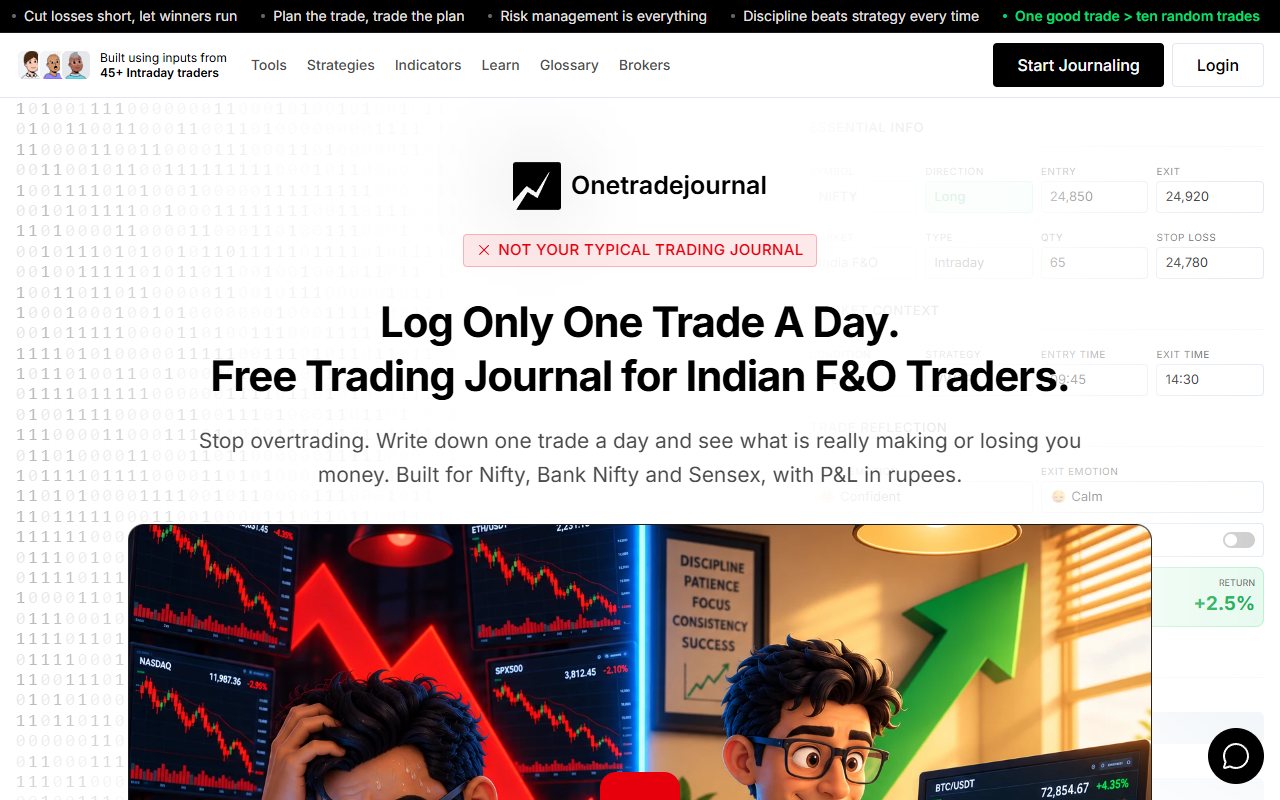
A Nifty chart can show a late entry. It cannot state whether you entered because the setup qualified or because you could not bear missing the move. OneTradeJournal is built around writing one daily trade, including that personal reason and the feeling at entry and exit. The aim is to build discipline, reduce overtrading and avoid repeating costly mistakes. Save the planned risk and any change instead of calling the whole day good or bad. One planned trade can still lose. OTJ does not block broker orders or enforce a cash loss limit. Free OTJ allows one saved trade per day per market. Paid plans permit extra entries. The daily focus should help you reflect, not hide a follow-up trade or turn one selected note into the whole day's account result. FnoDiary also addresses psychology. Its homepage describes session mood, discipline review and option/index charts. Supported imports can save copying and leave more time for notes. Those are useful strengths, especially if the price sequence is central to your review. Both products address Indian futures and options, often called F&O. These are contracts linked to a share, index or other asset. OTJ starts with manual writing and known emotion questions. FnoDiary adds its documented chart, broker and session-note routines. We checked current sources and OTJ code, without testing a connection, chart or discipline calculation. The made-up cases below show how to compare a daily habit, not a tested trading result. ## Keep the entry feeling beside the day's mood
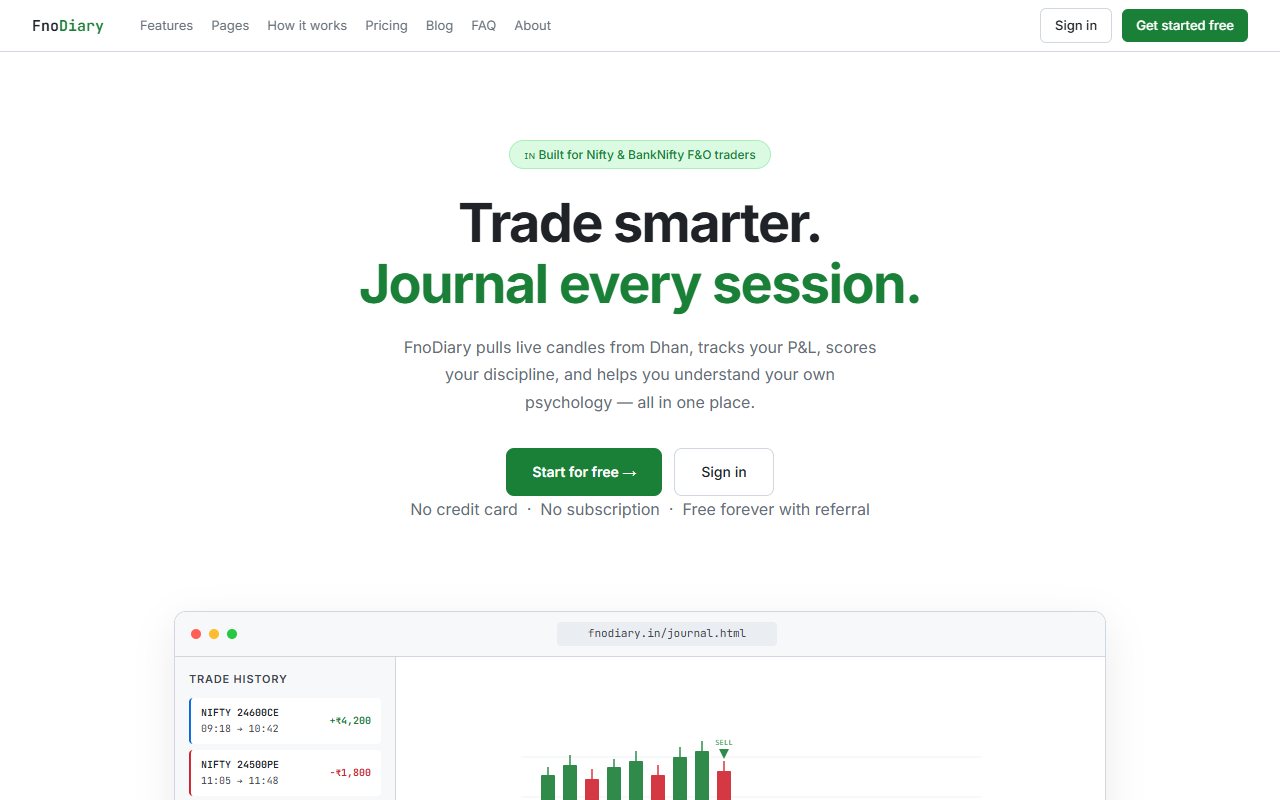
FnoDiary describes discipline and psychology for each session. Its homepage presents mood, mindset and lessons after a session. That can suit a trader who likes one review of the day's activity. Consider a made-up Bank Nifty trader who follows a plan in the morning and makes several impulsive entries later. A note like “stressful day” may be true. It may not show when the trader stopped following the plan. OTJ links feelings and reasons to each trade. You can record entry and exit emotions, stress, confidence, an impulse reason, a mistake, satisfaction and a deviation. The record can show that the first loss was planned and that the later size increase was not. The difference becomes especially useful when an impulsive trade wins. The trader's final mood may improve, but the original reason still needs to stay in the record. A winner is not proof that the decision followed the plan. A short whole-session note can still be useful. A trader may prefer it, and we have not checked every per-trade field in its app. Check whether you can find the moment when the choice changed. Try both styles using one ordinary difficult session. Find the trade where the plan stopped guiding the action. A daily note is useful when you can return to that exact moment, not just the final mood. ## Flags need an explanation from the trader
OTJ's free behaviour analytics compare saved emotions and habits with the results. It also has behavioural flags for possible revenge trades, size spikes and overtrading. They are rough checks from entered data, not diagnoses or broker order blocks. A flag should start a review, not end it. FnoDiary also advertises discipline flags on its Dhan page. Those tools can support its own psychology review. The trader still needs to explain the personal reason rather than accept a flag as proof of a motive. A made-up trader could increase quantity after a loss for several reasons. Perhaps the next contract has a different price. Perhaps the trader planned a different risk amount. Perhaps the trader wanted the money back quickly. The order of events alone does not prove the reason. In OTJ, the impulse and notes fields give that motive a place in the record. Use a short, concrete statement such as “I doubled quantity to recover before lunch.” This remains more informative than a general label like “bad discipline.”
Also record planned losses correctly. A stop hit on a valid setup can be part of the method. Treating every loss as a mistake can lead a trader to change a sound process simply because the result was unpleasant. Whichever journal you use, inspect the trade behind a flag. Compare it with the intended rule, then choose one action you can check next session. ## Your broker determines the import route
FnoDiary's broker overview lists Dhan and Upstox under API sync, and Zerodha, Angel One, Fyers and Groww under CSV import. The methods differ. Ask how your broker's records get into the journal. An API link lets systems exchange data. CSV is a file of rows and columns. The Dhan guide describes connecting the account and syncing F&O data. Its login steps differ from the homepage's access-token steps. Check the live setup. Public pages do not agree on every step. The Upstox guide describes broker authorisation and sync. The Zerodha guide instead describes downloading a Console tradebook and uploading a CSV. A file route is useful automation, but it is not a continuous API connection. OTJ has no broker sync and no CSV import. Paid voice fill helps complete the manual form. It does not turn a broker file into journal entries. If you need old history with less typing, try FnoDiary's documented route. OTJ cannot import that history. For a made-up trader moving between Dhan and Zerodha, think about both the current account and older records. Check the actual segment and file format, and check a normal trade with partial fills. A fill is one completed part of an order. After any import, compare quantities, prices, timestamps and grouping against the broker tradebook. An upload without an error still needs a check against the broker. ## The chart can help you recover the sequence
FnoDiary's Dhan page advertises option and index charts side by side with entries and exits. This may help with entry timing. It lets you compare the option price with the index price around a trade. Imagine a made-up Nifty trader who entered after a fast move and exited during a pullback, a short move back against the main price move. Looking at the sequence can help distinguish a late entry from an early exit. A P&L number alone cannot show which part of the position was uncomfortable. OTJ does not provide historical-market replay or backtesting. Its exit review compares your saved exit with your saved target. It does not measure the largest price move against or in favor of the position. It does not rebuild the market path while you held it. That boundary matters. If you need a market path to answer your main question, check FnoDiary's exact charts, dates and contract coverage. We have not tested whether every historical expiry can be reviewed in the same way. If the question is why you ignored the target, a clear note may be more important than another candle chart. OTJ can preserve that explanation beside the intended stop, target and strategy. The two kinds of evidence work together. Market prices can show the order of events. Your notes can explain the choice you made. Choose the tool that helps save the part you keep missing. ## Check the referral condition and listed price
FnoDiary's pricing section lists Standard at ₹199 a month and advertised lifetime-free Standard access through a referral link. We did not test signup or continuing access. The broker overview says that referral condition applies across supported brokers. That may be good value if the product does the work you need. OTJ is not cheaper than the listed Standard monthly amount, and it should not imply that the rival's free access is only a short trial. OTJ's India plans are ₹499 monthly, ₹1,299 quarterly and ₹3,499 yearly. Its free journal allows one trade per day per market. Paid subscriptions allow extra manual entries. For a made-up options trader who makes several decisions most days, the OTJ free allowance is not enough to capture the whole routine. Budget for paid access rather than leaving out trades to fit the cap. Choose OTJ if you prefer its manual reason fields and review tools. Do not ignore the other product's lower listed price. The published price difference should remain visible. Check referral eligibility in the actual signup process before assuming it applies. A public offer is useful information, but we have not created a referral account or checked the access that signup gives. ## Start a review with a question small enough to answer
OTJ has a profit and loss calendar and views by strategy and time. Its results line shows saved trades over time. Drawdown means a fall from an earlier high. Profit factor compares total gains with total losses. Those views help narrow a question, but they depend on complete, accurate manual entries. A made-up Sensex trader could ask whether late entries outside the plan are the main source of losses. That needs clear strategy and plan-change labels, trade times and notes. A chart by itself cannot reliably define which entries felt like chasing. A risk multiple compares the result with risk from a valid planned stop. If the trader invents the stop after the outcome, the figure no longer describes the original risk. Keep the original plan separate from the later choice. OTJ's paid AI includes Ask Your Journal, Trading Mentor with chart screenshot analysis and pattern feedback. Usage limits apply. These tools can help you inspect the record, but can be wrong and do not know about omitted trades. A useful question is, “What reasons repeat in the trades where I marked a deviation?” Check the entries behind the answer. Do not use an AI explanation as a substitute for writing the reason yourself. We did not establish FnoDiary's full AI feature list. That is an unknown, not proof that it has no AI. Its chart, import and session-note descriptions still give useful ways to compare the work. ## Keep the numbers anchored to broker records
OTJ includes Indian F&O fields, an expiry picker, lot-size hints and estimated brokerage and statutory charges. They support a manual review, but the trader still needs to confirm historical contract details. Broker tradebooks and contract notes remain the financial record. Check journal estimates and imports against those records. This page does not approve either journal for tax filing. For a made-up Nifty trader with many small trades, costs may help explain why a positive gross result became disappointing. Use the journal to ask why you traded so often. Use actual statements to establish the amount. OTJ exports CSV, JSON and text reports. CSV gives rows and columns, JSON keeps structured fields, and text gives a readable report. Check whether any alternative's record can also be retained in the form you need before committing a long history. This article does not infer export availability from an import feature. The useful record contains the execution facts and the explanation. Losing either weakens the next review. ## Choose the review you will complete after a difficult day
Take one ordinary week, including a planned loss, an impulsive winner and a trade with several fills. Try to answer what changed between the plan and the actual decision. OTJ suits an Indian F&O trader who wants to write a daily explanation and watch the urge behind a chase or recovery entry. Record the feeling while you remember it. Then read similar notes before treating the same urge as a new opportunity. FnoDiary may suit better when broker imports, charts and session notes save the most work. Verify your broker method and the exact chart workflow before depending on it. The final P&L is only part of the story. Keep the personal reason visible after a lucky win as well as a loss. The tools support a daily review; neither product promises profit or controls your next order.
Sources and limits
We checked these public product pages and OneTradeJournal’s current product on 12 October 2026. We did not test a private FnoDiary account, broker import, payment or AI answer. Check current plans and limits before paying.
- FnoDiary features and referral offer · Checked 12 October 2026
- FnoDiary broker routes · Checked 12 October 2026
- FnoDiary Dhan charts and sync · Checked 12 October 2026
- FnoDiary Upstox sync · Checked 12 October 2026
- FnoDiary Zerodha file guide · Checked 12 October 2026
A journal cannot promise trading profits. AI answers and fee estimates can be wrong. Check trades and charges against broker records. This page does not give trading, investment or tax advice. Competitor names and website pictures do not imply a partnership or endorsement. Any example is an explanation, not a private account screenshot or a real customer result.