
The detailed comparison
A closer look at the daily routine, the tools and the limits of each product.
Choose a section
A tested rule still needs an honest daily review
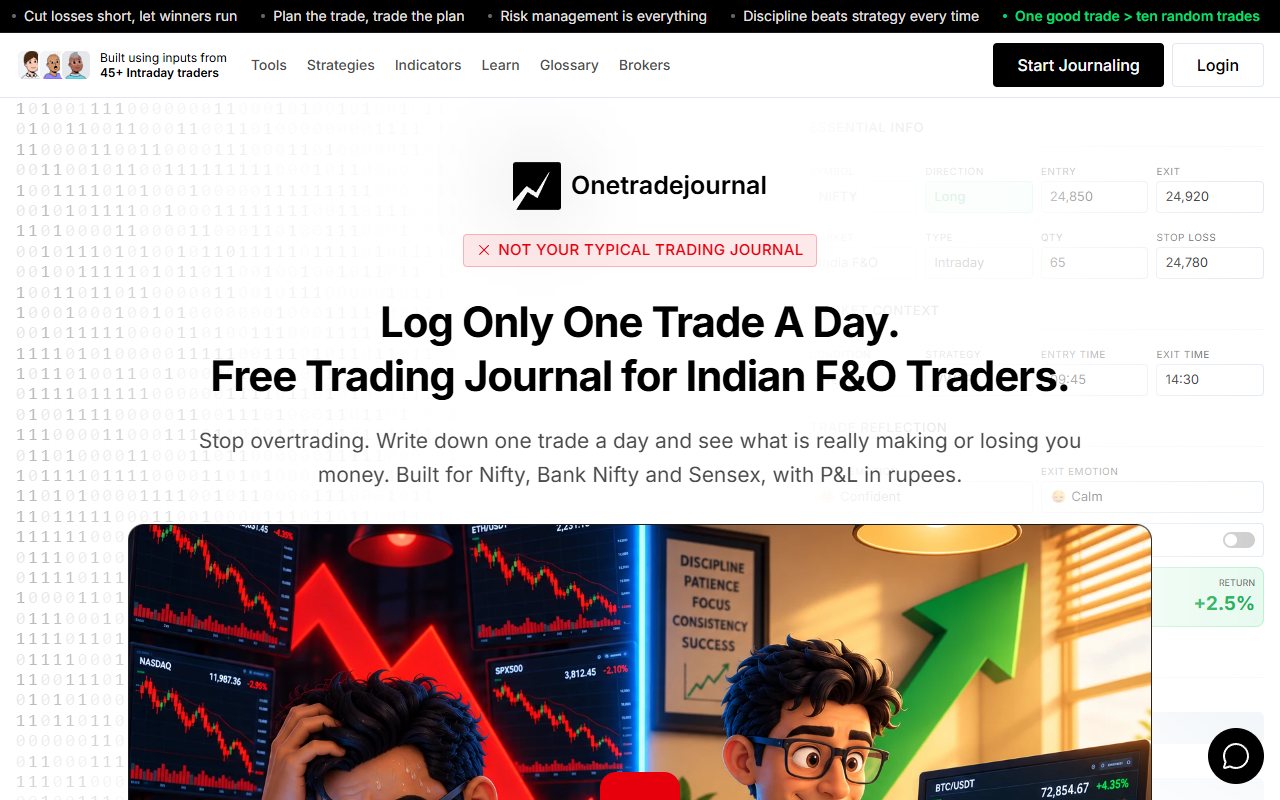
A trading rule can look clear on paper and still be ignored after a loss. The missing detail may be the urge to recover money, not another price report. OneTradeJournal starts with one planned trade a day and asks you to write what you did, why you did it and how you felt. That daily practice aims to reduce overtrading and repeated mistakes. Save the reason for an entry, the planned risk and any change at exit. The journal does not control broker orders or promise a loss limit. Even a trade that follows the plan can lose. Free OTJ permits one saved trade per day per market. Paid plans allow extra entries. The one-trade philosophy is a focused habit, not a reason to hide an unplanned second trade or treat a selected note as the whole account. WickLog has a wider set of tools. Its homepage describes emotions and reflections linked to trades, file imports and paid AI. Its historical rule testing is a separate strength to investigate. WickLog can hold personal notes too; an imported price by itself still cannot state a private reason. OTJ is built especially for Indian futures and options, often called F&O. These are contracts linked to a share, index or other asset. Its manual form makes writing your own context the starting point. WickLog can start with imported numbers and add reflection afterward. We checked official pages and OTJ code. We did not test broker connections, AI answers or the backtester. The sections below separate advertised tools from verified account results. ## Name the recovery urge even when it wins
Consider a made-up Bank Nifty trader who loses the first trade, then enters again at a larger size without a fresh plan. The second trade wins. The final P&L makes the decision easy to defend afterward. OTJ lets the trader save the impulse reason, entry emotion, stress, confidence and change from the plan. A note such as “I wanted the first loss back” remains visible even when the trade makes money. That helps distinguish an intended risk change from an impulsive one. The exit emotion matters too. Relief after a win can overwrite the anxiety before the entry. Recording both points gives the review a better chance of preserving what happened instead of retelling it as a good decision. WickLog also offers linked trade reflections, so psychology is shared by both products. The question to test is whether its record makes it easy to connect the imported trade with the explanation you need. OTJ's free behaviour analytics compare saved feelings and habits with recorded results. Its behavioural flags can highlight possible revenge trades, size spikes and overtrading. They are rough checks on saved data. They are not diagnoses or broker order blocks. The trader should inspect the entries behind a flag and decide whether the suggested pattern fits. For a trader who wants that reflection to become a daily habit, OTJ offers known questions about feelings and reasons while saving the trade. If you want to import numbers first and write notes later, WickLog's approach may suit you better. ## If the numbers never reach your journal
WickLog's Zerodha integration page describes Kite API imports on demand, with options coverage and a paid Pro requirement. API means a connection that lets systems exchange data. Its detailed instructions say to sync after approving the connection. That is a clearer description than assuming that every execution arrives continuously without any action. The Groww page describes adding API keys and importing on demand. It includes equity and F&O in its advertised scope. This may help if copying numbers is why you keep skipping the journal. OTJ has no broker sync or CSV import. You enter trades yourself. Paid voice fill helps complete the form. It does not import a broker report. You still check quantity and prices. Imagine a made-up trader using Zerodha for Nifty options and Groww for stock trades. The trader wants a record of both accounts without copying each fill, which is one completed part of an order. WickLog's documented connections may solve that need more directly than OTJ. Before choosing any importer, try a normal trade with the details you often use. Use a trade with two entries and a partial exit, then compare the journal grouping with the broker tradebook. Also inspect a trade that crosses a reporting date. Correct grouping matters as much as having a connection. OTJ fits better when the missing record is the reason for the trade, and the number of entries remains manageable. Manual entry is a drawback if you cannot keep doing it. ## Broker status is not uniform across the site
WickLog's homepage labels Groww and Angel One as beta and Upstox as coming soon. Its Groww integration page describes an available Groww connection, while the Zerodha page says Angel One is planned. These differences should be checked before relying on a particular connection. They do not establish that a feature is broken. They show that the public status labels disagree. A trader should ask whether the exact broker, segment and sync method needed is available in the account today. For example, a made-up Angel One F&O trader should not select WickLog solely because the homepage displays the broker name. A beta label and a roadmap description need a check inside the account. We do not convert either label into confirmed complete support. OTJ works without a broker connection because you enter the details yourself. You supply the execution details from whichever broker you use. That can be a practical advantage if you want to start a reflective routine immediately or regularly change brokers. This does not rank the products' security. The absence of a connection means broker credentials are not required for OTJ's manual entry. It does not prove that a connected rival handles data poorly. ## Study the price rule and review your daily behaviour
WickLog's backtesting page advertises a paid rule builder using past NSE/BSE prices. Backtesting means testing written rules on old market data. It lists price-based conditions, estimated test costs and limits on the dates you can test. OTJ has no rule-testing engine or historical market replay. A backtest can help examine a rule as written. A journal can examine whether you followed that rule. A good result on old prices cannot explain why you entered late, moved a stop or increased quantity after a loss. Imagine a made-up Nifty trader who defines an entry condition and an exit condition precisely. Testing those conditions against historical data is a separate exercise from recording a live session where fear caused an early exit. The trader may need both kinds of evidence. An index chart does not prove that every old option or group of contracts works. If your intended test concerns a specific option contract, check the dates, price data and assumptions about how an order would fill. Our research did not validate those details. OTJ can help compare the logged stop, target and actual decision. Its risk multiple compares the result with risk from a valid planned stop. Its exit review compares the saved exit with the saved target. It does not rebuild all prices while you held the trade. If you mainly want to test price-based rules, OTJ cannot do that job. If you already have a method and want to investigate why your live decisions depart from it, OTJ's narrower review focus can be useful. ## Compare AI questions and allowances together
WickLog's current Ticker AI page describes answers using trades and notes. It lists 15 credits each monthly billing cycle, or 180 upfront on the yearly plan. A 50-credit top-up is ₹79. One credit covers up to 50 question words. We retrieved this page during the fresh check, but did not test how credits are used in an account. AI use has a set credit allowance. A short question and a long chat may use different amounts. Check the current terms and think about how often you will use the assistant during a weekly review. OTJ's paid AI includes Ask Your Journal, Trading Mentor with chart screenshot analysis and pattern feedback. We do not promise unlimited usage. AI can be wrong and does not know the trades or reasons you did not record. A useful question for either product is, “Which trades after a loss also show an increase in size, and what reasons did I write?” You can inspect the sequence and the notes. A broad demand to make you profitable gives the assistant less specific evidence to work with. If an answer identifies a habit, check its examples. A larger quantity might reflect a different contract or a planned adjustment rather than revenge. Use AI to help read the records. Do not let it replace your own explanation. ## WickLog's listed prices are lower
WickLog's current Groww integration page lists Pro at ₹349 monthly or ₹2,250 yearly. Some older official blog text quotes ₹249. That older amount is not the current reviewed offer. Confirm the final bill at checkout. Its homepage presents the annual amount as about ₹188 per month. The annual figure is a payment for the year, not a promise that monthly billing costs ₹188. OTJ's India subscriptions are ₹499 monthly, ₹1,299 quarterly and ₹3,499 yearly. WickLog's listed monthly and yearly amounts are lower. We did not test the final payable bill or settle any tax differences. It would be misleading to sell this comparison as an OTJ cost advantage. The OTJ case is about the daily writing habit. A trader may prefer pausing to name the impulse and revisit the note enough to choose it. Try the habit yourself. WickLog's lower listed price still matters. The free allowances also differ. WickLog's homepage lists 50 trades and 50 journal entries a month, with manual entry and analytics. API broker import is described as paid on its integration pages. A current official file guide says Zerodha and Dhan uploads are free and do not count toward the 50-manual-trade cap. That does not prove every file or other usage limit is unlimited. OTJ allows one free trade per day per market. For a made-up trader active in bursts, a monthly allowance may fit more naturally. For one planned trade per day, OTJ's free plan may be sufficient. Neither allowance justifies leaving relevant losing trades out of the record. Check the final bill and included tools before paying. A lower price is useful only if the chosen plan contains the workflow you need. ## Try one review that ends in a concrete change
Select an ordinary recent week with a planned loss, an impulsive winner and a trade with several fills. Keep the broker tradebook beside you. Use a clear question instead of opening every menu. In OTJ, enter the planned risk and behavioral context. Look at the P&L calendar, strategy and time-of-day analysis, then return to the actual notes. The result should be one clear action, such as recording an impulse reason whenever taking another trade after a stop. In WickLog, verify the relevant connection and grouping, link reflection to the imported record and try a short Ticker question on the plan you intend to use. If you need the backtester, confirm the exact symbol and data scope separately. OTJ also exports CSV, JSON and text reports. CSV gives rows and columns, JSON keeps structured fields, and text gives a readable report. Its charge estimates can help with review. Broker contract notes remain the financial record. Choose OTJ when you want a daily F&O writing practice to notice the same rushed recovery entry before repeating it. Choose WickLog when its linked notes, supported imports, lower listed price or historical rule testing meet your needs better. Keep complete broker records and truthful reasons. Neither journal promises that a habit or a backtest will produce profit.
Sources and limits
We checked these public product pages and OneTradeJournal’s current product on 12 October 2026. We did not test a private WickLog account, broker import, payment or AI answer. Check current plans and limits before paying.
- WickLog journal and plan information · Checked 12 October 2026
- WickLog Zerodha sync guide · Checked 12 October 2026
- WickLog Groww sync and prices · Checked 12 October 2026
- WickLog AI credit terms · Checked 12 October 2026
- WickLog historical rule testing · Checked 12 October 2026
- WickLog free file-import guide · Checked 12 October 2026
A journal cannot promise trading profits. AI answers and fee estimates can be wrong. Check trades and charges against broker records. This page does not give trading, investment or tax advice. Competitor names and website pictures do not imply a partnership or endorsement. Any example is an explanation, not a private account screenshot or a real customer result.