
The detailed comparison
A closer look at the daily routine, the tools and the limits of each product.
Choose a section
Write the feeling before the day's result changes the story
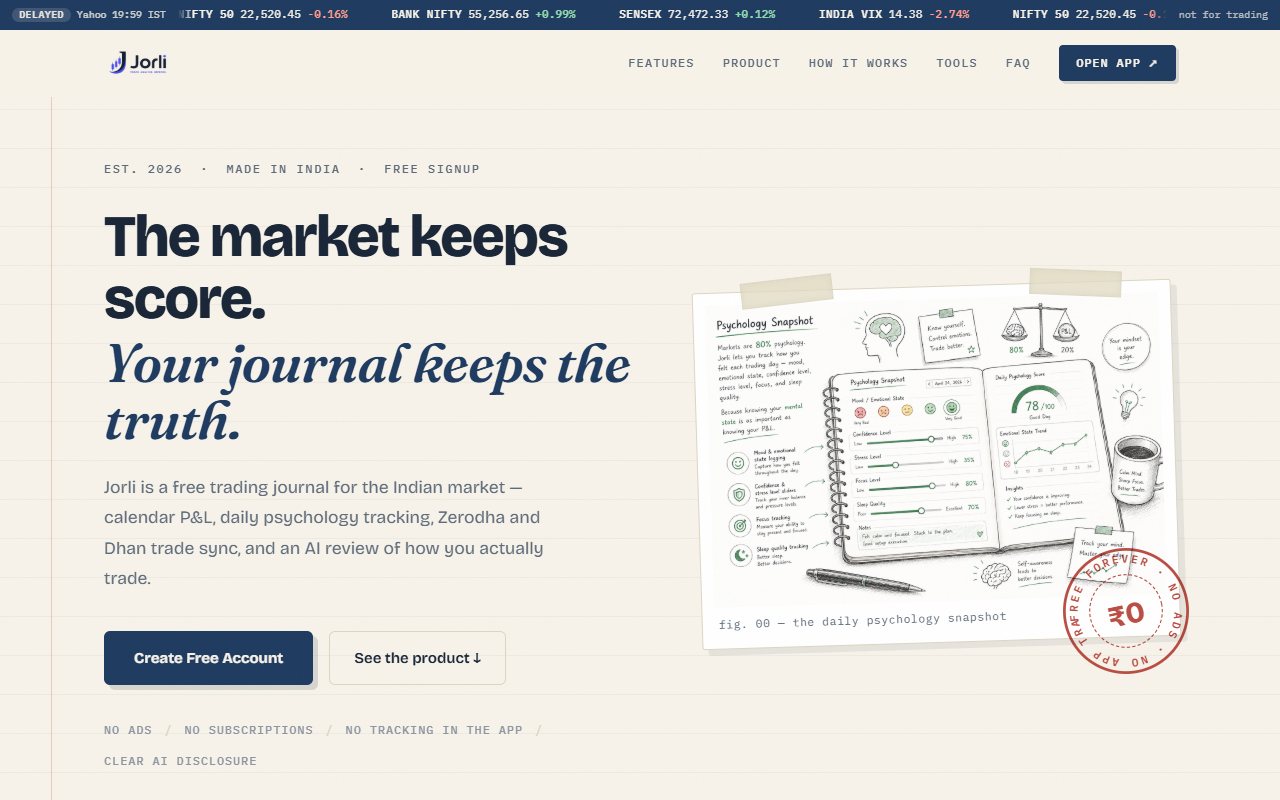
You can end a Nifty session relieved and still have taken a rushed recovery trade earlier. The final mood is one part of the day. The feeling that led to that entry is another. OneTradeJournal starts with a daily writing habit so you can keep that moment visible. Focus on one planned trade. Write why you entered, how you felt and whether you kept to the plan. The aim is to notice repeated mistakes and the urge to overtrade before you act on it again. A journal does not enforce a loss limit or make a planned trade safe from loss. Free OTJ allows one trade per day per market. Paid plans allow extra entries. The daily focus is a habit to practise, not a reason to hide a recovery trade or present one selected entry as the whole day's result. Jorli's official site offers its own daily psychology routine, free AI, calendar results and Zerodha/Dhan sync. It also advertises file import and CSV export. Scheduled sync needs a valid session and imports completed trades. Those tools can save copying and give context to the day. OTJ's manual form has known fields for entry and exit emotions, stress, confidence, impulses, mistakes and plan changes. It fits an Indian futures and options trader who wants those questions to be part of the daily entry. Futures and options, or F&O, are contracts linked to a share, index or other asset. We checked public pages and OTJ code, without testing Jorli's app or AI. Jorli has psychology tools too; exact per-trade fields were not all checked. Choose by the routine and detail you need. ## Walk through one morning before choosing
Consider a made-up Nifty options trader. The first position follows the plan and closes at its stop. The trader takes a second position with a familiar setup, the conditions used to enter, but doubles the planned risk to recover the loss. The second position wins. A review based only on final P&L could make that morning look acceptable. The danger lies in the decision to raise risk. Winning may make the trader repeat a choice that broke the plan. In OTJ, record the first trade's planned stop, target and strategy. A stop is the price where you planned to limit a loss; a target is the planned exit goal. Record the second trade separately with its impulse reason and change from the plan. A note such as “I wanted to end the morning green” says something that an execution history cannot supply. The entry emotion and exit emotion also help preserve the sequence. A trader might feel angry when entering and calm after winning. If only the final mood remains in memory, the reason for the trade can disappear. A daily note can answer a different question: how did you feel before and after the session? Poor sleep, low focus or unusual stress may help explain why a rule became harder to follow. Jorli's daily mood record may suit that routine. The choice is therefore about the level of detail you need. In Jorli, check how a day's notes connect to each trade. In OTJ, check whether you will fill the trade fields every time, including after a loss. ## Choose behavior fields you can answer honestly
OTJ has separate fields for confidence, stress, emotions, satisfaction and impulse reasons. They prompt clearer answers than a vague note like “bad trade.”
A made-up Sensex options trader might identify a repeated sequence: hesitation at the planned entry, chasing a later price, then moving the stop to avoid accepting the loss. Those are three separate choices. Writing them clearly is more useful than simply assigning the day a poor score. You do not need to write an essay for each trade. Use short statements that describe what you noticed at the time. “I entered late because I did not want to miss the move” is easier to review than “I need better psychology.”
Use the same meaning for a field over time. If high confidence sometimes means a clear plan and sometimes means excitement, the score becomes hard to compare. A journal is strongest when the labels remain stable. OTJ's free behaviour analytics let you compare saved emotions and habits with recorded results. Its behavioural flags can draw attention to possible revenge trading, size spikes and overtrading. The flags are rough checks based on your record. They are not diagnoses, and they cannot prevent an order at your broker. Jorli's daily psychology and AI can support reflection too. Its public page does not establish every per-trade field. OTJ's known entry and exit questions give this trader a clear way to begin the daily note. ## Less copying is a real benefit
Manual journaling has a cost. When you take many trades, entry work can consume the time intended for reflection. That is a reason to take Jorli's documented import options seriously, because manual typing does not suit every trader. OTJ has no broker sync or CSV import. Its paid voice fill helps complete the manual form. You still check and save the entry yourself. It is not a way to move a large broker archive into the app automatically. For a made-up Bank Nifty trader with several partial fills, decide how much history you need at the start. A fill is one completed part of an order. If you need many months of past activity, file import may matter more than a form's emotion fields. If your first goal is reviewing the next month honestly, beginning with new manual entries can be reasonable. You can keep the older tradebook at the broker and build a clean journal from a defined start date. Make clear that the new journal starts on that date and leaves older trades outside the sample. When evaluating Jorli, inspect what the connection brought in and what remained outside the journal. For any importer, an unfinished position, mismatched quantity or expired session can affect completeness. A sync button is not proof that every relevant decision is available for review. For OTJ, compare each day's entries with the broker tradebook. This check prevents the common temptation to record the planned trade and leave out the uncomfortable follow-up. The review needs every relevant trade, whether you enter the numbers or import them. ## A pattern does not prove what caused it
Imagine that most losing days in your journal also have high stress. There are several possible explanations. Stress might have affected the trades. The losses might have raised the stress score. A difficult market might have caused both. A journal can help you look into that link. A chart alone does not prove what caused it. Read the order of events and the notes. Then choose one change you can check later. For example, a trader could decide to write the planned stop and reason before reviewing the exit. That creates a clearer distinction between the original plan and the explanation made after the outcome. It is a documentation habit, not a promise of better returns. OTJ has strategy and time-of-day views, a profit and loss calendar, an equity curve, drawdown, win rate and profit factor. The equity curve shows saved results over time. Drawdown is a fall from an earlier high. Profit factor compares total gains with total losses. These views can help narrow a question. They still depend on all relevant trades being entered correctly. A risk multiple compares the result with risk from a valid planned stop. The exit review compares your saved exit with your saved target. It does not measure the largest market move against or in favor of the position while you held it. OTJ has no replay or testing of rules on past market data. For either product, ask whether the data answer the question you are asking. A psychology score can give useful context without being an execution metric. A precise P&L figure can be correct without explaining the reason for a decision. ## AI should leave you with an action you can inspect
Jorli's site says selected journal data goes to an external provider when you run AI analysis. Its disclosure is useful to read before choosing an analysis range. We have not tested the provider or compared either product's security. OTJ also has paid AI features: Ask Your Journal, Trading Mentor with chart screenshot analysis and pattern feedback. They can help you examine the record, but they may be wrong. They do not know what you failed to log. A useful review question is, “Find the trades where I marked a deviation, and group the reasons I wrote.” This gives the output a visible basis. If it suggests revenge trading, inspect the entries and decide whether that description actually fits. Try to end the review with a concrete behavior rather than a score. A made-up trader might choose to record an impulse reason whenever entering after a stop. Next week, the trader can check whether the note exists and whether the reason repeats. Read the trade records before accepting a polished AI explanation. A small sample, or one with missing trades, can produce a neat story that misses your normal behavior. Check the dates, the missing entries and the label definitions before accepting the conclusion. The relevant difference is which input process you will maintain. A richer form that you abandon gives the AI less useful evidence than a simpler routine you complete. Equally, an automatically captured execution without your explanation may leave the most important question unanswered. ## The broker command tools are a separate product
Jorli publishes separate broker command-line tools. Its CLI documentation describes command-line clients, called CLIs, that can work with broker orders. These are tools run by typed computer commands. Those tools should be assessed separately from the journal's review workflow. This distinction matters for someone browsing several products under one brand. A tool that records trades and a tool that sends orders have different purposes. Do not infer what the journal can do from a command-line feature list. OTJ has no broker execution or order control. It is a web app you can install from the browser to log and review decisions. You do not connect broker credentials to use its manual journal. That can be convenient when your preference is to keep journaling independent of a broker session. This does not prove OTJ is more secure than Jorli. It simply changes what setup is required for this particular workflow. If you want broker automation, check which product does it and what access it needs. If you want to reflect on a Nifty trade at night, choose the entry and review workflow that does that job clearly. ## A free rival changes the value question
Jorli's published pricing position is free, with no subscription tiers. OTJ should not claim a price advantage over a product advertising zero subscription cost. OTJ's free journal allows one trade per day per market. Its India paid plans cost ₹499 a month, ₹1,299 a quarter or ₹3,499 a year. Paid access allows extra entries, with paid voice and AI tools subject to usage limits. Pay only if the extra fields and tools meet a need you have. An Indian F&O trader may prefer the structured manual fields and the way they connect a trade's plan to emotions and deviations. Another trader may find the free alternative sufficient and prefer its import workflow. Try the routine with one ordinary week. Include a planned loser, an impulsive winner and a trade you were tempted to omit. In OTJ, test whether entering the context makes the weekly review clearer. In Jorli, verify that the imported record and daily reflections preserve the information you need. OTJ exports CSV, JSON and text reports. CSV stores rows and columns, JSON stores structured fields, and text gives a readable report. Keep broker statements as the authoritative financial record in either case. Choose OTJ if you want to write a daily F&O trade and notice whether frustration at entry later became relief at exit. Keep that personal account even when the recovery trade won. Choose Jorli if its free daily reflection and supported imports suit your routine better. Both need honest context. Neither promises that your next trade will profit.
Sources and limits
We checked these public product pages and OneTradeJournal’s current product on 12 October 2026. We did not test a private Jorli account, broker import, payment or AI answer. Check current plans and limits before paying.
- Jorli journal, sync and AI information · Checked 12 October 2026
- Jorli separate broker command tools · Checked 12 October 2026
A journal cannot promise trading profits. AI answers and fee estimates can be wrong. Check trades and charges against broker records. This page does not give trading, investment or tax advice. Competitor names and website pictures do not imply a partnership or endorsement. Any example is an explanation, not a private account screenshot or a real customer result.