The detailed comparison
A closer look at the daily routine, the tools and the limits of each product.
Choose a section
Write the daily feeling behind the skipped step
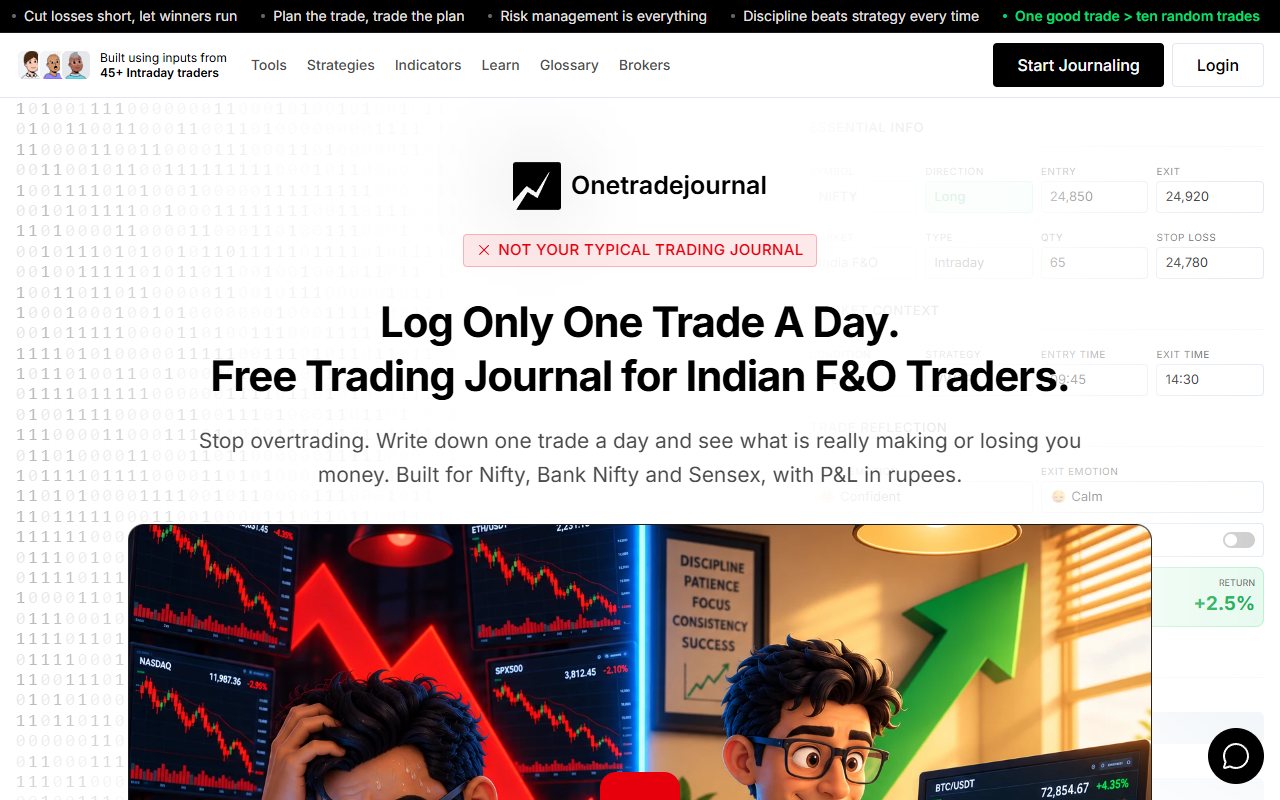
A trade can begin within your rules and end early because another price starts moving. The profit may look fine, but the exit still needs an honest reason. OneTradeJournal is built around writing one daily trade so that urge stays visible beside the plan and result. Save why you entered, how you felt and what changed before exit. The aim is to build discipline, reduce overtrading and avoid repeating costly mistakes. It does not promise fewer losses, stop broker orders or enforce a cash loss limit. Free OTJ permits one saved trade per day per market. Paid plans allow extra entries. One focused trade is the core daily habit, not a reason to hide other trades or present one selected entry as the full account. MarkMyTrade's homepage also offers emotion tags, mistake charts, discipline scores, playbook rules and broker CSV uploads. A CSV is a table file exported by the broker. Those tools can support its own psychology and rule-review routine; an imported price alone still cannot state your private reason. OTJ starts with manual writing and has known separate entry and exit feelings, stress, confidence, impulses and plan changes. Indian futures and options, or F&O, are contracts linked to a share, index or other asset. The daily questions are useful when the personal reason is the part you keep skipping. We read the public pages in a normal browser on 12 October 2026, without opening an account, uploading a file or buying a plan. The comparison credits the published tools while keeping scores, tax accuracy and exact form details separate from tested results. ## Feelings can change during one trade
OTJ has separate entry and exit feelings. That can help when a trade starts calmly but ends in a rush. You can also record confidence, stress, satisfaction and the mistake you want to review. Imagine you enter as planned, then close early to chase another moving price. This is a made-up case, not a report from a user. Calling the whole trade “fear of missing out” may hide the part that changed. The entry might have followed your rule; the exit might have broken it. Write what you knew at entry and what changed at exit. Include the planned target and the action you actually took. At the weekly review, look for other records with the same change in feeling. MarkMyTrade already lists emotion and mistake fields. The public pages did not show enough form detail to confirm the same separate entry and exit structure. That is an unknown, not proof that it is missing. OTJ is a useful fit when these specific fields are central to your routine. ## Make a playbook rule clear enough to check
MarkMyTrade's pricing page lists a trading playbook, checklist and rule tracking. A playbook is your written set of trading rules and setup checks. The homepage says trades are checked against those rules. We did not test how those checks work. A rule such as “do not trade with emotion” can be hard to judge. You need to say which action would break it. A rule such as “check the planned stop before entry” gives you a clearer event to review. In a made-up example, you enter a Bank Nifty trade and then increase its size after a loss. The size change matters. So does the reason. Were you following a written scale-in plan, or trying to recover the earlier loss? OTJ lets you record the impulse reason and change from your plan. Its ordinary behaviour analytics are free and compare saved emotions and habits with results. Review flags can point to unusual size changes or possible revenge trading. Those flags use simple data rules. They are not a diagnosis and they do not stop orders at your broker. ## A health score needs the trade behind it
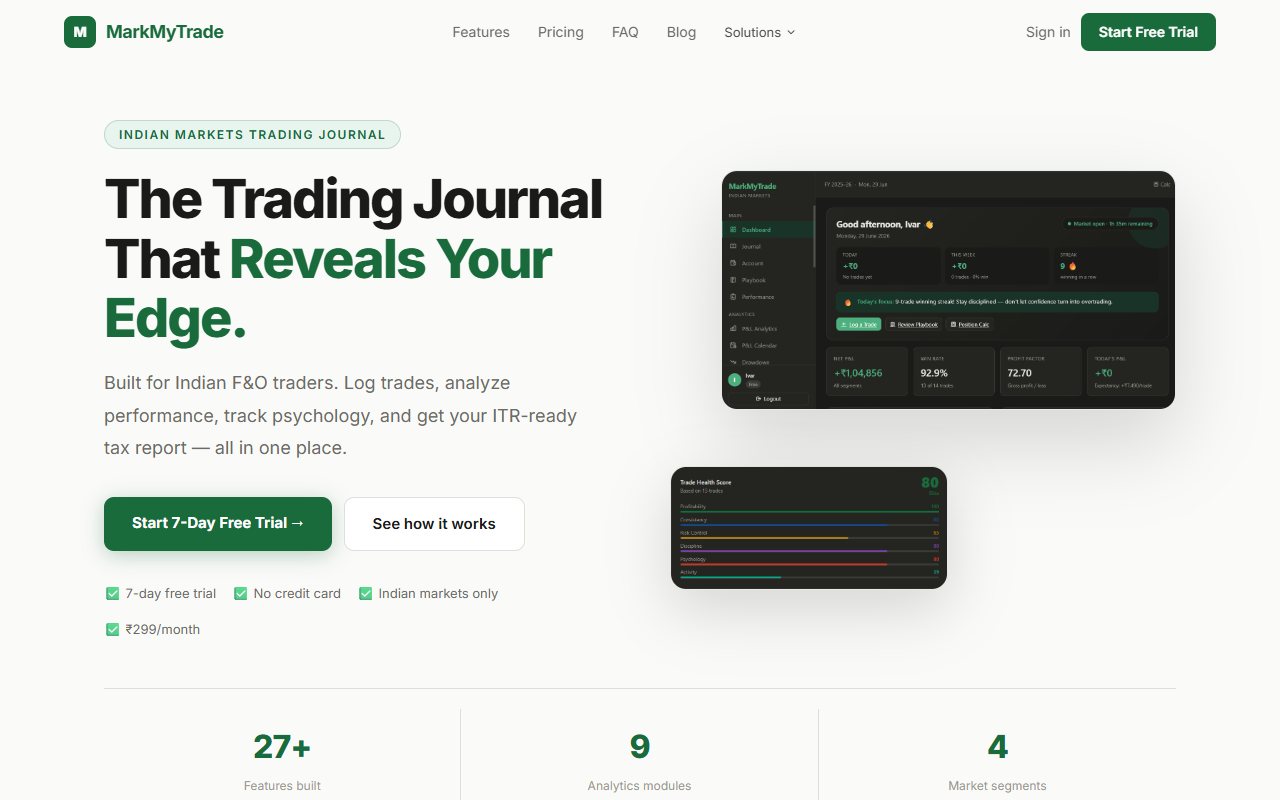
MarkMyTrade advertises a Trade Health Score from zero to 100. Its homepage says the score combines profit, consistency, risk control, discipline, psychology and activity. It also lists a psychology score trend. We checked that these are public claims, not that the scores are accurate. A score may help you find a change worth reading about. It should not become proof that every high-score trade was wise. A profit can follow a poor decision. A planned small loss can follow a careful decision. OTJ's reasons and plan-change fields help you review that gap. They do not prove that OTJ produces better scores or better returns. In either journal, read the event before judging the number. For a weekly check, choose one profit with a broken rule and one loss taken as planned. Read the notes without looking only at the color of the result. Ask which action you could control and what evidence supports your view. ## MarkMyTrade has its own behavior tools
The MarkMyTrade homepage lists Indian equity, F&O, commodity and currency trading. F&O means futures and options. It also names Zerodha, Upstox, Angel One and Groww for broker CSV files. Its journal section lists manual entry, chart pictures, emotion tags and mistake tracking. Its review sections describe charts for emotions, repeated mistakes and discipline scores. Those tools can keep emotions and repeated mistakes beside imported numbers. Profit and loss, often shortened to P&L, is the gain or loss from the trades you record. A chart that groups P&L by feeling can point you toward records to read. It cannot, by itself, prove that a feeling caused a loss. OTJ also keeps reasons and behavior fields next to the trade result. MarkMyTrade's listed emotion and rule tools give it a personal-review role too. The choice depends on which fields you need, how the history gets in and whether you can keep the record complete. ## AI review has a known place in OTJ
OTJ's paid plans include Ask Your Journal and Trading Mentor. Ask Your Journal lets you ask questions about your saved records. Trading Mentor can discuss a chart image. AI and voice use have limits. These tools can be wrong, and their usefulness depends on the information you give them. You might ask whether early exits share a recorded feeling or a written reason. Then open the named trades and check the answer. If you only entered a few losses, the AI cannot speak for your whole trading history. MarkMyTrade's public pages list charts and weekly review. They did not state a clear AI chat plan or allowance. That does not prove there is no AI anywhere in the product. It means we cannot compare an exact chat quota from these sources. The fair OTJ claim is that its paid plans include these named review tools. We do not promise unlimited use, correct advice or improved returns. Ask a small question and check the records before acting on an answer. ## Broker files are a clear reason to test MarkMyTrade
MarkMyTrade's homepage and pricing FAQ name tradebook CSV files from Zerodha, Upstox, Angel One and Groww. This can suit someone with a long broker history. Test the file from your own market and broker before relying on the whole set of charts. Look at a partial exit and a trade with several fills. Check the quantity, time, fees and final result against the broker file. A published broker name does not show how every unusual record will be handled. We did not run that test. OTJ requires you to enter trades yourself. Paid voice fill can reduce typing in the form. It is not a tool that reads a broker file into complete trade records. If you trade many times a day, this entry work can be a real OTJ downside. Missing trades can change the win rate and loss totals. For a smaller set of trades, writing the reason yourself may be the part your broker statement cannot supply. ## What happens after the trial? MarkMyTrade lists a seven-day trial without a credit card. Its pricing FAQ says that past trades and charts remain available in read-only mode after the trial. You cannot log new trades without upgrading. That answer is more useful than simply calling the account free. Its terms refer to Free and paid plan types in general. They do not define a separate continuing allowance for new entries. We use the specific pricing FAQ for the after-trial limit and note the broader wording in the terms. OTJ's free plan continues and allows one trade a day per market workspace. Extra manual entries, AI and voice need a paid plan. It is not a trial of every paid feature. Check this against your normal week. A free daily allowance may suit a person reviewing one chosen trade. It will not fit a person who needs to record every trade from a busy session. A temporary trial may help test an import, but it is not a lasting free entry plan. ## Compare the monthly and yearly prices
MarkMyTrade lists ₹299 per month or ₹2,999 per year. OTJ's India prices are ₹499 monthly, ₹1,299 for three months or ₹3,499 yearly. Check the OTJ plans page and the final payment screen before paying. At those listed amounts, MarkMyTrade is ₹200 less for a month and ₹500 less for a year. Neither result proves better value. The entry methods, rules and reports are different, and no checkout was tested here. Choose the period after testing the task you need. For example, try a real CSV file during MarkMyTrade's trial if bringing in history is your main need. If manual review matters most, see whether OTJ's free entry is enough to build the habit. Do not buy a year because the price looks small next to a trading loss. A journal is useful when you keep accurate records and return to them. The amount you pay does not cause that habit or remove trading risk. ## Treat tax reports as a file to check
MarkMyTrade markets tax reports and charge calculations. Its homepage says it groups results for tax use and offers Excel or CSV reports for an accountant. That may help you prepare records, but we did not test the calculations or filing fit. Its terms say tax calculations and charts are for information. They give no accuracy guarantee and advise a chartered accountant for actual filing. An accountant can check how your own records should be treated. This page does not repeat the site's accuracy claim as a proven fact. OTJ estimates brokerage and other charges and offers CSV, JSON and text exports. Its estimates also need a check against broker contract notes. A contract note is the broker's official record of the trade and its charges. OTJ does not offer a certified tax-filing service. Prefer it here if your main task is to explain an exit or size change. If preparing an accounting report is your main task, test MarkMyTrade's file with the person who will use it. ## Check what your export keeps
MarkMyTrade's privacy policy describes trade records, notes, emotion labels and uploaded pictures. It also describes data-copy and account-deletion requests. We read the policy; we did not test how the service carries out those requests. OTJ has data and text exports for entered records. Before changing tools, open a sample export and check the fields you need. A total gain or loss does not preserve a reason unless the notes travel with it. Keep a readable backup of the record that matters to your review. If your main question concerns feelings at exit, check that field rather than only the trade count. Do the same for a rule violation or a chart picture. There is no security ranking in this comparison. OTJ asks for no broker token because it has no broker connection. MarkMyTrade describes CSV uploads. Those facts explain the entry routes; they are not an independent security audit. ## Use one completed trade to decide
Pick a trade you can explain clearly. Ask: “Did I exit because the plan changed, or because I wanted to escape discomfort?” Write the planned exit, the action you took and the reason you remember. Try OTJ if you want to write one daily trade and notice the urge that changed a calm entry into a rushed exit. Keep both feelings and the original plan. Read the note before repeating that same chase. Check whether the free daily allowance fits your routine before choosing paid tools. Try MarkMyTrade if broker CSV files, a playbook and reports solve a larger record problem. Check the file format, the rule checks and the after-trial limit during the trial. Treat score and tax accuracy as things to test. Both tools support behaviour review. Choose the daily questions and wider tools you will keep using honestly. Keep the complete broker record beside your personal notes. A journal can support discipline; it cannot promise profit or take control of your next order.
Sources and limits
We checked these public product pages and OneTradeJournal’s current product on 12 October 2026. We did not test a private MarkMyTrade account, broker import, payment or AI answer. Check current plans and limits before paying.
- MarkMyTrade home: CSV files, markets and behavior tools · Checked 12 October 2026
- MarkMyTrade prices, trial and after-trial FAQ · Checked 12 October 2026
- MarkMyTrade terms: tax and accuracy limits · Checked 12 October 2026
- MarkMyTrade privacy: stored records and data requests · Checked 12 October 2026
A journal cannot promise trading profits. AI answers and fee estimates can be wrong. Check trades and charges against broker records. This page does not give trading, investment or tax advice. Competitor names and website pictures do not imply a partnership or endorsement. Any example is an explanation, not a private account screenshot or a real customer result.