
The detailed comparison
A closer look at the daily routine, the tools and the limits of each product.
Choose a section
Write the daily reason before the rush becomes a routine
A broker file can show that you bought a Bank Nifty option. It cannot say whether the planned setup qualified or you entered because the move felt too urgent to miss. OneTradeJournal, or OTJ, is built around writing one daily trade so that private reason stays visible. Save the plan, entry and exit feelings, and any impulse or risk change. The aim is to build discipline, reduce overtrading and avoid repeat mistakes. It cannot block orders at your broker or enforce a cash loss limit. One planned trade can still lose. Free OTJ permits one saved trade per day per market. Paid plans allow extra entries. The one-trade focus is a daily reflection habit, not a reason to hide real follow-up trades or report one selected note as the whole account. TradeX Journal's plan page has a wider published Free offer: unlimited journal entries, CSV files from three Indian brokers and 20 monthly AI messages. Its homepage also describes personal reflections and emotion tracking. Pro lists a psychology tracker. OTJ starts with manual writing and known separate emotion questions. Indian futures and options, often called F&O, are contracts linked to a share, index or other asset. TradeX can start with imported numbers and also offers manual entry. Both need your own personal context. We checked the public pages on 12 October 2026, without testing an account, upload or AI answer. This is the product at www.tradexjournal.co.in; similar names do not establish the same service. Compare the daily habit honestly alongside its wider free access and lower listed monthly price. ## A file can save typing, but the reason still needs a note
A CSV is a table stored in a file. A broker trade file can carry prices, dates and quantities. It cannot describe a private feeling unless you add that information elsewhere. Imagine a made-up Bank Nifty trade entered out of fear of missing a move. The file may show the trade correctly. The missing question is whether the setup you planned was present before you clicked. OneTradeJournal asks you to enter the facts by hand and add personal context. You can record impulse reasons, mistakes, feelings and a change from your plan. Its separate prompts are useful if you tend to skip those parts of the story. This takes time. It is not automatic psychology analysis from a broker feed. TradeX also advertises manual reflections and emotion tracking. The choice is whether OneTradeJournal's particular prompts make the record clearer for you, rather than whether one product alone can hold a reason. ## Both products talk about feelings, so compare the details
The TradeX homepage describes emotion tracking and an AI coach. Its plan page puts a psychology and emotion tracker in Pro. We have not tested how its exact form fields differ from OneTradeJournal's fields. OneTradeJournal has separate entry and exit feelings. It also has stress, confidence, satisfaction and mistake inputs. You can write what changed from the plan rather than leave one broad mood for the whole session. Take an example where you felt confident at entry and anxious at exit. A note should preserve both states. If the next entry came from trying to recover a loss, that reason is worth writing too. One word for the day may hide the sequence. Ask to see how each tool stores that sequence. Do you prefer separate fields or a written paragraph? Can you understand the entry later without guessing what you meant? These are useful questions for a first check. TradeX's own emotion tools can support that writing too. ## Review the decision apart from the money made
Suppose a trade breaks your written rule but closes at a profit. You might be tempted to label it a good trade just because the result is green. A planned loss can suffer from the opposite mistake. A journal can keep the result and the process in view at the same time. Save the actual profit or loss, then explain whether the entry and exit followed your plan. Those are separate parts of the record. In OneTradeJournal, you can mark a mistake or a plan change and add the reason. Its ordinary behaviour analytics are free and compare saved emotions and habits with results. Possible behaviour flags work from the saved sample. They are rough checks, not a diagnosis. They do not know your thoughts or block orders at the broker. TradeX publishes psychology review too. Those tools can support its own personal-review routine. Its benefit is the explicit record you choose to make. If TradeX's form already helps you write that clearly, imports may remain a strong reason to prefer it. ## AI message limits are part of the price
TradeX currently lists 20 AI coach messages each month on Free and 300 on Pro. Those are published plan limits, rather than an unlimited AI promise. We have not compared the quality of its responses with OneTradeJournal's responses. OTJ offers paid Ask Your Journal, Trading Mentor and voice help with usage limits. You can ask about saved trades or review a chart picture. A picture review does not prove a broker fill or supply a missing trade. Start with a narrow question you can check. For example: which saved entries did I mark as rushed, and what did I change? Read the actual records after the answer. The value is making the review easier to inspect. AI may be wrong or too confident. If you left out losing trades or did not save the reason, the answer has an incomplete sample. Do not treat either coach as proof of a future edge, a private motive or a safe next trade. ## TradeX is cheaper on the published monthly price
TradeX Pro is listed at ₹349 a month. OneTradeJournal's India plans are ₹499 monthly, ₹1,299 quarterly and ₹3,499 yearly. At the listed monthly amounts, TradeX is ₹50 lower. That is a clear price difference. We do not turn it into an annual savings claim. The TradeX pages we reviewed did not establish an annual offer for this comparison. Check final billing terms before you pay. Price alone cannot tell you whether a tool solves your problem. A free importer may save you more work than a paid note form. A clear set of prompts may also help you keep records you previously skipped. Use the actual task to judge the cost. Try the record before paying. If OTJ's free daily allowance fits your routine, write a known trade and read it again later. If you need all trades in one place, check TradeX's published free offer and test a small file. Avoid choosing a plan just because a comparison uses the word “better.”
Contract details still need a careful check
OneTradeJournal has Indian option fields for strike, expiry and call or put type. It also offers lot guidance and charge estimates. These make a manual options entry more specific than a plain index name. Check the price you entered. An index level is different from the premium of the option you bought or sold. If the note refers to an index chart, make that clear rather than mix the two prices. If you use a TradeX file upload, begin with a record whose facts you know. Compare the saved contract, side, quantity, dates and prices with the file. Include a partial fill or a repeat upload if those cases matter to your history. We have not tested TradeX's parser, duplicate handling or every instrument. The three broker names on the plan page are published coverage. They do not prove that every old file format or account case will work without a check. ## Tax report wording does not remove the need for source records
TradeX Pro advertises tax and income tax return (ITR) reports. Its privacy policy describes tax estimates based on entered trade data. We have not certified these reports, checked every charge or filed a return with the product. OneTradeJournal's relevant Indian forms also show estimated charges. They can help you review costs, but they do not replace actual broker notes. A missing or wrong trade can change the result in either journal. Keep the complete source history. Read the gross result, the listed charges and the net result as separate parts of the check. If a journal total differs from a broker report, find the reason rather than simply change a value to make the screen look tidy. This comparison gives no tax or investment advice. Discuss filing requirements with a qualified professional. A feature called a tax report is still something to check against your records and your own circumstances. ## A privacy policy describes promises rather than an audit result
TradeX's policy says it does not collect broker login details. It also says journal content is sent to an AI model for coaching, and describes CSV export. We checked this public wording, but not how its systems enforce it. OneTradeJournal's manual entry avoids a broker-sync connection. It still involves saving private trade details and notes. When you use its AI review, the context you provide is processed for the response. Manual entry does not prove better security. Read policies with the type of data you plan to save in mind. A chart picture may contain an account name. A note may describe personal stress. Remove details that are not needed for your review. If exports matter, try a small record before you rely on them for a backup. OneTradeJournal can export saved information as CSV, JSON and TXT. We did not test TradeX's export or deletion requests. Neither brand's privacy wording is presented here as a security certificate. ## Write a review question you can return to
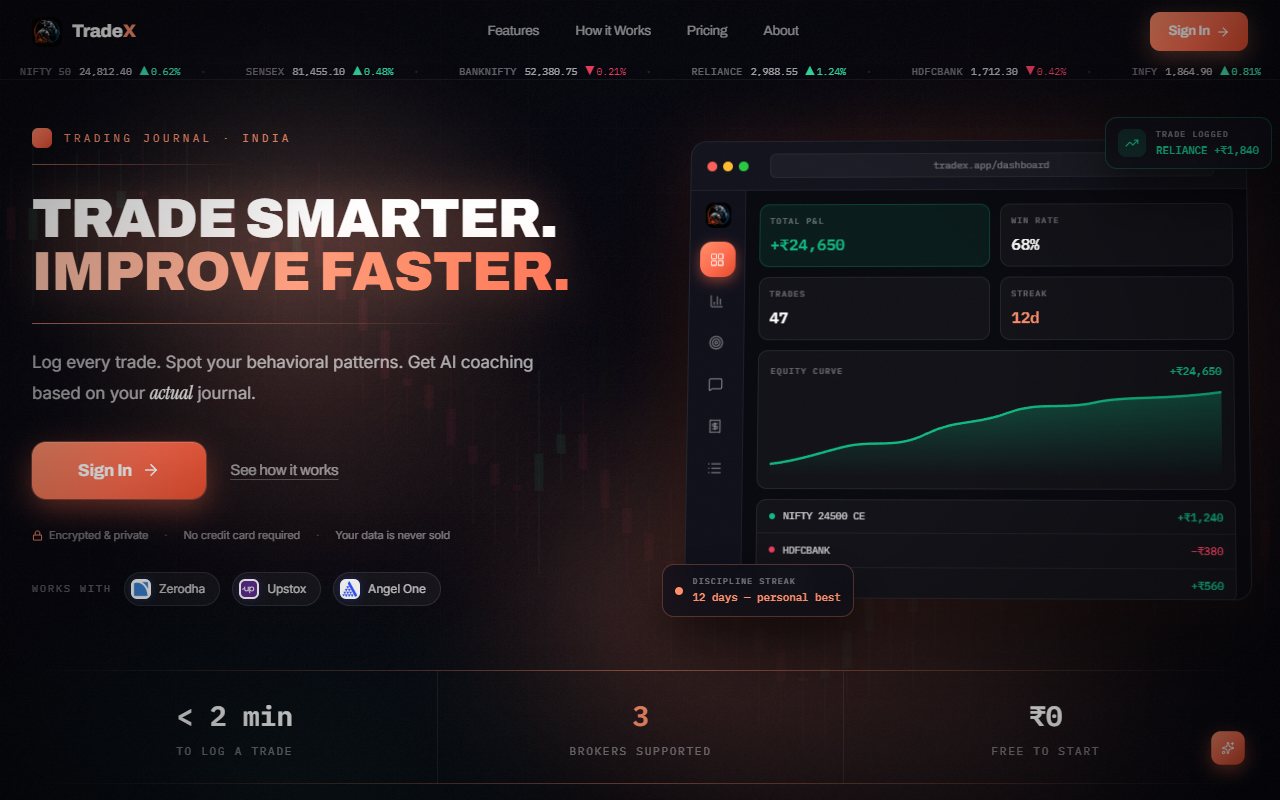
For a first manual note, choose one decision rather than try to explain your whole trading history. Write the setup, the planned exit and what you actually did. Add the feeling that mattered at the point of change. After a few days, read the note without looking at the result first. Can you follow the reason? Can you tell whether the change was planned? If not, add clearer wording to your future entries rather than invent a reason for the old trade. OneTradeJournal can help keep these details in separate places. TradeX's notes and tracker may also suit you. The practical test is whether you keep the useful context, not which homepage sounds more certain about improving performance. The example and illustration on this page are made-up explanations. The website image is a public page capture. None of them is a private account review, a real customer's result or proof of a partnership between the two brands. ## Choose the offer that fits your record
Choose OTJ if you want to pause over one daily trade and write the fear behind a chase or unplanned recovery entry. The separate feeling and plan-change questions help keep that reason clear. Return to the note before treating the same urge as a new opportunity. Consider TradeX when the listed broker file imports, unlimited free entries or stated AI allowance are your priority. Its monthly Pro price is lower. Its advertised psychology features also deserve credit. You may keep complete broker records and use a selected manual note for reflection. Make the difference clear. A few chosen notes are not the performance of the full account, even when a report gives them a total. Neither journal promises profit. An imported fill or AI label cannot establish an unwritten private motive as fact. Keep truthful daily notes and the full broker record, then choose the routine and tools you will keep using.
A made-up review note
The file has the price. You add the reason.
Made-up example: a Bank Nifty entry is correct in the file, but you took it because you feared missing the move.
- Written plan
- Wait for a pullback
- Actual reason
- Fear of missing the move
- Change from plan
- Entered before the pullback
- Review question
- Was my setup present before I clicked?
Write the fear of missing out while it is fresh. OTJ makes that part of the daily note. TradeX's reflections and emotion tools can also add personal context to imported numbers.
Sources and limits
We checked these public product pages and OneTradeJournal’s current product on 12 October 2026. We did not test a private TradeX Journal account, broker import, payment or AI answer. Check current plans and limits before paying.
- TradeX Journal official Indian-market product overview · Checked 12 October 2026
- TradeX current free/Pro selection and limits · Checked 12 October 2026
- TradeX privacy, AI processing and export policy · Checked 12 October 2026
A journal cannot promise trading profits. AI answers and fee estimates can be wrong. Check trades and charges against broker records. This page does not give trading, investment or tax advice. Competitor names and website pictures do not imply a partnership or endorsement. Any example is an explanation, not a private account screenshot or a real customer result.