
The detailed comparison
A closer look at the daily routine, the tools and the limits of each product.
Choose a section
Write the hesitation before blaming the exit
A trader can wait too long at the planned Nifty entry, chase a later price and then leave early in fear. Calling the trade an early-exit mistake misses the first feeling that changed it. OneTradeJournal is built around writing one daily trade so that sequence stays visible. Save the original setup, your reason and the emotion at entry and exit. The aim is to build discipline and avoid repeating costly mistakes, including unnecessary follow-up entries. OTJ cannot block broker orders or promise that one planned trade will avoid a loss. Free OTJ permits one trade per day per market. Paid plans allow extra entries. The daily focus is a habit to practise, not a reason to hide actual trades or report a selected entry as the whole account. My Trade Diary's homepage also describes manual trades, emotions, mistakes, playbooks and AI summaries. A playbook is a written guide to the setup, or conditions you want before entering. Its public checklist can support preparation too. Both products have personal reflection tools. OTJ starts with your own writing and known Indian futures and options fields. Futures and options, often called F&O, are contracts linked to a share, index or other asset. It has no broker sync or CSV import; paid voice can help with the manual form. We checked public pages and OTJ code, without testing a My Trade Diary account, AI answer or payment. Its lower listed prices are a useful check. First compare the daily questions you will keep answering honestly. ## Hesitation deserves its own explanation
Many journal comparisons focus on angry entries after losses. Another problem is hesitation: the trader sees the intended entry, waits too long, then acts at a less comfortable price. Imagine a made-up Sensex options trader who repeatedly writes early exit as the mistake. On closer review, the first issue was doubt that delayed the entry. The late entry left less room to the target and changed the risk. That may explain the anxious exit. OTJ's confidence, stress, emotion and impulse fields can help preserve that sequence. A note such as “I waited because I doubted the setup, then entered to avoid missing it” separates the two decisions. My Trade Diary's emotion and mistake tools can support this review too. The advantage to test is whether its confirmed set of fields helps you distinguish hesitation at entry from fear at exit. OTJ's free behaviour analytics compare saved feelings and habits with recorded results. Its behavioural flags can highlight possible revenge trades, size spikes and overtrading. They are rough checks on entered data, not diagnoses or broker order blocks. They cannot explain every delayed entry by themselves. The trader still has to supply the reason. A specific explanation gives next week's review something to check. A generic instruction to be confident does not show what happened. ## A checklist starts the plan; notes save what changed
My Trade Diary offers a free public checklist without sign-in. It asks about setup, confirmation, risk and mental readiness. The page makes clear that its score reflects completion rather than the chance of profit. That is a useful distinction. A trader can complete every question and still have a planned loss. A completed checklist is not proof that a trade will win. Consider a made-up Nifty options trader who waits for the correct entry but exits early when the option price moves against the position. The plan can be sound while the later choice changes. A checklist alone cannot explain that change. OTJ connects the planned stop, target and strategy with entry and exit emotions, stress, confidence, an impulse reason, a mistake and a deviation. Those fields can save both moments. For example, “I was confident at entry but became anxious when the premium paused” is more useful than simply marking the trade bad. The explanation shows what changed between the plan and the exit. A trader may use a public checklist before trading and a journal afterward. A brand offering both does not prove they are linked in the saved journal. Check how your chosen product keeps the original decision and later behavior connected. ## Playbooks work best with a clear definition
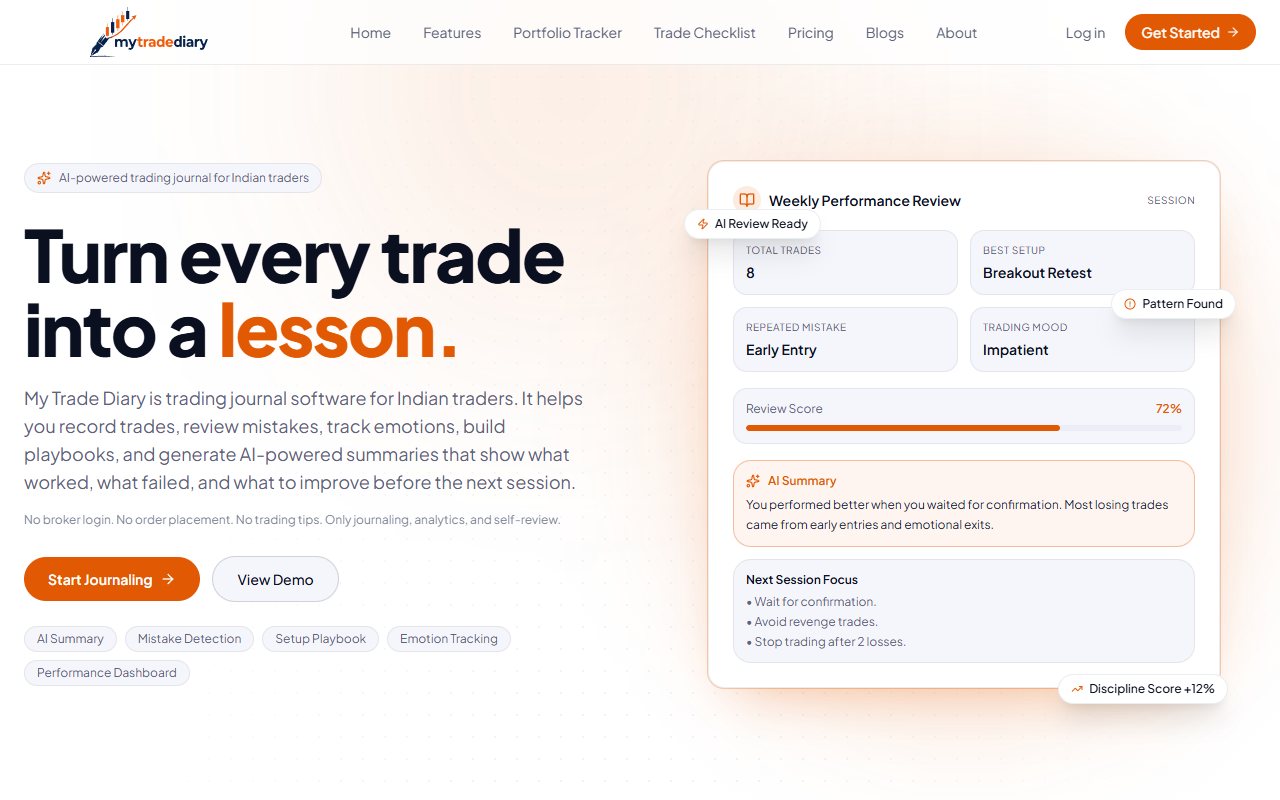
My Trade Diary's homepage advertises custom setup playbooks and rule checklists. A written setup can keep the rules the same from trade to trade. A made-up Bank Nifty trader may call several entries pullbacks. A pullback is a short move back against the main price move. Some follow a defined level and confirmation; others happen because the trader does not want to miss the move. Putting them under one method hides the difference. Write clear entry conditions. Save plan changes separately. OTJ records strategy, planned risk details, notes and deviations. It gives the trader a direct place to explain whether the recorded entry actually followed the method. A strategy name does not prove you followed it. The label is only useful if the reason and plan match it. A short clear note can explain the choice better than a broad label. My Trade Diary's playbook approach may appeal to a trader who likes working from a saved description of setups. OTJ may suit someone who wants reason fields while entering the trade. Test with an entry that almost matched the method. If the record can show the missing condition, the later review is more likely to examine the decision rather than simply blame the strategy. ## Manual entry can be useful, but it still takes work
Both sites describe manual review. OTJ cannot import an old trade archive, and My Trade Diary's app pricing page says it is not connected to a broker. If you have hundreds of old fills, do not assume either tool can import them all. A fill is one completed part of an order. Check any file route you need. A portfolio tool or journal name does not prove import support. For OTJ, a practical approach is to start from a defined date and enter new trades consistently. Keep older broker records as the financial source. Make clear that the new journal starts on that date. Paid voice fill can make the form easier to fill, especially after a busy session. It still needs checking. A wrong quantity or contract can distort the result even when the note is thoughtful. For either journal, compare the day's entries with the broker tradebook. This catches missing trades and protects against selecting only the planned ones. The difficult trade may be the one you most need to explain. Be realistic about the effort. A detailed manual routine is useful only if it survives a tired evening. Start with fields you can fill each day and one clear question. Add detail as you keep the habit. ## AI should summarise evidence you can find again
My Trade Diary's homepage advertises session summaries using setups, mistakes, emotions and notes. OTJ also has paid AI. This is shared, not unique to either product. OTJ offers Ask Your Journal, Trading Mentor with chart screenshot analysis and pattern feedback. Usage limits apply. These tools can help organise the record, but may be wrong and do not know unrecorded trades. A good question for the hesitation example is, “Which early exits also have notes describing a late entry?” The answer should lead to specific trades. You can then check whether the interpretation fits the written explanation. A clear summary can still be wrong when trades are missing. If the trader only saves losing trades, AI may describe the losses rather than the whole method. If setup labels change, the comparison can combine unlike decisions. Check the examples behind the summary and end with one action. A made-up trader might choose to record the original entry reason before writing about the exit. Next week, the presence and clarity of that reason can be inspected. AI text on a product page is an example, not our tested result. We have not measured My Trade Diary's answers or the effect of either journal on a trader's returns. ## Exact F&O fields are worth checking in the form
My Trade Diary markets to Indian traders, but the reviewed pages did not fully establish its handling of expiry, strikes, quantities and charge calculations inside the app. That needs a check. It does not prove options support is absent. OTJ has confirmed Indian stock and F&O fields, familiar index choices, an expiry picker, lot-size hints and estimated brokerage and statutory charges. These give an options trader a place to enter contract details. Try an ordinary Nifty or Bank Nifty contract in the form you choose. Check the quantity and expiry against the broker record. A name in a setup note is less useful than clear contract details. OTJ's hints do not certify old exchange specifications, and its estimates do not replace actual contract notes. Use broker records when matching money figures. This comparison is not tax advice. The journal can help ask why frequent small trades raised costs or why changing size affected the experience. It should not be presented as a tax filing service or an audited performance record. If you mainly trade options, OTJ's known contract fields may help. Still check the other product's form before choosing. ## Published pricing is lower; checkout remains untested
My Trade Diary's homepage displays ₹99 monthly and ₹999 yearly, with a launch countdown at zero. Its pricing page currently agrees with those amounts. Older search copy showed ₹299 and ₹1,999. Those older amounts are not today's reviewed prices. The current public amounts are below OTJ's corresponding plans, but checkout, eligibility and actual access were not tested. OTJ should not claim a price advantage. OTJ's India plans are ₹499 monthly, ₹1,299 quarterly and ₹3,499 yearly. Free journaling allows one trade per day per market; paid access allows extra manual entries. My Trade Diary's current public pages do not establish a usable permanent free journaling allowance. Do not infer an unlimited free plan or a defined journal trial from its free public tools. Before paying, confirm the bill, term and AI allowance. The current pricing says renewal is manual, not automatic; we did not test a payment. Public cards do not prove the final checkout amount or actual access. The decision can still progress while those terms are checked. Compare the entry form and review routine first, then apply the confirmed cost to the product that fits. ## Look beyond one summary at the weekly review
OTJ has a profit and loss calendar and views by strategy and time. Its results line shows saved trades over time. Drawdown means a fall from an earlier high. Profit factor compares total gains with total losses. These views help identify which entries deserve attention. A risk multiple compares the result with risk from a valid planned stop. The exit review compares your saved exit with your saved target. OTJ does not measure the largest price move against or in favor of the trade. It has no old-price replay or rule testing on past market data. For the made-up trader who hesitates, the useful review may be a short group of trades with the same entry reason. Read the notes alongside the analytics rather than expecting one headline number to explain everything. OTJ exports CSV, JSON and text reports. CSV gives rows and columns, JSON keeps structured fields, and text gives a readable report. My Trade Diary's pricing page mentions report export in the yearly plan; verify the actual output and included context before relying on it. Choose OTJ when you want to write one daily F&O trade and watch the hesitation that turns into a chase or early exit. Read those reasons again before blaming the outcome alone. Choose My Trade Diary if its playbooks, emotions and summaries suit your routine better, after checking the exact form and paid terms. Neither journal promises profit or diagnoses the reason for an unwritten feeling.
Sources and limits
We checked these public product pages and OneTradeJournal’s current product on 12 October 2026. We did not test a private My Trade Diary account, broker import, payment or AI answer. Check current plans and limits before paying.
- My Trade Diary tools and prices · Checked 12 October 2026
- My Trade Diary plans and renewal · Checked 12 October 2026
- My Trade Diary free checklist · Checked 12 October 2026
A journal cannot promise trading profits. AI answers and fee estimates can be wrong. Check trades and charges against broker records. This page does not give trading, investment or tax advice. Competitor names and website pictures do not imply a partnership or endorsement. Any example is an explanation, not a private account screenshot or a real customer result.