
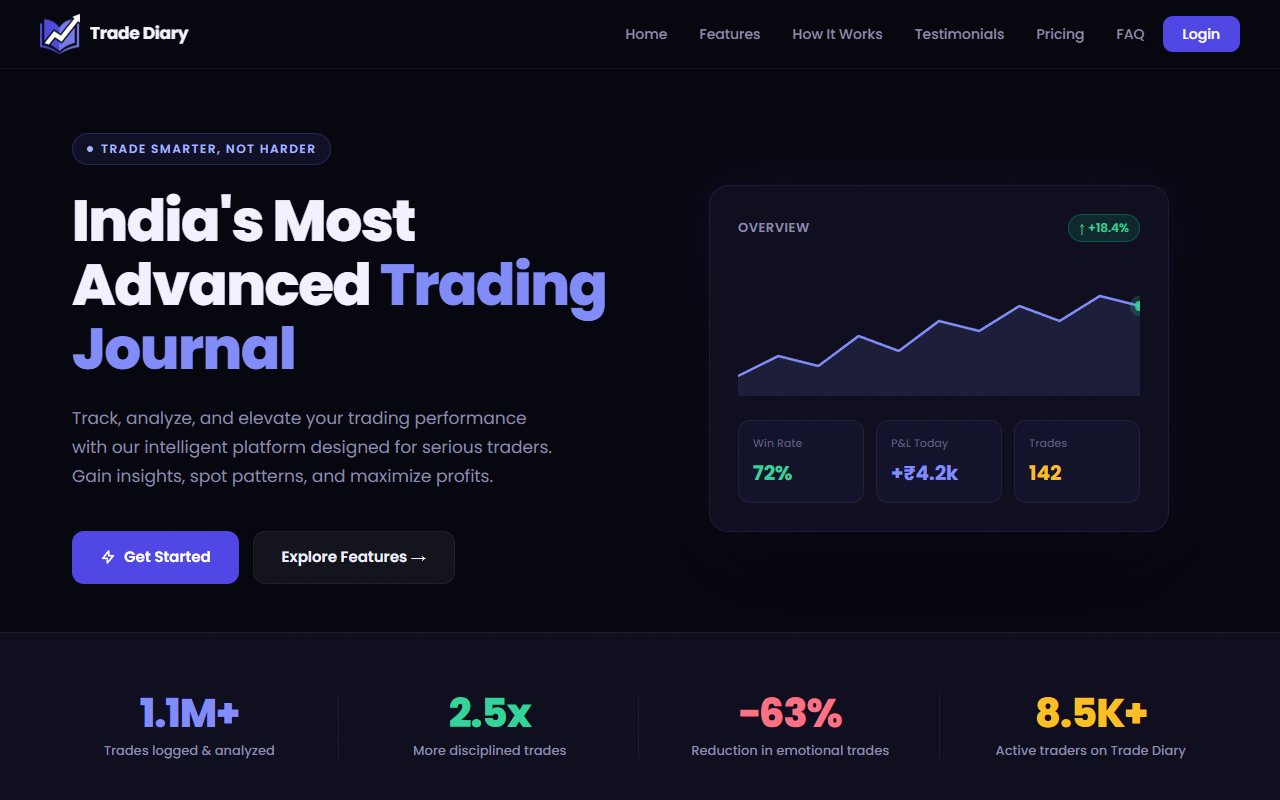
The detailed comparison
A closer look at the daily routine, the tools and the limits of each product.
Choose a section
A winning run still needs a daily psychology review
After several good days, confidence can turn into a reason to raise risk beyond the plan. OneTradeJournal is built around writing one daily trade so that the feeling stays visible, even if the next oversized trade wins. Save why the setup qualified, your emotion at entry and exit, and any change to quantity or the stop. The aim is to build discipline and avoid repeating costly mistakes. It is not a promise that fewer trades will produce profit. OTJ does not block orders or enforce a broker loss limit. Free OTJ permits one saved trade per day per market. Paid plans allow extra entries. The daily focus is a reflection habit, not a rule that asks you to hide any other trades you took. This page compares TradeDiary at tradediary.in. The similarly named tradediary.app is covered separately. Their public offers differ, and we have not established an ownership link. TradeDiary (.in)'s psychology page describes emotions, confidence, rules and behavioural summaries. Its options page adds contract details, strategy review, mistake tags and screenshots. Those tools give it its own psychology routine. OTJ starts with writing the trade yourself. It supports Indian futures and options, often called F&O, which are contracts linked to a share, index or other asset. We checked public pages and OTJ code, without testing TradeDiary's app or sync. The question is which daily practice you can keep honestly, alongside the prices and conditions below. ## A good week can still lead to a broken rule
Consider a made-up Sensex options trader after a run of profitable sessions. Confidence rises, quantity increases and a stop is moved because the trader expects the next position to recover. The trader did not need a losing streak to make that choice. Save more than a revenge label. Overconfidence, excitement and impatience can also change the plan. Last week's wins do not prove this week's risk choice is sound. OTJ lets the trader record confidence, stress, entry and exit emotions, an impulse reason, a mistake, satisfaction and a deviation. A note such as “I raised size because I felt I could not be wrong this week” preserves the reasoning. TradeDiary (.in)'s psychology tools advertise emotion and confidence logging, mistake tracking and rules. Both products offer these tools. Its confidence and rule tools can also help you review what changed. The practical difference to test is how each form helps you express the decision. Check whether one emotion tag is enough. You may prefer several fields to show how the feeling changed. OTJ's ordinary behaviour analytics are free and compare saved emotions and habits with the results. Its flags can bring attention to possible size spikes, overtrading and revenge trades. They are rough checks on entered data, not diagnoses or broker order blocks. Read the entries behind the flag. The flag does not prove the reason. ## Use the same meaning for a strategy label
TradeDiary (.in)'s options page describes strategy performance and mistake analysis. OTJ also supports strategy review. Use each label to mean the same thing from week to week. A made-up Nifty trader may call every long call a breakout, even when some entries follow a planned level and others chase a sudden move. The strategy totals then mix planned and chased entries. Define the setup, or entry conditions, before reviewing the result. Record an unplanned entry as a deviation and explain it. That lets you distinguish a strategy losing within its rules from a trader abandoning those rules. OTJ has a profit and loss calendar and views by time. Its results line shows saved trades over time. Drawdown means a fall from an earlier high. Profit factor compares total gains with total losses. These views can show which records to read. They cannot fix a label that keeps changing meaning. A risk multiple compares the result with risk from a valid planned stop. If the stop is added after the outcome to make the risk look sensible, the figure does not represent the original decision. OTJ's exit review compares the saved exit with the saved target. It does not measure the largest market move against or in favor of the trade. There is no historical market replay. Check any old-price tool separately. The same report name can mean different sums in different apps. ## India support needs accurate entries as well as familiar names
TradeDiary (.in) explicitly addresses Indian F&O. OTJ also includes Nifty, Bank Nifty, Sensex and Indian stock/F&O fields, an expiry picker, lot-size hints and estimated brokerage and statutory charges. A familiar index selection can make entry easier, but it does not establish the correctness of an older contract. Use the broker record for expiry, quantity and fill price. Expiry is when the contract ends; strike is its agreed price level. For a made-up trader reviewing several expiries, keep contract details clear enough to tell two trades on the same index apart. Otherwise an analysis by index can combine activity with different risks and intentions. Charges deserve the same care. OTJ's estimates help frame the review but do not replace a broker contract note or create certified tax records. Use actual broker statements when matching money figures. This comparison is not tax advice. A journal is useful for asking what behavior led to frequent small trades or increased costs. The broker record establishes the amount. Keeping those roles clear makes the review more trustworthy. For TradeDiary (.in), verify the actual contract and charge behavior in the app. The options page describes intended support. It does not show that we tested every calculation. ## Public broker claims need a working guide
TradeDiary (.in)'s homepage names direct integrations for Zerodha, Dhan and Upstox and describes bulk sync. Its pricing page also lists broker sync. However, the linked integrations route returned a 404 during this review. A missing guide does not prove the broker links are absent. It means we could not check setup, update times, trade types or older history from that guide. Check those details inside the product before relying on imports. OTJ is explicit about its workflow: manual entry only, with no broker sync or CSV import. Paid voice fill helps complete the form. It does not bring in old broker files. A made-up Bank Nifty trader with hundreds of old fills may need a tested import route. A fill is one completed part of an order. Recreating every entry manually can be too much work. If that is your main requirement, confirm TradeDiary's actual connection before choosing either product. For a trader starting a new reflection habit, it may be enough to begin manual entries from a defined date and keep older broker records separately. Make clear that the journal starts on that date and leaves out older trades. The key is to understand the work involved. A broker name establishes a marketing claim. A working import of your normal kinds of trade gives stronger evidence. ## The listed TradeDiary prices are lower
TradeDiary (.in)'s pricing page lists ₹299 monthly and ₹999 billed yearly, with GST potentially applicable. OTJ's India plans are ₹499 monthly, ₹1,299 quarterly and ₹3,499 yearly. TradeDiary's listed monthly and yearly amounts are lower than OTJ's. GST may apply, and final checkout was not tested. OTJ should not claim the cheaper plan in this comparison. The periods also matter. TradeDiary's ₹999 covers a year, while OTJ's ₹1,299 covers three months. A monthly equivalent displayed on an annual card is not the amount paid for one month of access. Choose OTJ if its manual reason fields and review tools fit the habit you want. That preference can make sense while the listed price difference stays clear. Before paying, check the final bill and included tools. A published amount is a useful comparison point, but it is not evidence that the app will meet every requirement you bring. For a made-up Nifty trader, the right test is whether the journal helps you notice and check a repeated choice. Saving subscription money is worthwhile when the lower-priced product does the required job. Pay more only if the difference matters to your daily use. ## The three-month free promotion has separate conditions
TradeDiary (.in)'s pricing page displays a three-month premium offer. The same page says you must open Lemonn through its referral link, make an F&O trade and send details for manual checking. It is not free premium for every new account without conditions. This is separate from the permanent free tier, which the page lists as up to ten trades per month. An offer and the ongoing free plan are different. OTJ's free plan permits one trade per day per market. It is ongoing free journaling with a cap, not a time-limited trial of the paid subscription. Paid access allows extra manual entries. Imagine a made-up trader who trades once on several days each week. The OTJ daily allowance may fit a consistent routine, while a ten-trade monthly cap could be reached earlier. A trader active in short bursts needs to consider the daily restriction as well. Do not plan a review around omitted trades. If the allowance does not hold your normal activity, compare paid plans and confirmed terms. A partial record may look better but leave out the choices you need to review. Read the offer as a purchase condition. It is not a reason from this comparison to take a trade or change brokers. Choose the journal by the record and review you need. ## AI summaries need a question and a record
TradeDiary (.in)'s homepage advertises an AI summariser, and its psychology page describes recurring-behavior summaries. OTJ also has paid AI. This is an area to compare rather than an exclusive feature. OTJ offers Ask Your Journal, Trading Mentor with chart screenshot analysis and pattern feedback. Its AI and voice tools have usage limits. AI can be wrong and cannot know about unrecorded trades or reasons you never entered. A useful request is, “Which high-confidence trades also show a deviation, and what reasons did I write?” The answer can be checked against the journal. A broad demand to fix your psychology is harder to check. Check whether the sample contains all relevant trades. If a busy week was skipped, a summary may describe the habit of selective logging rather than the habit of trading. End the review with one action you can check. A made-up trader might choose to record the intended quantity before explaining the final outcome. Next week, the trader can inspect whether that step was completed. AI should help organise evidence, not promise profitable trades. The value comes from a question you can check and an action you can repeat. ## Test the habit, then choose the subscription
Use one ordinary week that includes a strong-confidence entry, a rule deviation and a trade you were tempted to leave out. Keep broker records beside the journal when checking the numbers. OTJ suits an Indian F&O trader who wants to write a daily note and notice the moment when confidence became an excuse to raise risk. Keep the original plan and real emotion together. Then read the note before repeating the same size or stop mistake. TradeDiary (.in) deserves consideration for its lower published prices, psychology tools and advertised sync. Confirm the broker workflow and any promotion conditions directly before making them central to your decision. OTJ exports CSV, JSON and text reports. CSV gives rows and columns, JSON keeps structured fields, and text gives a readable report. Check how any alternative preserves notes and labels when you take records out. Try taking records out before you add a long history. Choose the journal whose daily entry and weekly review you will complete. The point is to name one repeated habit and watch it, not to make every loss look like a mistake or every win look disciplined. Neither tool promises trading profit.
Sources and limits
We checked these public product pages and OneTradeJournal’s current product on 12 October 2026. We did not test a private TradeDiary (.in) account, broker import, payment or AI answer. Check current plans and limits before paying.
- TradeDiary.in broker and AI descriptions · Checked 12 October 2026
- TradeDiary.in prices and offer conditions · Checked 12 October 2026
- TradeDiary.in emotion and rule tools · Checked 12 October 2026
- TradeDiary.in options fields · Checked 12 October 2026
A journal cannot promise trading profits. AI answers and fee estimates can be wrong. Check trades and charges against broker records. This page does not give trading, investment or tax advice. Competitor names and website pictures do not imply a partnership or endorsement. Any example is an explanation, not a private account screenshot or a real customer result.