The detailed comparison
A closer look at the daily routine, the tools and the limits of each product.
Choose a section
Write the daily feeling before memory changes the exit
An options history can show the price where you left. It cannot prove whether the exit followed the rule or happened because watching the position felt too hard. OneTradeJournal, or OTJ, is built around writing one daily trade so that private reason stays beside the plan. Save why you entered, your feelings at entry and exit, and any change to the risk. The aim is to build discipline, reduce overtrading and avoid repeating costly mistakes. The journal cannot block broker orders or enforce a cash loss limit. Even a planned trade can lose. Free OTJ permits one saved trade per day per market. Paid plans allow extra entries. The daily focus is a reflection habit, not a reason to hide actual trades or call one selected entry the whole account. NiftyWise's official guide describes a free options file tool. It reads a CSV, which is a table saved as a file, and builds records from executions. It also has notes and tags for personal context. That can support an honest review too. OTJ starts with manual writing and known separate emotion questions. It supports Indian futures and options, often called F&O. Those are contracts linked to a share, index or other asset. It has no file importer or automatic pairing of broker fills. We read the current guide on 12 October 2026, without testing an account or uploading trades. The published free offer and storage cap are useful facts, not proof of account access or every calculation. Compare the daily habit alongside those limits. ## Name the anxiety behind an early exit
Suppose you close an options position earlier than planned. The record shows the exit price and time. It may show a profit. Those facts do not tell you why you left. You may have followed a clear exit rule. You may have felt anxious while watching small price changes. You may also have needed to leave your desk. Those are different reasons, even if they lead to the same exit. OneTradeJournal lets you record entry and exit feelings, stress, confidence, satisfaction and impulse reasons. It also has fields for mistakes and a change from your plan. These prompts make the personal reason part of OTJ's daily writing practice. They remind you to save details that are easy to forget. You still have to answer honestly. A prompt cannot prove your motive. It can help you leave a clear note for your future review. NiftyWise also describes notes and tags, so personal context is not exclusive to OneTradeJournal. Check which style of writing you will actually use. ## More trades can mean several different things
Imagine a month with many small entries. You could ask whether the costs made those trades less useful. You could also ask why you kept returning to the market. Both questions need evidence. Perhaps repeated entries were part of the strategy you chose. Perhaps you kept trying to recover one loss. The trade count alone cannot decide between those explanations. Treating all frequent trading as the same mistake would miss the point. In OneTradeJournal, you can write whether the next entry was planned or driven by an urge. You can then compare those labels with your saved results. Its ordinary behaviour analytics are free and compare saved emotions and habits with results. Reports and possible behaviour flags work from the records you enter. They do not know the trades or feelings you leave out. The flags are rough checks, not diagnoses or order controls. A useful next step is a question you can check. For example: did I have a written reason for each new entry after a loss? That is clearer than a broad promise to become more disciplined. It also avoids turning a journal observation into a rule for everyone. ## Start by checking what counts as one trade
The NiftyWise guide describes matching fills in the order they happened. A fill means an executed part of an order. This method is often called FIFO, or first in, first out. The guide also describes grouping nearby options legs into positions. We have not tested those matches. Imagine buying one contract in parts and selling it in parts. There may be several file rows for a decision you think of as one trade. Now imagine a position with several contracts. The number of rows, closed trades and positions may all differ. Before you read a win rate, ask what the report counts. A result based on individual legs may differ from a result based on whole positions. A bigger percentage is not enough to show that one report is more useful. OneTradeJournal has no automatic fill matching or imported position grouping. You must keep your manual entries clear. If you need a complete record of many complex options positions, manual reflection alone will not do that work for you. ## The guide's cost claims need your own checks
NiftyWise describes using charge schedules for the date of each trade. We have not checked its calculations against a broker statement. We do not repeat its quoted tax rates or treat its sample figures as a real customer's returns. OneTradeJournal shows estimated charges in relevant Indian trade forms. These are also estimates for review. Keep the actual broker report for the amount you were charged. Neither a neat chart nor a close total makes a journal a certified tax report. A useful check starts with a small known sample. Match the contract, date, side, quantity and prices. Then compare the costs. If the numbers differ, find the reason before you import a whole year or base a review on the totals. This page is a product comparison. It gives no investment or tax advice. We have not filed a return with either tool. Ask a qualified professional about filing needs, and keep the source records that support your figures. ## A free fill allowance is not a daily trade allowance
NiftyWise's current guide says the journal is free, with no paid tier or trial deadline. It states a limit of 25,000 stored fills per account. That is a storage limit for fills. It is not a promise of 25,000 complete trades each month. OneTradeJournal's free plan allows one new trade per day per market. Several Indian options trades on the same day do not each get a free slot just because the contracts differ. Paid plans allow extra manual entries. The India plans are ₹499 monthly, ₹1,299 quarterly and ₹3,499 yearly. OneTradeJournal is not cheaper than a journal advertised as free. The reason to pay must be a feature or review habit that matters to you. Think about what you will record. If you want the full account history with many fills, a selected daily note is a different sample. If you choose one trade for reflection, label it as a selection. Do not read its results as the return for your whole account. ## Keep the contract price and your plan clear
An options journal needs more than the name of an index. The option has a strike, an expiry and a call or put type. Its own premium is different from the level of the index. OneTradeJournal has fields for those contract details. It also provides quantity and lot guidance for relevant entries. Check the exact contract and quantity against the broker record. Guidance is helpful, but it does not remove the need to enter the right values. Use the same care with a planned stop and target. Write which price belongs to the traded instrument. A vague note such as “exit below support” may be hard to read later if the chart and the price refer to different things. This is a place where a short manual review can help. You have to make the meaning clear in your own words. It also takes effort. If you know you will skip that work, do not choose a manual tool on the hope that it will somehow write the missing reason. ## Paid AI is useful only when the records support the answer
OneTradeJournal's paid tools include Ask Your Journal and Trading Mentor. You can ask about saved trades or review a chart picture. AI and voice are paid tools with usage limits. These tools do not turn a chart into a verified broker execution. A useful question might be: which trades did I mark as rushed, and what changed from my plan? Read the source entries after the answer. Check that the explanation fits the data rather than accepting a confident sentence. AI can make mistakes. It can also miss context that you did not save. A single early exit does not prove a habit. A small set of selected trades does not prove how you trade across all accounts. The NiftyWise guide did not establish an equivalent conversational AI allowance. That is unknown, rather than proof that AI is absent. Choose paid OneTradeJournal review for a task you need. Do not pay merely because another provider did not describe every feature in the page we read. ## What to check before another file upload
NiftyWise describes skipping duplicate rows on later uploads and keeping notes and tags. It names TradeSmart and Zerodha, and describes a required-column path for other broker files. We have not tested duplicate handling or broad broker compatibility. If you try a file journal, keep a copy of the original file. Begin with records whose meaning you already know. Include a partial fill, a repeat upload and a position with several legs if those occur in your history. Then look at the saved records, not just the summary. Are the quantities right? Did two separate decisions get grouped? Did one intended position get split? These are questions for a sample check, not claims that NiftyWise makes those errors. OneTradeJournal has no upload process to check. Its risk is different: you might leave out a trade or mistype a value. Compare the entry with the broker record and read your own note before saving. Both methods need care, but in different places. ## Privacy statements are not a security test
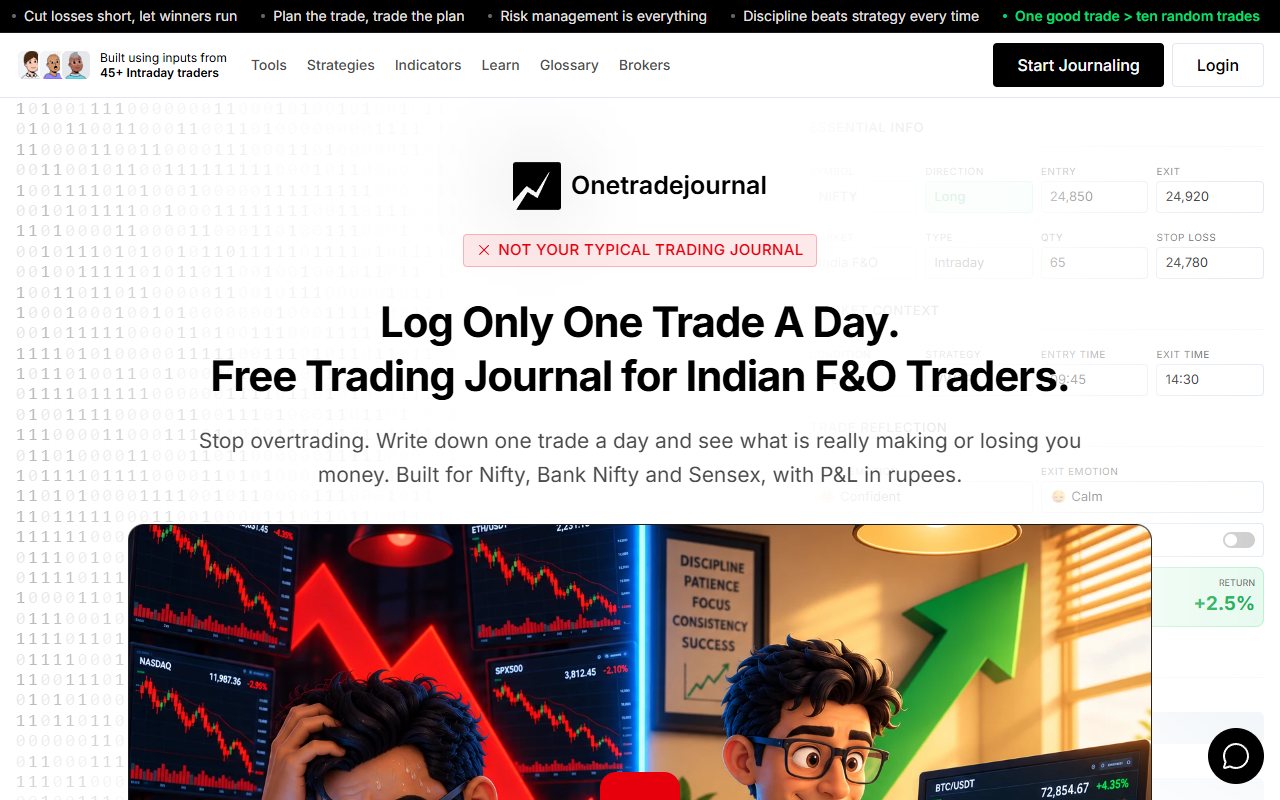
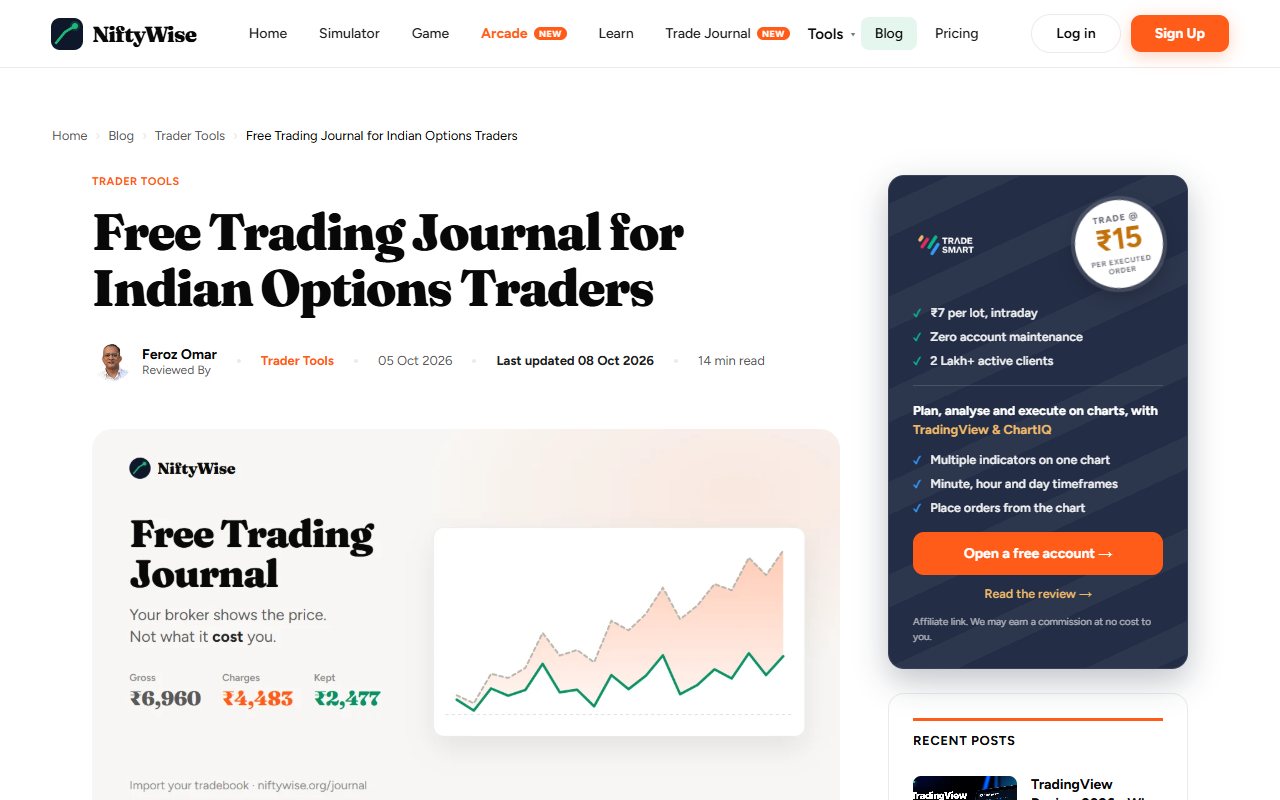
The NiftyWise guide says it stores fills against an account, does not keep the CSV itself and does not ask for broker credentials. These are the provider's statements. We have not audited storage, deletion or access controls. A manual OneTradeJournal record also contains private information. Prices, screenshots and notes can reveal more than you expect. AI review uses the context you provide. Manual entry by itself does not prove that one service is more secure than another. Share only what you need for the review. Check a picture for account details before adding it. Read current policies if storage or deletion is part of your choice. Ask the provider about anything the public wording leaves unclear. The website image on this page shows a public guide. It is not a picture of a private account test. The diagrams explain the choice between records. They do not show real trades, live software results or a partnership between the brands. ## Choose the daily reason and the wider history you need
Choose OTJ when you want to write one daily trade and notice the feeling behind an anxious exit or rushed recovery entry. Keep the original reason while it is fresh, then read it before repeating the same urge. A planned loss and an impulsive winner both deserve an honest note. Consider NiftyWise when your first task is to build an options history from a file. Its published free allowance and fill-matching approach are relevant to that need. Confirm the current account access and test a small sample before relying on the totals. You may keep a file-based history and a selected reflection journal. If so, make their roles clear. Use broker records for the full account, and personal notes for the reasons only you can supply. Choose the daily writing routine you will keep. OTJ's emotion prompts and NiftyWise's notes/tags both need your own reason. Keep the full broker history separate from selected reflection entries, and check imported numbers before trusting reports. Neither tool promises profit.
Sources and limits
We checked these public product pages and OneTradeJournal’s current product on 12 October 2026. We did not test a private NiftyWise account, broker import, payment or AI answer. Check current plans and limits before paying.
- NiftyWise official free options journal guide, 5 October 2026 · Checked 12 October 2026
A journal cannot promise trading profits. AI answers and fee estimates can be wrong. Check trades and charges against broker records. This page does not give trading, investment or tax advice. Competitor names and website pictures do not imply a partnership or endorsement. Any example is an explanation, not a private account screenshot or a real customer result.