The detailed comparison
A closer look at the daily routine, the tools and the limits of each product.
Choose a section
Preserve the reason you would rather leave out
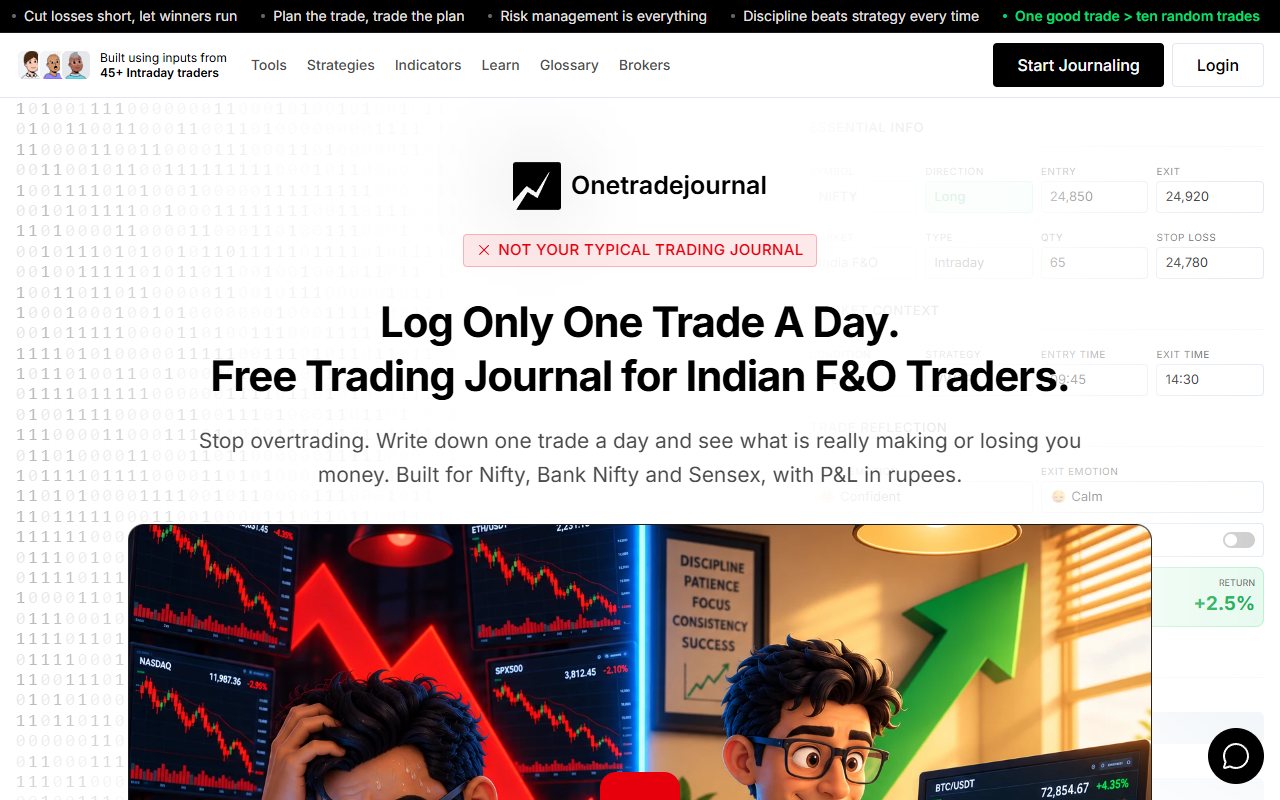
The Zerodha tradebook has every fill, including the larger afternoon entry after a loss. Your daily note needs one extra sentence: you wanted the day to turn green. That sentence matters even if the recovery worked. OTJ makes one planned trade the focus of a daily manual reflection. Write the contract, risk and reason yourself, then name any urge or rule change. The pause is deliberate. It is meant to help you recognise overtrading and repeated costly mistakes without making a profit promise. Free allows one trade per day per market and includes Behaviour analytics. Paid plans permit more entries. The daily focus is a voluntary habit, not a broker order cap. A learning note must not hide other activity from the full financial record. PaisaTools is a meaningful free alternative. Its journal has manual records, Indian broker files, reports and a notes/emotion field, with no required signup. It can hold personal reasons too. OTJ's case is the daily practice and separate prompts, rather than an assumption that you must pay to reflect. ## Keep the afternoon recovery reason beside the trade
Imagine a Zerodha trader importing a month that contains careful morning setups and several hurried afternoon recovery attempts. This example is made-up and makes no claim about a tested importer or real customer. The fill history may reveal that afternoon results deserve attention. It cannot, by itself, show that every afternoon loss was caused by revenge trading. Some trades may have followed the plan and simply lost. Others may have broken the plan while making money. The trader needs context to separate those cases. The app includes a notes/feeling input on its journal form, so a person who writes clear notes can save that reason. It would be unfair to say the product cannot record feelings. OTJ provides more distinct places to put the reason. A planned stop and target describe the intention. Entry confidence and stress record part of the state at entry. A plan change and impulse reason describe a changed choice. Exit feeling and satisfaction capture how the position ended. Suppose the trader writes, “I doubled size after the morning loss because I wanted the day to recover.” That statement gives the review an observable action. It is more useful than assuming the trade was bad because its P&L was negative. After several sessions recorded consistently, the trader can compare choices that followed the plan with choices driven by recovery. The goal is to identify a routine to change, rather than use one month's statistics as a guarantee about future results. Free Behaviour analytics in OTJ helps you return to recorded emotions and habits. Read the underlying note before naming a pattern. Paid AI behaviour review is separate. The saved recovery urge may be a useful repeat to watch, but it does not prove that one feeling caused every loss. Make the daily entry short enough to keep even after a tiring session. Preserve the original stop, what changed and why. A profitable result does not excuse increasing size without the plan. Neither manual writing nor a review flag blocks the next order at the broker. ## The stop is more useful before the result
Both journals can show risk multiples when you supply the needed stop. The app's reports FAQ makes the stop condition explicit. OTJ also needs a valid planned stop. A risk multiple, or R, compares the result with the risk you planned to take. The important habit is deciding what the stop represents. A stop added after the result can give you a neat number. It may not show the risk you accepted when you entered. In a made-up Bank Nifty trade, a recorded entry, planned stop and quantity can save the intended loss exposure. If the trader later widens the stop, the journal should also explain that choice. A final P&L alone cannot show the change. OTJ's plan change, mistake and notes fields help keep that event attached to the relevant trade. They do not enforce the original stop at the broker. The product has no order placement, position-closing function or execution block. Likewise, a rising equity curve does not automatically prove good risk choices. A few unusually large winners can hide repeated plan changes. Review the entries behind the chart and use the recorded plan to distinguish good process from an outcome that happened to be favorable. ## A broker file is a valuable starting point
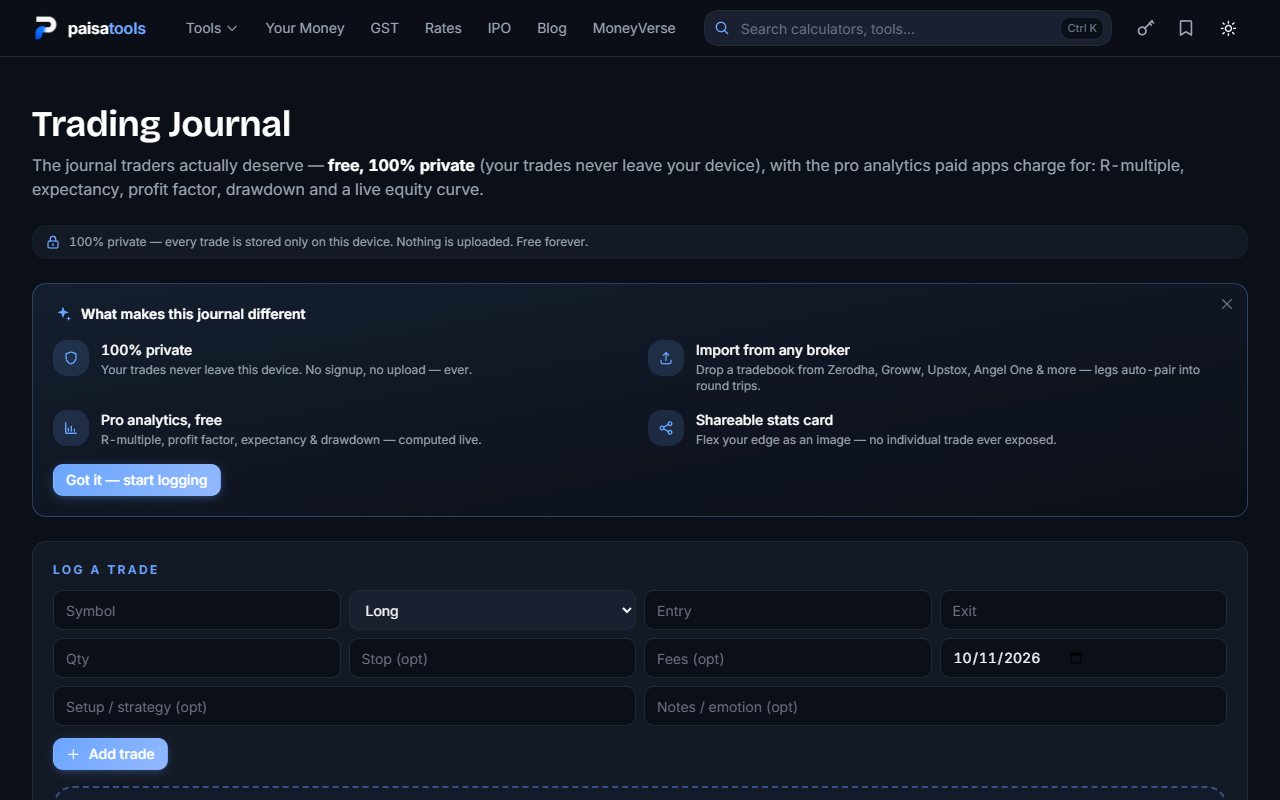
The import FAQ lists Zerodha, Groww, Upstox, Angel One, Dhan and FYERS tradebook files. It says the app finds the right columns and pairs buys with sells. It uses FIFO, or first in, first out. That means an earlier buy is paired first when a sale is recorded. It also accepts pasted spreadsheet rows. This is a file workflow. The broker name in the list does not imply that the app is continuously connected to the trading account. The trader obtains the report and supplies it to the journal. OTJ does not offer this route. It has no broker sync or CSV import, and it cannot promise bulk migration from a PaisaTools export. Its export options are useful for taking saved records out, rather than bringing a large existing history in. For a trader with hundreds of past fills, that difference is large. A supported import can provide a faster starting dataset for review. Typing the same history into OTJ would require time that may be better spent examining a few useful examples. PaisaTools is useful when collecting an existing tradebook takes time. OTJ makes writing a new entry the beginning of reflection. Both can keep a note, and raw executions alone do not establish a motive. Check which routine you will use honestly, rather than only which collects the first numbers fastest. ## Local by default has a practical meaning
The journal page says records stay on the device. Its privacy policy adds a key detail. Journal records stay in the browser unless you turn on optional account sync. The policy describes encrypting data on the device before that sync. Records stay local by default, according to the policy. Optional sync is a stated exception. The journal headline says nothing is uploaded. That should not be read as a promise for every setting. We did not test storage, encryption or network traffic. For the reader, the important issue is continuity. Know which browser and device hold the records, whether optional sync is active, and how exports are kept. You still need a copy if you replace the device or clear browser data. The privacy policy says clearing browser storage can erase data. The account page now also lists journal sync. It warns that it cannot recover a lost passphrase. These are public descriptions; we did not sign in or test recovery. Before a major browser cleanup, verify that any needed records have a usable copy. A saved export should be opened and checked, rather than assumed complete because a download button was clicked. The journal FAQ offers CSV export. CSV is a table file you can open in a spreadsheet. OTJ can also export CSV, JSON data and a TXT text report of entered records. Use those for periodic copies and for reviewing what detail is preserved outside the app. This does not show that OTJ is more secure than the app. Different storage approaches should be judged by the user's workflow and the evidence available. ## Test the contract you actually trade
An importer that reads a broker file still needs to record the right contract. For Indian F&O, check the contract name, quantity and expiry. Also check how partial order fills are grouped. Reading the right column is only the first step. The public pages list Indian broker files. They do not show checked results for every option, future or commodity contract. This is an evidence limit. It does not prove those contracts are unsupported. Try a few trades whose details you know. Start with a simple equity round trip. Then inspect one actual F&O trade and any scale-in or partial-exit position that matters to your routine. Compare quantities, grouping and result with the broker report before trusting a whole historical sample. OTJ gives Indian traders dedicated Nifty, Bank Nifty, Sensex and stock/F&O entry fields, an expiry picker and lot hints. The manual form makes the contract explicit, but it still depends on the trader entering accurate details. Its brokerage and other required charges are estimates. Neither a calculated import result nor an OTJ estimate replaces the actual contract note. If the figures disagree, first match the trade values. A habit review becomes clearer when the underlying trade record is settled. ## AI should solve a review question
OTJ's paid Ask Your Journal, Trading Mentor with chart screenshot analysis and pattern feedback can help a trader organize a review. They are most useful when the records already contain enough context to ask a specific question. For example, a trader might ask which recorded exits departed from the target during high-stress sessions. A useful answer would help locate those records and suggest details to inspect. It should not be treated as proof that stress caused every early exit. OTJ's exit-efficiency measure compares the entered exit with the logged target. It is not a reconstruction of historical option prices or true maximum favorable and adverse excursion. A chart screenshot is also not a backtesting engine; OTJ has no market replay. The privacy policy lists optional AI in other money tools and games. That does not show equivalent AI chat inside the trading journal. It also means a claim that the app has no AI anywhere would be wrong. The buying question is whether in-app discussion of your journal helps you act on the record. AI can be mistaken and cannot see unrecorded trades. If a clear note and a weekly manual review already answer the question, paying for another way to phrase it may add little. ## Price the habit you will keep
The app is free, according to its journal page. OTJ's continuing free plan allows one trade per day per market. This is a daily allowance, not unlimited logging and not a temporary trial of every paid feature. The Indian OTJ plans cost ₹499 monthly, ₹1,299 quarterly and ₹3,499 yearly. OTJ cannot claim to be cheaper than a free journal. Choose it for the daily practice and questions you intend to use. Behaviour analytics is free within the entry cap; extra daily entries and AI or voice tools are paid. Think about a normal active day. If you take several F&O trades and want all of them in OTJ, the free allowance may not fit. Logging only one selected trade would leave a partial sample, so its statistics should not be presented as the complete trading account. Paid voice assistance can help populate OTJ's manual form, but each value still needs checking. It reduces some typing; it does not create an automatic import pipeline. Choose a few fields that matter to your current mistake. If separate feelings, impulse, plan change and satisfaction help make the choice clear, OTJ provides a useful free structure within its daily cap. If symbol, prices, stop, setup and a short note are sufficient, the app's free approach has a strong case. ## Choose the daily practice and keep a copy of it
OTJ fits an Indian F&O trader who wants to write the uncomfortable reason behind a recovery entry or a moved stop. Its planned-trade routine and free Behaviour review help you return to those moments. Paid access permits more entries and optional limited AI tools, but paying is not required to begin reflection. PaisaTools is worth checking for free broker files, manual notes and clear reports. Its notes/emotion field can support an honest daily habit too. Keep the contract grouping checked and understand which browser holds the data or whether optional account sync is on. Use a trade you already took for the first note. Write the rule, action and reason in simple words. There is no need to force a trade to keep the diary going. A planned trade can still lose, and a lucky recovery can still break the rule. At the next review, read a repeat you want to recognise, then check that the record and its notes remain recoverable. Exported numbers alone may not preserve every useful piece of context, so inspect the copy. Keep the full broker statement when the daily note is a selected example. The aim is to learn from a recurring mistake, without claiming that a journal can diagnose it or guarantee the money a changed decision would save.
Sources and limits
We checked these public product pages and OneTradeJournal’s current product on 12 October 2026. We did not test a private PaisaTools Trading Journal account, broker import, payment or AI answer. Check current plans and limits before paying.
- Free journal, file imports and CSV export · Checked 12 October 2026
- Local records, optional sync and AI policy · Checked 12 October 2026
- About PaisaTools · Checked 12 October 2026
- Optional journal sync and passphrase warning · Checked 12 October 2026
A journal cannot promise trading profits. AI answers and fee estimates can be wrong. Check trades and charges against broker records. This page does not give trading, investment or tax advice. Competitor names and website pictures do not imply a partnership or endorsement. Any example is an explanation, not a private account screenshot or a real customer result.