
The detailed comparison
A closer look at the daily routine, the tools and the limits of each product.
Choose a section
Write the reason before a daily profit goal takes over
The last trade of a day can have a different reason from the first. You may begin with a planned setup, then enter again because the total has not reached the number you wanted. OneTradeJournal's daily writing habit gives that change a place in the record. Write one actual trade, its plan and the feeling behind the action. The purpose is to recognise repeated urges and avoid overlooking costly mistakes. Your entry confidence, exit worry and desire for another attempt need not be one mood for the day. Free behaviour analytics help you return to the recorded context. They cannot enforce a broker loss limit or promise that fewer entries will make money. Angel One already describes reflection tools. Its Trading Insights guide lists daily text notes, chart points and filters alongside stock and futures-and-options reports. The guide remains dated 3 October 2025. Check current account access; this review does not certify the signed-in screen or a separate charge. A clear Angel One daily note may hold the whole story. OTJ adds deliberate manual questions when you keep losing the difference between a planned trade and a late urge. It complements Angel One's brokerage account. Keep the broker for execution, actual charges and official records. ## Keep entry confidence separate from exit worry
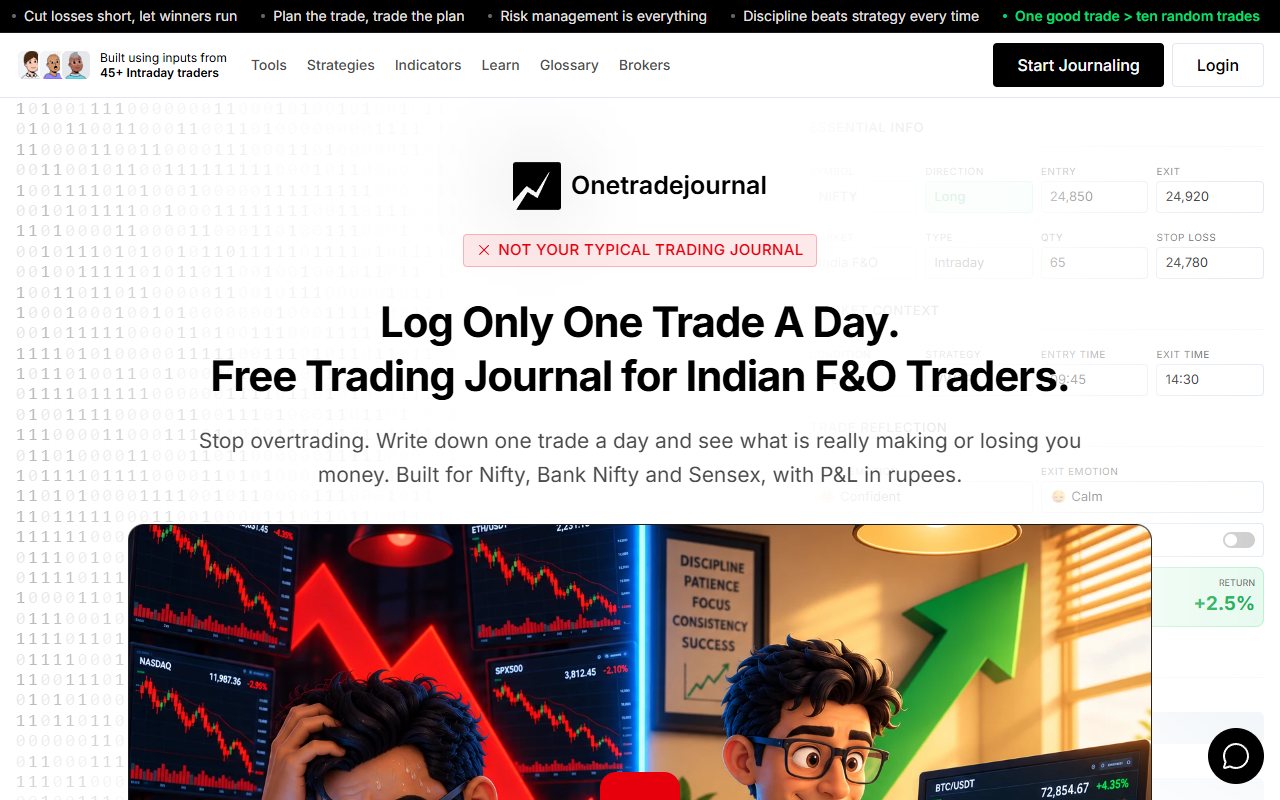
A daily note is a useful place to describe the session. It can keep the market context, the ideas considered and the moments that mattered. A careful writer may explain every important choice in that one note. The difficulty is a note that gives the whole day one feeling. An opening entry may be calm, its exit anxious and a later entry rushed. Calling the day “stressed” loses the order of those changes. OTJ asks about entry and exit feelings separately. It also keeps the planned stop, target, strategy, confidence, stress and a change from the plan. A note can explain what did not fit those fields. For example, confidence before entry and fear near exit can both be honest. An average feeling for the day hides that difference. The review question is whether something in the setup changed or the feeling alone changed the action. This is a reason to consider separate trade questions, not proof that a daily note is weak. You can write the same sequence clearly in Angel One's daily note. The extra form is useful only if it helps preserve detail you otherwise miss. ## A made-up Bank Nifty session
Imagine three Bank Nifty option entries. The first follows the planned entry condition and loses at the stop. The second follows another planned condition and wins. The third is taken late because the trader wants to reach a particular daily profit number. This is a made-up review example, not a customer result or a suggestion to trade a contract. It shows how one day can contain different decisions even when the final total looks acceptable. The broker's account records help locate the entries and results. A daily note can describe the sequence. OTJ can give each selected entry a separate plan and feeling record, if the trader completes it. The third entry needs a reason of its own. Was there a new setup, or was the daily number the real trigger? Keep that question even if the trade makes money. The result does not restore a missing planned condition. A planned loss may deserve a different lesson from an unplanned win. Without a clear reason, you may try to remove ordinary losing outcomes while overlooking the choices that happened to be rewarded. There is a limit to the extra record. OTJ Free allows one trade a day in each market. It cannot hold all three Indian-market trades separately that day. Paid access adds entries, but all the details still need manual input. ## Filters help you choose a smaller group
The published Trading Insights guide lists filters by hour, weekday, index or stock and holding duration. Holding duration means how long a trade stayed open. It also describes custom date periods. These filters may help find entries worth reading. A weak hour does not prove that the clock caused the loss. The group could include a different setup, a larger quantity or more hurried entries. Consider a made-up review of very short trades. Some may follow a plan for a quick exit. Others may be nervous exits from a position that was meant to last longer. A short holding time can therefore describe two different decisions. Keep the intended plan with the result. If the intended hold was longer, say what changed. If the quick exit was planned, say that too. Do not force every short trade into a “mistake” group. OTJ has reports by strategy and time for logged trades. Its extra fields can help keep these reasons separate. The reports still cover only the record you supplied. They cannot create missing context or prove a cause. Read exceptions before writing a new rule. A small group of similar-looking outcomes may not be enough to support a firm conclusion. The note often explains why one trade differs from the others. ## Use the chart for the question it can answer
The Angel One guide describes viewing entry and exit points on charts from the daily trade view. This is useful published support for a timing review. Check its current availability in your account. A chart can help you see where the recorded order occurred. For example, was the entry after the price had already moved beyond the original setup area? A pair of typed entry and exit numbers may not show that clearly. OTJ can keep a chart link in the record. Paid Trading Mentor can discuss a supplied chart picture. You must provide the evidence and check the answer. It is not an automatic history of every price reached during the trade. OTJ has no historical market replay or backtesting. Backtesting means trying a strategy against old market data. Its exit measure compares your exit with the target you recorded. It does not identify the best possible historical exit. Use the broker chart to inspect timing and a timely note to explain the reason. A picture alone cannot tell you what the trader intended before entry. A remembered reason alone may not locate the correct order. ## Practise the pause of writing it yourself
OTJ has no Angel One sync or CSV import. CSV is a common spreadsheet file format. Even a downloaded broker file does not create a supported transfer into OTJ. Paid voice help can fill parts of the form. It does not retrieve the account history or check the actual order. The trader still confirms the contract, quantity, prices and explanation. Writing the entry yourself is deliberate. It is a moment to separate what you intended from what you did. Keep it short enough to repeat while the reason is fresh. Several fills may belong to one position; a fill is one completed part of an order. Keep that meaning honest rather than using a tidy count to hide the late trade. Choose what one journal entry represents before comparing days. A position entered in stages should not become one trade on winning days and several on losing days just to improve the count. Keep the grouping honest. OTJ can apply the same questions to manual entries from Angel One and another broker. That gives you a common way to write the reasons. It does not produce a combined account report or fill omitted trades. For Indian options, record type, strike and expiry. Strike is the option's contract price level; expiry is its end date. A suggested value or remembered index name does not confirm the actual contract. Check the broker record. ## Keep the broker files with your explanation
Angel One's Trade History help page says the record includes transaction details and corresponding charges, with date, type and segment. We checked that public description. We did not test a private download. Its public report directory lists P&L Summary, Trades and Charges, Ledger, Contract Note and Tax P&L. These are account documents. A journal file does not replace them. OTJ downloads recorded journal information as CSV, JSON and TXT. JSON is structured text data; TXT is plain text. They can preserve your explanation for a later review. Another app may not accept every field. If the financial totals differ, first compare periods, quantities, prices and costs. OTJ estimates charges from entered details. The broker's documents remain the place to check actual money amounts. Keep enough detail to match the note with the correct trade. A clear date and contract can help you find the right explanation months later. That is useful record keeping, rather than proof that the journal checked the account. ## Start the daily habit before buying extra tools
OTJ's ongoing free allowance has no trial clock. It holds one trade a day in each market. If your normal session has several Indian-market decisions, that limit is part of the choice. The current India paid plans cost ₹499 a month, ₹1,299 for three months or ₹3,499 a year. Paid access adds entries and tools such as voice help, journal chat and chart-image review. AI has usage limits and can give wrong answers. The cited Angel One pages do not state a separate Trading Insights price or daily note cap. This comparison does not guess those terms. Nor does it claim OTJ is cheaper. Ordinary OTJ behaviour analytics are free. You can compare recorded feelings, stress, confidence and habits without buying an AI review. Paid AI and voice tools have separate limits. Decide whether you will use those tools rather than assuming psychology review itself needs a subscription. Try a clear entry within the free allowance. At the next review, check whether you used it. If your daily Angel One note already keeps the same detail and is easy to find, another record may add little. ## Return to the note before repeating the late entry
Take a trade you have already made and write its intended condition. Add the actual reason, entry and exit feelings and any changed rule. If the daily profit goal drove the last order, keep that reason visible even if it won. A final total should not replace the story of the decision. Free OTJ behaviour analysis can help you find saved emotions and habits worth reading again. Possible revenge-trade or size-change flags are prompts, not diagnoses. Revenge trading means entering mainly to recover a loss. You still choose the next order in Angel One. At the next review, compare similar entries. Read planned losses and rushed wins with equal care. A small group of notes cannot prove a feeling caused the result, but it can leave you with a clearer habit to watch. Angel One's published notes, chart points and filters deserve credit. Confirm current access and use them when they support your daily reflection. Choose OTJ when writing the trade yourself and answering separate questions makes that routine easier to keep, including manually recorded trades from another broker. Free allows one entry per day per market; paid plans allow more. The daily habit is not a reason to force an order or hide other activity. Keep the full broker record and label a selected journal sample honestly. OTJ can help you review the personal reason, while Angel One remains the brokerage account and financial record.
Sources and limits
We checked these public product pages and OneTradeJournal’s current product on 12 October 2026. We did not test a private Angel One Trading Insights account, broker import, payment or AI answer. Check current plans and limits before paying.
- Angel One's published notes and filters · Checked 12 October 2026
- What the Trade History report contains · Checked 12 October 2026
- Angel One's report directory · Checked 12 October 2026
- OTJ journal features · Checked 12 October 2026
- OTJ paid plans · Checked 12 October 2026
A journal cannot promise trading profits. AI answers and fee estimates can be wrong. Check trades and charges against broker records. This page does not give trading, investment or tax advice. Competitor names and website pictures do not imply a partnership or endorsement. Any example is an explanation, not a private account screenshot or a real customer result.