
The detailed comparison
A closer look at the daily routine, the tools and the limits of each product.
Choose a section
Keep the feeling at exit in the daily note
Closing a small gain can feel like relief after an earlier loss. Later, you may forget that worry changed the exit plan. OneTradeJournal's daily habit is built around preserving that moment: write one planned trade, the rule you meant to follow and the feeling that influenced the actual exit. The aim is to recognise costly habits you keep repeating, without pretending every early exit is wrong. Your daily record separates entry and exit feelings, stress, confidence and changes to the plan. Ordinary behaviour analytics are free. They help you read the saved entries, while paid AI review is a separate tool with limits. Dhan also promotes thoughts, observations and highlights in Trader's Diary. Give those notes a fair place in your routine. A reason written inside Dhan may already preserve the memory you need. OTJ adds a deliberate manual form when separate questions help you write it more clearly. Keep using Dhan as your brokerage account. OTJ complements its execution tools and reports. It cannot place an order or replace the ledger and contract notes. The personal note explains your choice; the broker record checks what happened to the trade and money. ## Look closely at one early Sensex exit
Here is a made-up example. A trader buys a Sensex put after their planned entry condition appears. A put is an option contract. The trader has a stop, a target and an intended quantity. After a small move in their favour, the trader closes the position. The reason is worry about losing the small gain. The planned exit condition has not arrived. This is an example for review, not an account result or a suggestion to buy a contract. The broker records show what was bought and sold. The later Diary result helps find the closed trade. The review question is why the plan changed. Did new information matter, or did the feeling alone drive the exit? In OTJ, the trader can keep the target, exit price, exit reason and exit feeling in separate fields. A note can say whether the entry idea had changed. This gives the next review more detail than a label such as “bad exit.”
On another day, a similar early exit may follow real new information. The result might look the same, but the reason is different. Keep that difference visible. A journal should help you question the choice rather than label every early exit as wrong. OTJ's exit measure compares the recorded exit with the target you entered. It does not replay every price the contract reached. A low score does not prove that the trader could have achieved the best later price. ## Record the reason before later events change it
Dhan's update guide says Trader's Diary refreshes daily at 9:00 AM. Today's closed trades appear the next morning. It directs customers to the order book or trade history for current details before that update. A review can therefore have two moments. At the first, write what you knew when you acted. At the second, check the processed result. The result does not have to be ready before you preserve the reason. Suppose you exit a Nifty option when your written stop is reached. A later price move goes in the direction you first expected. The exit may then feel like a mistake. But the later move was not known when you made the decision. A short note written at exit can keep that difference clear. It may say that the stop was reached and the planned rule was followed. A later review can still question whether that rule needs more study. It should not quietly change the original reason. OTJ can keep a manually entered explanation without waiting for the Diary report. Dhan also promotes recording thoughts, observations and highlights. We did not test the exact timing or fields of those notes. The comparison does not claim that Dhan customers must wait until morning to write anything. ## Recognise the urge without guessing its cause
A weekly review can start with a day selected in Trader's Diary. Then read your explanations in the order the decisions occurred. An early loss may matter to the later feeling, but it is not proof that every later trade was a revenge trade. Free OTJ behaviour analytics compare the feelings, stress, confidence and habits in the logged sample. Missing or guessed notes weaken that review. Revenge trading means entering mainly to recover a loss. OTJ can flag possible patterns such as this, large quantity changes or too many trades. A flag is a prompt to inspect the record. It is not a diagnosis and cannot block a Dhan order. A made-up review might find that the third entry often comes after the original plan is complete. Ask why that entry happened. Was there a new planned setup, worry about the day's result or boredom while watching prices? Those reasons deserve different notes. Keeping them separate can make the next question clearer. A count of third trades alone cannot explain them. The quantity, contract and market conditions may also differ. Paid Ask Your Journal or Trading Mentor may help with a focused question or chart picture. Check the answer against your record. AI cannot know the trades you left out. The cited Dhan pages do not settle all AI tools in its wider platform, so no wider absence is claimed. ## Make manual reflection part of the day
OTJ has no Dhan sync and no CSV import. CSV is a common spreadsheet file format. Each trade you choose to keep needs manual details. Paid voice help can fill the form, but cannot retrieve or check your Dhan history. Writing the trade yourself is deliberate. It creates a moment to separate the plan from the reason you acted. Keep that moment short enough to repeat while the memory is fresh. If you took other trades, keep their broker records and avoid calling the selected daily note a complete account history. Start with the facts that identify the decision. Keep the contract, quantity, entry, exit and the rule you meant to follow. Then explain what changed. Long notes are useful when they answer a question. Vague extra words can hide the point. For example, “I was worried because the previous trade lost” is clearer than “psychology was bad.” It names the event and the feeling. You can later look for the same situation in other entries. OTJ has Indian option type, strike and expiry fields. Strike is the option's contract price level. Expiry is its end date. Check the actual contract and quantity. Similar names can describe different contracts, so a remembered index name alone is not enough. If you trade through Dhan and another broker, the same OTJ questions can cover both. That is a manual common record, not a complete account link. Missing trades remain missing until you enter them. ## Check the Dhan report after writing the reason
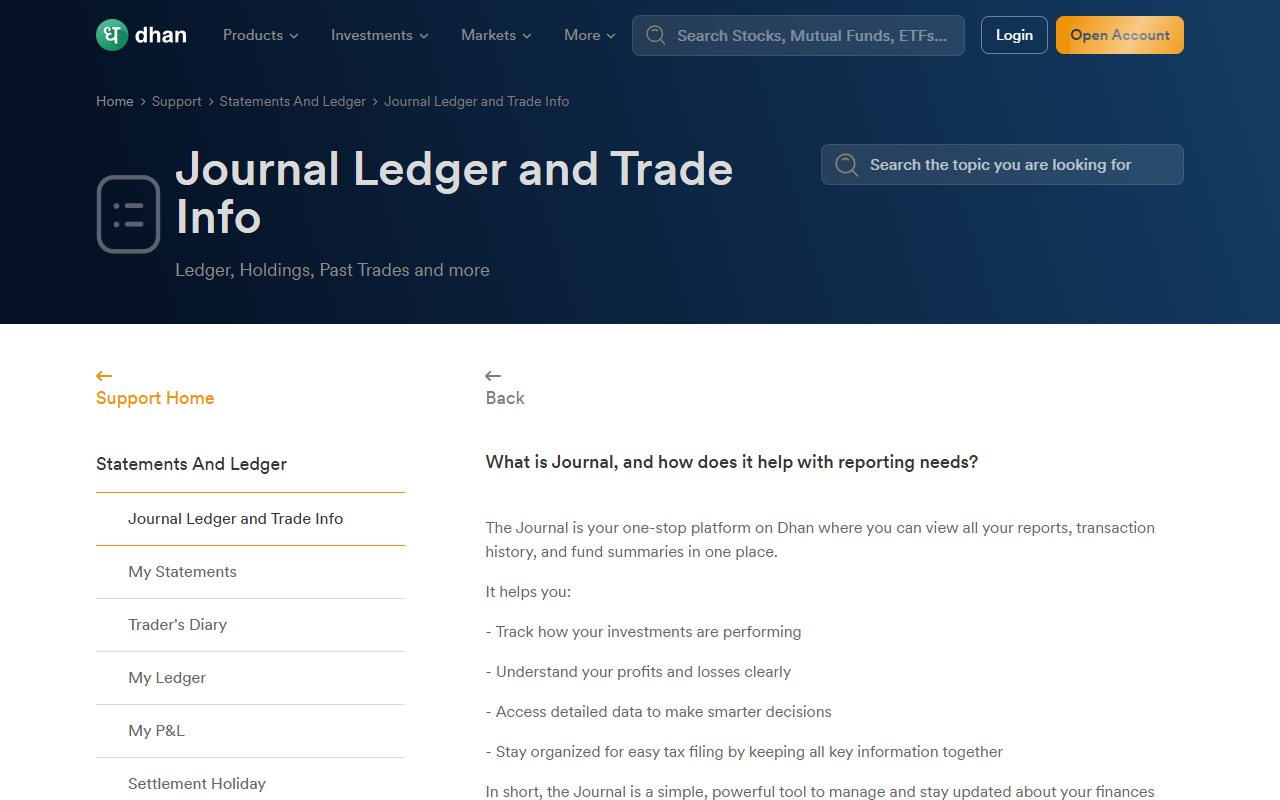
Dhan Journal and Trader's Diary are related account tools, but their names can lead to different expectations. The Journal help page describes reports, transaction history and fund summaries in one place. This is useful when you need to check the account. The Trader's Diary guide describes a visual record of past trades and profit and loss. It offers daily, monthly and custom views of up to three months. The tools save a Dhan customer from rebuilding the account story by hand. Dhan's Diary guide separates gross realised P&L, net realised P&L and charges. P&L means profit and loss. Gross is before charges; net reflects the adjustments listed for that view. Realised refers to the result of closed positions. The guide says Diary P&L covers closed positions and speculative trades, not open positions. Speculative is the term used in that report's calculation description. Its buy and sell values include open and closed positions. Those figures therefore do not all have the same scope. The cost-exclusion guide lists some interest, share-account fees, broker square-off charges and penalties outside the Diary total. Square-off means closing a position. Dhan says these costs appear separately in the ledger or contract note. This is a reason to read the right broker records. It is not evidence that a manual journal has the complete cost picture. An OTJ entry cannot discover an account fee that you never entered. OTJ estimates Indian trade charges for review. Compare the selected period, quantity and costs with the broker documents before deciding that a difference is an error. An attractive net-result chart is still only as complete as the information behind it. ## Start the daily habit within the real allowance
OTJ Free continues without a trial end date. It permits one trade a day in each market. Several Indian-market trades on one day cannot all be kept as separate entries within that limit. You can still use the allowance to try one clear explanation. Treat the result as a sample of your writing routine. Do not omit difficult trades and then read the sample as the full account's performance. Current Indian paid prices are ₹499 a month, ₹1,299 for three months or ₹3,499 a year. Paid access adds entries and tools such as voice help and AI review. AI has usage limits and its responses can be wrong. The cited Dhan Journal and Diary pages do not set out a separate journal subscription price. This page does not guess one or claim OTJ costs less. If your existing Dhan routine meets the need, keeping one record may be the sensible choice. Judge the routine by a reason you keep forgetting. Can you still explain the early exit when you read the note next week? More screens are not the aim. A short, honest account of the feeling is something you can return to. ## Keep one clear lesson for the next review
After reading the entries, name something you can observe. One example is writing the entry condition before making a second attempt at the same idea. This is a record habit, not a guaranteed profitable rule. At the next review, look for that written condition. Did it exist before the order, or was it added afterward? An honest missing note can be more useful than an impressive explanation written after the outcome is known. Dhan's account tools remain valuable for the processed trade and money records. Its thought notes may already support a daily reflection. Add OTJ when writing the trade yourself and using free behaviour review makes that habit easier to keep. The goal is to notice the worry or urge that keeps changing your plan, not to collect a different badge for the same result. OTJ can download journal information as CSV, JSON or TXT. JSON is structured text; TXT is plain text. These files can keep your explanation for later. They are not broker statements or certified tax reports. For the trader in the Sensex example, the useful gain is a clearer reason for the exit. Keep that reason while it is fresh, then check the broker's result. A journal works through that careful review, not through a promise that a chart or AI reply will improve returns.
Sources and limits
We checked these public product pages and OneTradeJournal’s current product on 12 October 2026. We did not test a private Dhan Journal / Trader's Diary account, broker import, payment or AI answer. Check current plans and limits before paying.
- What Dhan Journal contains · Checked 12 October 2026
- How Trader's Diary works · Checked 12 October 2026
- When the Diary refreshes · Checked 12 October 2026
- Dhan's thoughts and observations · Checked 12 October 2026
- Costs outside the Diary · Checked 12 October 2026
- OTJ journal features · Checked 12 October 2026
- OTJ paid plans · Checked 12 October 2026
A journal cannot promise trading profits. AI answers and fee estimates can be wrong. Check trades and charges against broker records. This page does not give trading, investment or tax advice. Competitor names and website pictures do not imply a partnership or endorsement. Any example is an explanation, not a private account screenshot or a real customer result.