The detailed comparison
A closer look at the daily routine, the tools and the limits of each product.
Choose a section
Preserve the fear behind an early exit
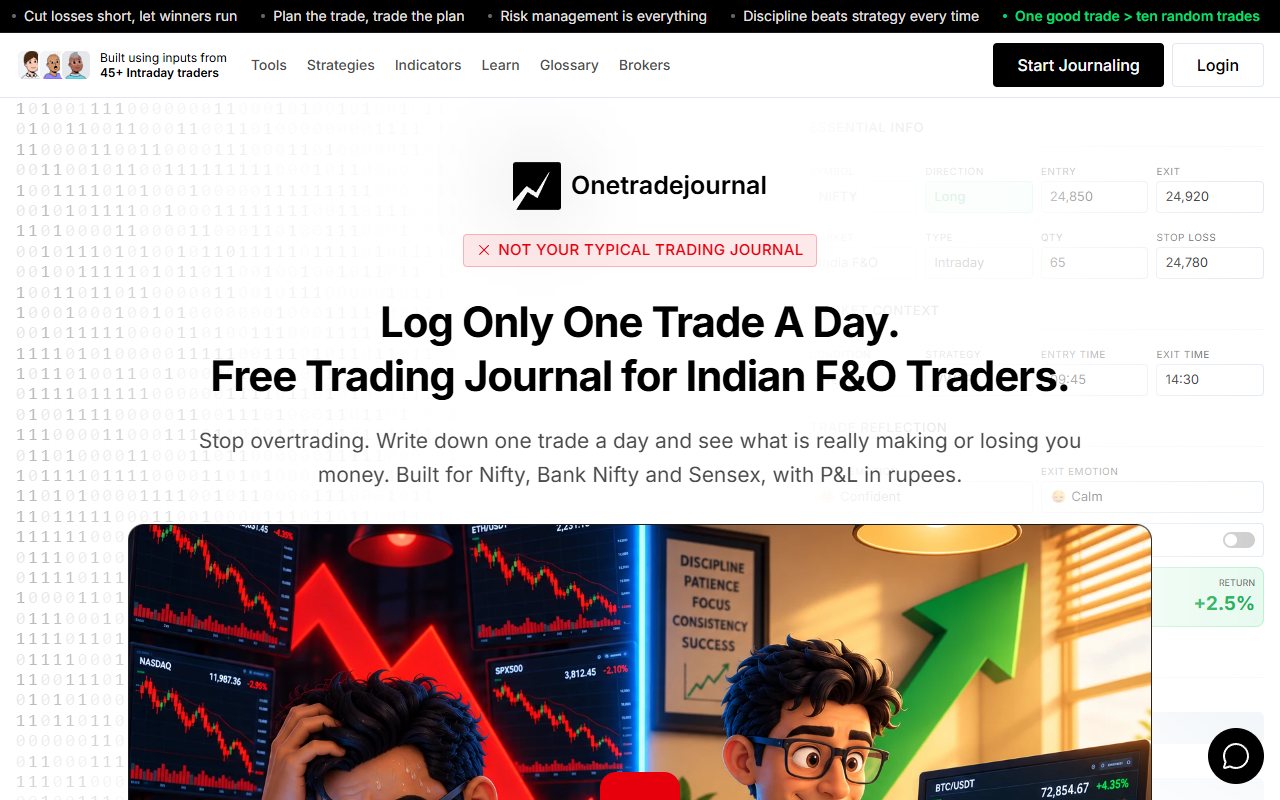
A Nifty call can finish in profit while leaving a difficult question: did you follow the exit plan or leave because the pullback felt worrying? OneTradeJournal's daily habit asks you to write that distinction yourself. Keep one actual trade, its intended condition and the entry or exit feeling while you still remember them. The aim is to recognise repeated choices that can put more capital at risk, not to call every anxious exit wrong. Free behaviour analytics help you read feelings, confidence, stress and plan changes in saved entries. Manual writing is deliberate. It is not a claim that typed records are always better than imported ones. DT Terminal already supports reflection. Its stock journal describes notes, chart images, setup tags and reviews. Edge AI can discuss recorded context. These are real reasons to consider its routine alongside free entry capacity and CSV files. OTJ is useful when separate daily prompts make the emotional reason easier to write and revisit. Free allows one trade per day per market; paid plans add entries. The daily focus is not a verified badge, an enforced trade limit or a promise of profit. Both journals add a review to your broker evidence. Keep the account records that establish the contract and execution. A finished form or reviewed marker cannot prove that you wrote the original intention honestly. ## Write the action and the feeling separately
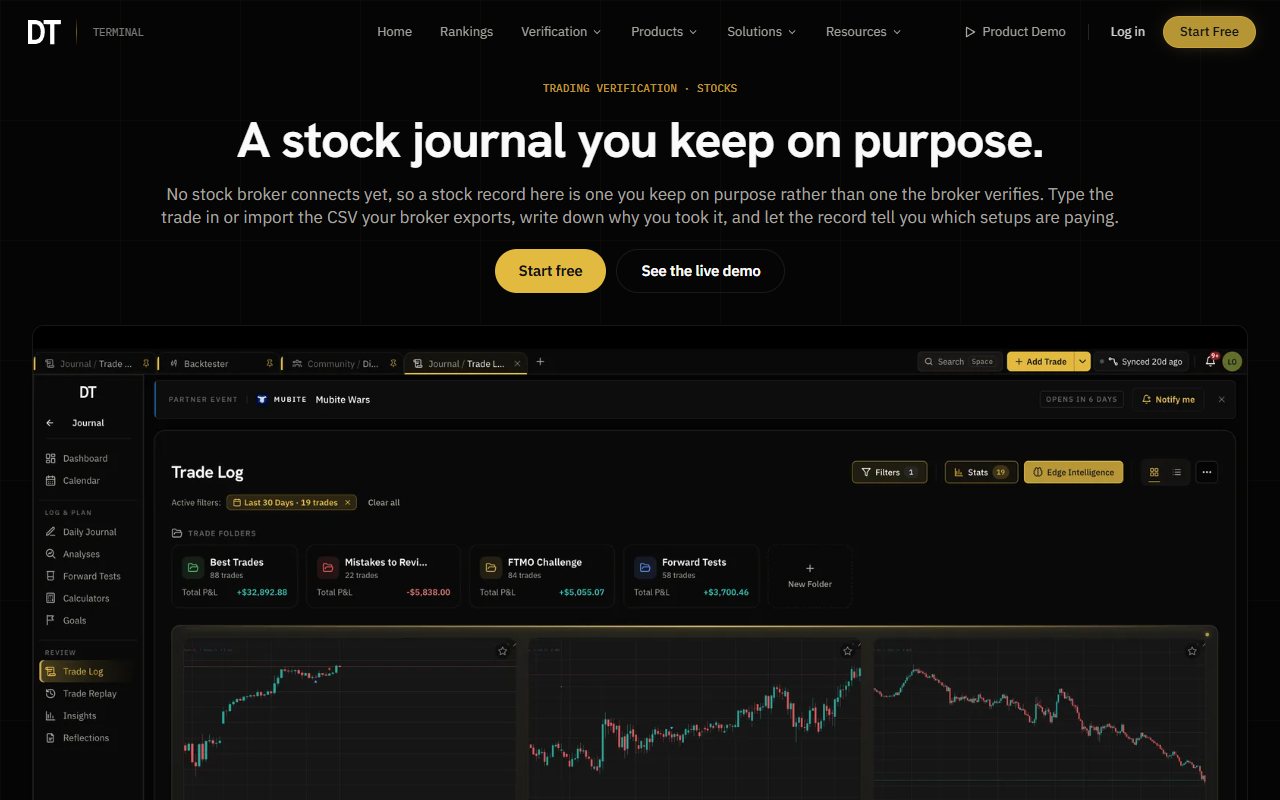
DT Terminal advertises notes, chart images, setup tags and structured reviews. It also marks reviewed trades. That is meaningful support for reflection, rather than only tracking profit and loss. OTJ has separate fields for confidence, stress, entry feelings and exit feelings. It records the planned stop and target, mistakes, changes to the plan and the reason behind an impulse. A reviewed marker answers whether you returned to a trade. A change-to-plan field asks what you did differently. Both are useful. Neither proves you wrote an honest or complete explanation. Imagine moving a stop during a trade. Marking the record reviewed is not enough to explain the move. Filling a stress field is also not enough. A short note should say what changed and what evidence supported it. DT Terminal's notes may already do that well for you. The public pages do not confirm exact matches for every OTJ field. OTJ is worth considering if repeated named questions help you record details you often forget. ## A made-up early exit from a Nifty call
Suppose a trader buys a Nifty call after a planned breakout. A small pullback follows. The trader exits with a profit, then sees the price move further up. This is an example, not an observed trade. The later move does not prove the exit was wrong. Start with what was known at the time. Did the setup fail? Did new evidence change the plan? Or did fear cause an early exit? OTJ can record the original target, exit reason and exit feeling. Confidence and stress at entry are separate. A note can explain whether the trader acted on new information. DT Terminal's notes, chart image and review can preserve the same kind of explanation. Its AI can discuss the recorded context. That is a reason to credit the existing review workflow. OTJ's exit-efficiency measure compares the exit with the target you entered. It does not rebuild every market price during the trade. A target invented after seeing the final chart would weaken the review in either journal. ## Use AI to inspect the note, not invent the reason
DT Terminal's Edge AI reads trades, notes and journals. Its options page says it does not price options or model their changing price sensitivity. It is review help, not an options-pricing engine. The current pricing table lists 20 AI chat messages per month for Free and Verified. Pro advertises unlimited chat. The page separately lists 10 Edge credits on signup for Free and Verified. Credits and chat messages are different allowances. Those are public terms; account usage was not tested. OTJ's ordinary behaviour analytics are free. They compare the emotions, stress, confidence and habits in the logged sample. Paid AI help is separate from those views. OTJ's paid Ask Your Journal and Trading Mentor have use limits. Trading Mentor can review a chart image you provide. AI can be wrong in either service, and it cannot safely reconstruct facts you never recorded. Ask a question tied to a real entry. For example, which exits have a written fear reason? Then read the records behind the answer. A broad request for future profitable trades needs evidence a journal does not supply. AI is therefore not an OTJ exclusive. The useful comparison is the context supplied, the allowance and whether the answer helps you inspect the original decision. ## An options journal is not an options-price terminal
DT Terminal's options page says options are logged by hand or CSV. It explicitly says options brokers do not sync. It also excludes live option chains and detailed option-pricing analysis. An option chain is a list of available contracts and prices. More advanced price tools study how an option reacts to market changes. A journal can record an option without providing those tools. OTJ does not offer a full options-price terminal either. Its strike, call or put type, expiry and contract fields identify a manual trade. They help you preserve what you traded and what you planned. For Nifty options, a similar name is not enough. Two calls with different strikes or expiry dates are different contracts. Check those facts before comparing results or feelings. DT Terminal describes ways to record legs with notes and combine the result of a journey. We did not test that process. Do not assume every Indian broker file or multi-leg position will be read correctly without a sample check. ## A paid Verified tier does not verify every market
DT Terminal is relevant to Indian traders, but the limits matter. Its stock-journal page names Zerodha and Dhan as labels for accounts. It clearly says no stock broker currently connects. A label helps name the account that a record belongs to. It does not fetch an execution from that broker. Do not choose DT Terminal expecting live Zerodha or Dhan sync from those names alone. The stock journal accepts manual entry or CSV files. CSV is a table saved as a text file. That gives it a way to bring in older records which OTJ does not offer. DT Terminal uses a verified seal for trades read from supported broker connections. Its stock and options pages clearly say those manual records are self-reported. That means the user supplied the record. Buying a tier called Verified does not make an unsynced Indian stock trade broker-verified. The data source is the important fact. Its wider connection features cover other supported markets and platforms. OTJ's records are self-entered too. A correct entry can be useful, but OTJ does not independently know whether you included every order or typed each quantity correctly. Exporting the file does not change that. Keep broker tradebooks, contract notes and statements. They give the original execution and money evidence. The journal adds the reason and review. A chart image is useful context but does not replace those records. When comparing accounts, match the dates and trades first. A full broker-read history and a selected manual sample can give different results even if both calculations are correct. ## Free entry capacity is a DT Terminal strength
The stock FAQ lists unlimited logging on one free account. It also lists 50 trades per free CSV import batch. That is a batch allowance, not a total lifetime limit of 50 trades. OTJ free access allows one trade per day per market. It is continuing free access, but several same-market entries need paid access if you want separate records for each. This difference matters for a busy Indian options day. A single selected trade cannot describe all the decisions in the session. Use a small free OTJ sample to test the form, not to claim it represents the full account. DT Terminal's CSV route may save time for a history you already have. Check the format, joined entries and cost fields using a small file. We did not upload or test a file. OTJ has no CSV import at any plan level. More paid entries remain manual entries. If your first task is bringing in years of trades, that limitation should have a large place in the choice. ## The current public prices are clear
DT Terminal's pricing page lists Pro at $24 a month or $199 billed yearly. Verified is $9 a month or $89 billed yearly. The current stock and options pages agree with those monthly prices. These are the published amounts checked on 12 October 2026. We did not test payment or renewal. Read the selected tier's features as well as its price. Free logging is different from all filtered reports. A paid tier can add reporting while leaving an Indian stock trade self-reported. Extra features do not remove the market limits stated on the product pages. OTJ's Indian plans cost ₹499 for a month, ₹1,299 for three months and ₹3,499 for a year. Paid access adds entry capacity and paid tools. It does not add broker sync or imports. Rupee pricing may make budgeting simpler for an Indian user. We do not claim a guaranteed lower checkout cost than a dollar plan. That would depend on current payment terms and currency conversion, which were not tested here. ## Keep studies within the supported market
DT Terminal's stock page says single-stock backtesting is not live. Backtesting means checking an idea on old prices. Its wider study tools cover other named markets, but that does not establish Indian option history. Do not assume a general reference to indices or futures includes your exact Nifty contract and date. Ask about the data needed for your study. We did not run a historical study in DT Terminal. OTJ does not provide backtesting or historical replay. Its charts describe logged trades by strategy and time. They also show win rate, an account-result curve and losses from a peak. A result measured against planned risk needs a valid original stop. Guessed risk inputs can make that comparison unreliable. OTJ's estimated charges also need checking against the actual broker documents. A study of old market prices and a review of a recent anxious exit are different tasks. You may need different tools for them. Choose based on the question instead of assuming a large feature list covers every market. ## Choose the daily reflection, then check its evidence
Start with an actual exit you can explain. Write the original target, the evidence at exit and the feeling at that moment. Do not add a better-looking target after seeing the full chart. At the next review, compare similar notes, including early exits that were sensible and early exits driven by worry. OTJ fits when the deliberate daily record and its free behaviour analytics help you keep returning to that question. Its Indian fields identify a manually entered contract. They do not turn the entry into a broker-verified result, and no flag can block your next order. DT Terminal deserves credit for unlimited free stock logging, CSV batches, notes, reviews and its own AI. Its explicit Indian connection and verification limits make the data source clearer. Confirm the exact contract and file you need rather than treating a broker label or paid tier name as evidence. Free OTJ permits one trade per day per market, while paid plans allow more. Keep all other activity in the full broker record. Its exports preserve your saved explanation, not a certified financial statement. The useful outcome of the routine is an honest note about the fear or new evidence that changed your plan. A few notes can suggest a habit to study. Neither a badge, a chart nor an AI answer proves a profitable next decision.
Sources and limits
We checked these public product pages and OneTradeJournal’s current product on 12 October 2026. We did not test a private DT Terminal account, broker import, payment or AI answer. Check current plans and limits before paying.
- DT Terminal stock journal · Checked 12 October 2026
- DT Terminal options journal · Checked 12 October 2026
- DT Terminal plans · Checked 12 October 2026
- OTJ journal features · Checked 12 October 2026
- OTJ paid plans · Checked 12 October 2026
A journal cannot promise trading profits. AI answers and fee estimates can be wrong. Check trades and charges against broker records. This page does not give trading, investment or tax advice. Competitor names and website pictures do not imply a partnership or endorsement. Any example is an explanation, not a private account screenshot or a real customer result.