The detailed comparison
A closer look at the daily routine, the tools and the limits of each product.
Choose a section
What would you write after an unplanned win? It is easy to forgive a rushed entry when the trade makes money. It is harder to write that you felt pressure to join a move and acted before your rule. That short note can matter more to the next review than a green result. OTJ centres a one-trade daily writing habit. Put the original plan beside the action, then name the feeling and the reason for a change. Manual entry is deliberate. OTJ has no broker sync or file import, so it asks you to supply both the facts and the thought behind them. The daily habit is not an instruction to trade every day. Free allows one trade entry per day per market. Paid plans allow extra entries. Do not hide other trades or call a selected example a complete account review. Hone In's current Apple India listing already offers plan review, psychological tags and results measured against planned risk. OTJ cannot fairly claim those ideas as its own. OTJ's specific approach is a browser form with separate entry and exit feelings, confidence, stress, impulse reason, satisfaction and changes to the plan. Hone In's native Apple app and imported records may suit a different routine. Begin with a planned loss and an unplanned win. Can you explain each without letting the money result rewrite the reason? That is the habit worth comparing. ## A planned loss and an unplanned win
Consider a made-up NSE swing trade. The trader writes the entry rule, stop and target, then closes at the planned stop. The trade loses money. Later, an entry taken outside the rule makes a profit. A money-only review may favor the profitable entry. A process review asks two questions: what happened financially, and did the action follow the intended rule? Neither answer should erase the other. Hone In explicitly describes separating trades that followed the plan from those that did not. OTJ can record changes and mistakes beside the result. Both support this kind of question. OTJ's separate prompts can add detail. The planned loss might show clear confidence and low stress. The unplanned win might show urgency and dissatisfaction with the process. These are possible notes in the example, not assumed facts. Do not call a loss financially successful. Keep the actual result. The useful point is that following a plan and making money are separate observations that deserve separate records. ## Which feeling changed the action? Hone In's current listing includes psychological tags and chart images. Behavioral review already exists there. OTJ should not claim that feelings or plan review are unique to its form. A tag such as FOMO means fear of missing out. It can describe hesitation, a rushed entry or an added quantity. Without the action and timing, the same label can join very different decisions. OTJ has separate entry and exit feelings, stress and confidence. Impulse reason and change-to-plan fields may help preserve what happened. Notes can add the detail behind the label. OTJ's ordinary behaviour analytics are free. They let you revisit recorded feelings, mistakes and changes to the plan. Paid AI behaviour reviews are separate. A few tagged trades do not establish a diagnosis or prove a stable pattern. A careful Hone In note may answer the same questions. Exact matches for each OTJ field are not confirmed by the public description. The advantage is the reminder that works for you, not a claim that another form cannot hold a clear explanation. Keep a chart image connected to its time. A picture saved after closing may show information unavailable at entry. Neither a tag nor an image should replace the original reason. ## Can the risk number change the story? A risk multiple measures the result against the initial planned risk. Often called R, it helps compare trades of different sizes. The definition needs to be stable and the original inputs correct. Hone In's listing defines risk using entry-to-stop distance and position size. OTJ's planned-risk measure also needs a valid stop. Neither number promises that an actual loss cannot exceed the plan. Suppose someone edits the original stop in the journal after a loss. The new risk figure can make the result appear less severe. It no longer describes what was intended at entry. Preserve the original stop and explain an actual adjustment separately. If quantity changes or exits occur in parts, check what the displayed risk refers to. We did not validate Hone In's calculations. Target capture also has a boundary. A comparison with the written target is not a history of the best market price reached. Do not turn a planned target into proof of the best possible exit. ## Indian equity support is explicit
The developer's listing says symbols are typed by hand and can represent Indian equities. That is stronger evidence than simply appearing in India's store. It gives a clear local stock use case. Typed symbols do not prove every Indian option convention is understood. A name can include a strike and expiry without the journal treating them as separate contract fields. Exact derivative parsing was not tested. OTJ has manual strike, call or put type and expiry fields. Its expiry picker and lot hints assist the form. They do not guarantee the contract and quantity are correct. For cash-equity swing trades, the derivative gap may matter little. For repeated option adjustments, it can matter much more. Check a representative contract and any partial exits before choosing a routine. We did not test Hone In's price lookup, Indian broker files or combined positions. Its equity relevance is documented. That should not become a promise of automatic support for every Indian trade. ## Use the current store evidence for access
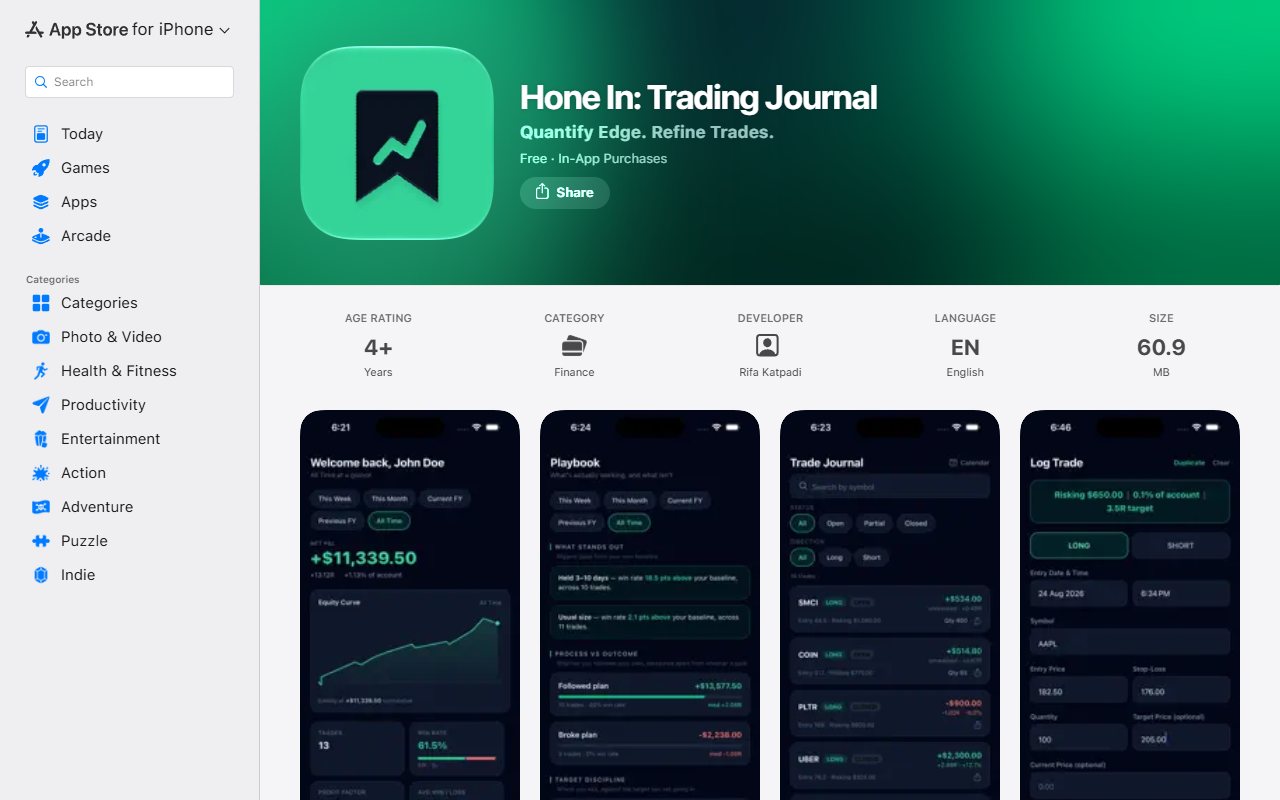
Hone In has a published iPhone and iPad listing. We did not install it or create an account. Store publication is evidence of the offered app, not a certificate that every device can use every feature. The developer website and privacy page could not be rechecked on 12 October 2026. They stopped at browser verification. The current product facts here use the readable developer-published Apple listing. An older website launch notice is not treated as current evidence. Android publication and a full Android subscription offer remain unconfirmed. Check the store on your own device if that platform is essential. OTJ is an installable web app. You use it in a browser and can add it to a home screen where supported. This page does not claim a public native OTJ App Store release. For someone moving between a computer and phone, browser entry may fit. For someone who prefers an Apple app, Hone In deserves attention. Choose based on the access you actually need, not a device image on a landing page. ## A trial and a daily allowance differ
Hone In's current listing advertises one month free. It lists ₹199 monthly and ₹1,499 yearly in-app subscriptions. Those published amounts are below OTJ's corresponding monthly and yearly prices. We did not test trial eligibility, payment or renewal. The listing gives the offer to check, not a guarantee for every existing or new account. Read the terms shown before your own purchase. OTJ offers continuing free access at one trade per day per market. It is not unlimited daily logging. A trader opening several same-market positions on one day needs paid capacity for separate entries. OTJ's Indian paid plans are ₹499 for a month, ₹1,299 for three months and ₹3,499 for a year. Paying more needs a specific routine benefit. There is no honest claim that OTJ is cheaper here. A month of broader evaluation and a small continuing allowance serve different habits. Count your busiest day, and decide whether you need a past-history review or a longer practice of writing new decisions. ## Keep the reason beside imported prices
Hone In's current listing describes CSV import from a spreadsheet or broker export with column detection. It also advertises export. Specific Indian broker-file compatibility remains untested. That can save work on a backlog. Check a small file first, including quantity, contract, dates and fees. An imported total should agree with the source before you use it to study habits. OTJ has no CSV import, broker sync or bulk migration. Paid voice fill can assist manual entry, but does not retrieve old executions. That remains a useful strength for Hone In when reviewing an old history. It does not make manual writing pointless. Use either method to keep a timely explanation beside the numbers. A broker file may not include the original reason. Importing all the numbers does not create a complete behavioral history. Add remembered context carefully, and mark what is unknown. For future trades, write close to the decision. For old trades, avoid filling missing feelings with a story that fits the result. An honest gap is more useful than invented certainty. ## Keeping old records after a subscription ends
Hone In's current description says existing trades remain readable and exportable if the subscription lapses. It says payment is needed to add new trades. This is a useful published retention policy, not a transition we tested. OTJ exports logged data as CSV, JSON and TXT. CSV is a table file, JSON keeps structured fields, and TXT is plain text. These can preserve the manual explanation. Check what a saved copy contains. A file with dates and money totals may omit the notes that matter most to you. Export formats alone do not guarantee a complete move between apps. Keep broker statements and contract notes separately. OTJ's Indian charges are estimates. A journal export is not an official account record or certified tax calculation. If totals differ, inspect the included trades, quantity, fees and grouping. A missing losing trade can make the journal look better than the account before any other analysis begins. ## Keep tomorrow's review honest
OTJ's free behaviour views and simple rule flags can help you look again at an entry taken after a loss, a quantity jump or too many trades. A flag is a question about the record. It does not diagnose you, prove a motive, or stop an order at the broker. Its paid Ask Your Journal and Trading Mentor can help inspect recorded context or a supplied chart image. Use limits apply, and the answer can be wrong. AI cannot recover a reason you never wrote down. Hone In's current AI-coach scope is not settled by the listing reviewed. That is an open question, not evidence that the app has no AI. Its published risk and process tools already support useful review. For the next note, choose one action you want to examine. It could be joining a move before the rule or changing a stop after discomfort grew. Write what happened in plain words. Keep the actual gain or loss too. Reflection should not excuse the financial cost of a mistake. Choose Hone In if its Apple-device routine, imports and lower listed prices fit. Consider OTJ if named manual prompts make a small daily review easier to repeat. Do not switch simply because another page promises better discipline. Public evidence was checked on 12 October 2026. No installation, import, quote, calculation or checkout was tested. Neither product guarantees profit or control over the next decision. The useful test is whether the plan, result and reason remain clear when you return to the note.
Sources and limits
We checked these public product pages and OneTradeJournal’s current product on 12 October 2026. We did not test a private Hone In: Trading Journal account, broker import, payment or AI answer. Check current plans and limits before paying.
- Developer website (not refreshed) · Checked 11 October 2026
- Hone In Apple India listing · Checked 12 October 2026
- Developer privacy page (not refreshed) · Checked 11 October 2026
- OTJ journal features · Checked 12 October 2026
- OTJ paid plans · Checked 12 October 2026
A journal cannot promise trading profits. AI answers and fee estimates can be wrong. Check trades and charges against broker records. This page does not give trading, investment or tax advice. Competitor names and website pictures do not imply a partnership or endorsement. Any example is an explanation, not a private account screenshot or a real customer result.