The detailed comparison
A closer look at the daily routine, the tools and the limits of each product.
Choose a section
Write the fear before a score becomes the whole story
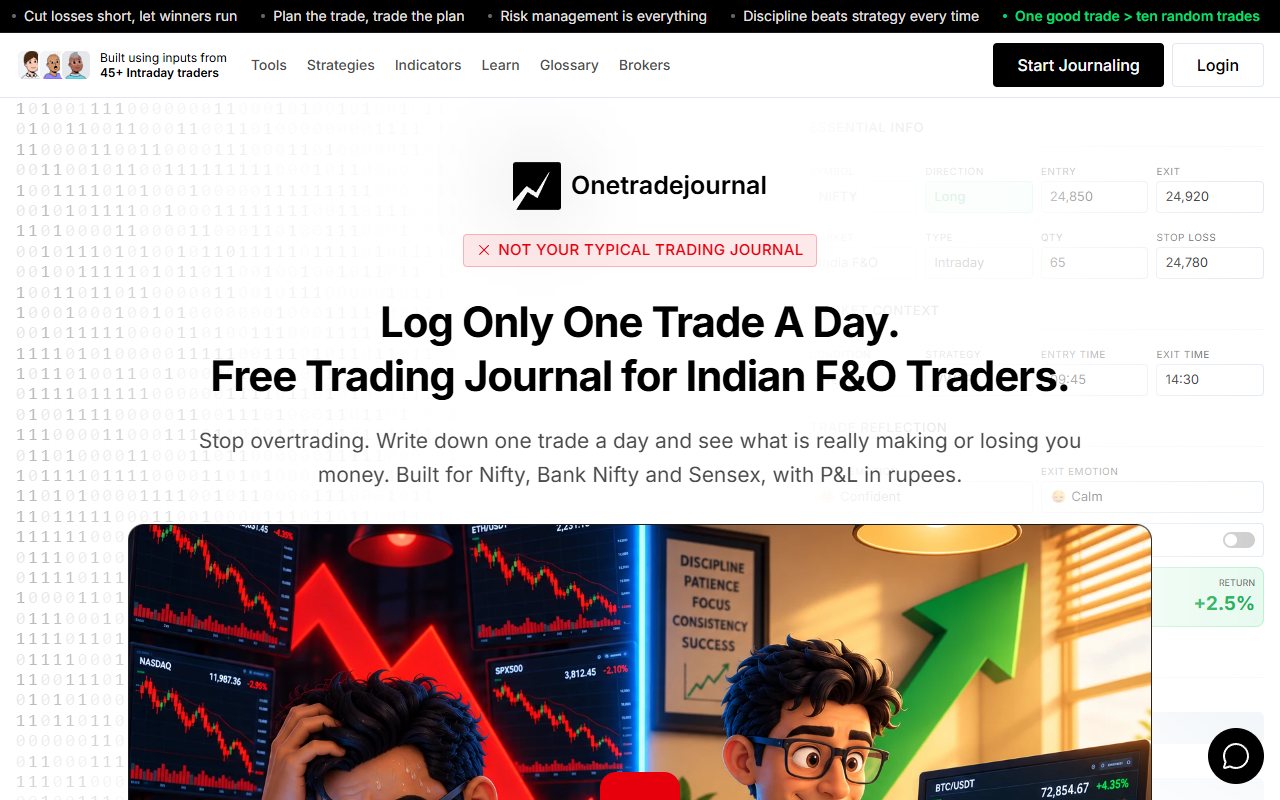
An opening-range Nifty trade can meet the plan at entry, then feel uncomfortable during a small pullback. The early exit may make money and still leave a question about the changed reason. OneTradeJournal's daily habit is to write that trade yourself and keep the feeling beside the original condition. Separate prompts preserve entry confidence, exit anxiety, stress, impulses and plan changes. Free behaviour analytics help you return to the recorded habit. The purpose is to recognise repeated costly mistakes, not to make a discipline score proof of a good decision or a promise of profit. TradeVek already offers psychological notes, mistakes and an AI coach. Its journal page says the coach uses metrics, tags and recorded feelings. Give those tools credit. Either product needs your personal reason; an imported price alone cannot reveal it. OTJ fits when deliberate daily writing and named questions help you keep returning to that explanation. Its free access allows one trade per day per market, with paid plans permitting extra entries. TradeVek's Free Basic card instead lists 100 lifetime trades, strategy tags, basic analysis and CSV export. These are real capacity limits, not rules about what you should trade. A daily selected note is not the full account if other entries are missing. Do not force a trade to keep a routine or assume a monthly total makes the two free plans equivalent. ## Give the feeling a moment and an action
TradeVek advertises psychological notes, mistake tags, discipline scores and an AI coach. Its journal page says the coach reads metrics, tags and recorded feelings. These deserve credit. OTJ cannot claim feelings or AI as exclusive features. Its more specific reason to consider is the arrangement of prompts. Entry feelings, exit feelings, confidence, stress, impulse reasons and changes to the plan have separate fields. A note saying “fear” may describe several moments. Did fear delay the entry? Did it cause an early exit? Did it only appear after the loss? Those events call for different questions. TradeVek's notes can preserve the same explanation if you write it clearly. The public pages do not establish exact matches for every OTJ field. We do not claim that detailed reflection is impossible there. Try an ordinary trade in your chosen form. Can you explain the action and the reason without writing a long essay? A useful prompt makes the important detail easier to preserve, but still needs an honest answer. ## A made-up opening-range exit
Imagine a Nifty options trader enters after a planned opening-range trigger. The trade has a stop and target. A small pullback feels threatening, so the trader closes early with a modest profit. This is not a trade recommendation. The numerical review asks whether prices, quantity and costs are right. TradeVek's file workflow may save work on those facts. Check any partial fills and exits rather than assuming the final result proves a complete record. The decision review asks what changed. Was there new evidence against the setup? Or did discomfort alone cause the exit? OTJ's separate exit feeling and change-to-plan fields can help record that distinction. Do not call the exit wrong simply because the later price rose. The question is what was known at the time. Some early exits follow a valid rule. Keep the original target and reason. Changing them after viewing the final chart can make the trade look more planned than it was. Both journals need the same care with hindsight. ## A screenshot or score needs words around it
TradeVek's free-journal page broadly includes screenshots and discipline tools in its feature descriptions. Its homepage puts screenshot storage, discipline scores and AI in paid cards. The exact free allowances are therefore not fully consistent. Confirm the selected plan before relying on a feature. We did not open an account to settle those differences. A broad free-page heading is not enough to promise every advanced tool for free. A screenshot can preserve the chart. It cannot show why two people looking at that chart made different choices. One may wait for the trigger; another may feel pressure from a message. A note is still needed. A discipline score also depends on its rules and inputs. A rule written after a successful trade can flatter the process. Neither a high score nor a filled field proves the original decision was sound. OTJ's advantage may be a repeated place to record the plan and reason. It has no special way to make dishonest notes true. Compare how each form helps you keep the evidence clear. ## Record context while it is still fresh
TradeVek's intraday page advertises timestamps, chart images and file imports. Intraday means a trade opened and closed within a trading day. Its annotation workflow deserves consideration alongside imports. An end-of-week upload can help with numerical completeness. It may be harder to remember Tuesday's feelings on Friday. A workable routine may import numbers while adding reasons closer to the trade. OTJ uses manual entry throughout on purpose. Writing the plan and feelings is the daily pause, not an automatic copy of executions. TradeVek's file route can save numerical work and still be followed by timely context. Choose the routine you can keep without hiding trades or guessing old feelings. Paid voice fill can help populate the OTJ form. It does not fetch broker executions. Check the prices, quantity and notes before saving. Ask when you have time to complete the record. If you cannot keep up with entries, prioritize a route that preserves the full sequence. Extra prompts matter less when the trades themselves are missing. ## TradeVek is relevant to Indian trades
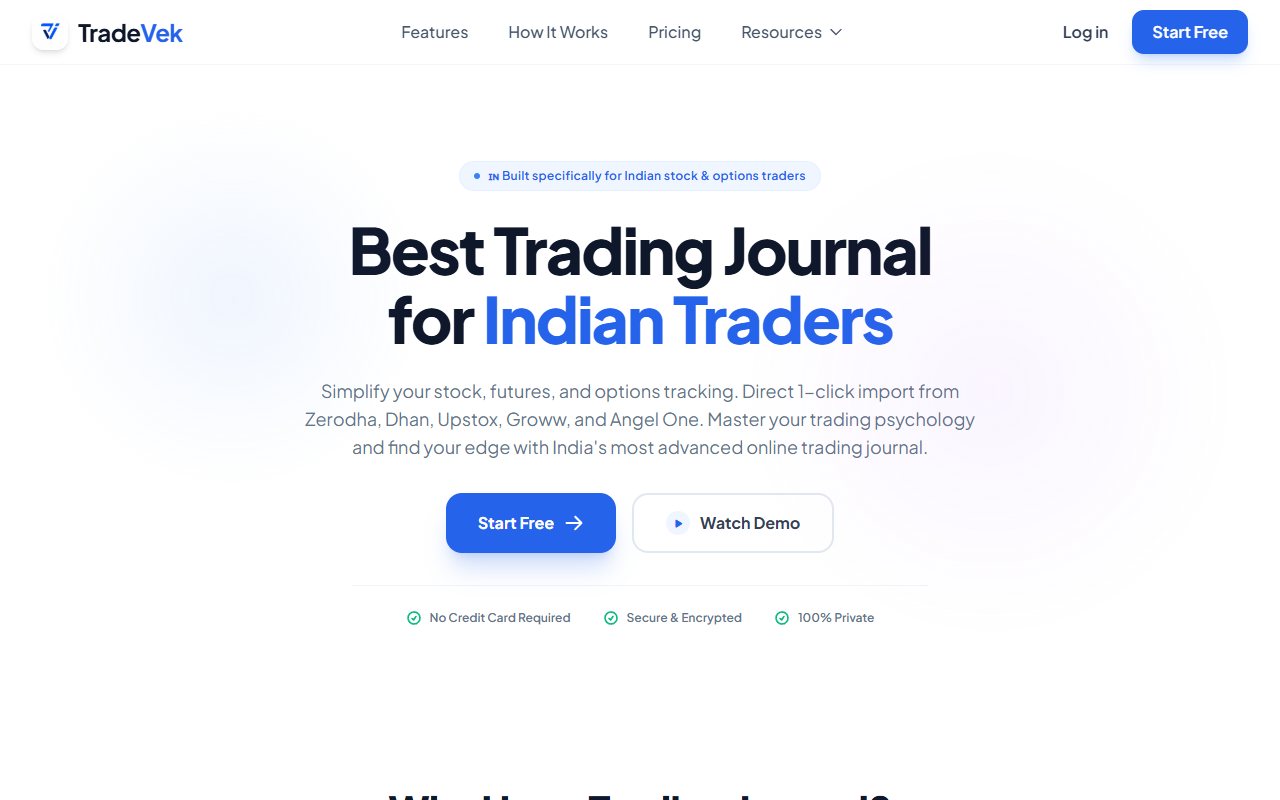
The Indian journal page describes INR records, stocks and options. It names tradebook uploads from Zerodha, Dhan, Upstox, Groww and Angel One. INR means the rupee currency used in India. Its FAQ tells users to download a CSV or Excel report from the broker and upload it. CSV is a table saved as text. That is a meaningful route for someone with a large history. OTJ has no broker-file import, continuous sync or bulk migration. A paid subscription does not add those features. Typing several months of trades may take time better spent reviewing them. The TradeVek homepage also mentions direct integrations and sync. The reviewed pages do not settle the exact connection method or timing for each broker. We credit the documented file route without certifying a continuous connection. If automatic updates are your reason to choose it, confirm that exact feature first. A broker logo or a one-click upload message does not prove background collection works for your account and plan. ## Check how an imported position is built
A broker file may contain several executions for one idea. A partial exit can add more rows. Before drawing conclusions, check what the journal treats as one trade. Compare a simple known session with the original file. Check the contract, quantity, entry, exit and included charges. If the position changed, inspect that case too. These are suggested checks; we did not upload a file. For Indian options, strike and expiry matter. Similar symbols may refer to different contracts. A tidy total is not enough to prove the correct grouping. TradeVek advertises options features, but this page does not certify every broker-file format, combined strategy or option-value calculation. Public product descriptions are a starting point for evaluation. OTJ avoids an import setup because you enter the record yourself. That does not make the result automatically accurate. A mistyped quantity or omitted exit can still change the analysis. ## Compare the actual prices and saved records
TradeVek's homepage lists ₹199 per month or ₹999 per year for paid access. Both are lower than OTJ's corresponding monthly and yearly prices. We do not claim OTJ is cheaper. OTJ costs ₹499 for a month, ₹1,299 for three months and ₹3,499 for a year in India. Paying more needs a clear reason, such as prompts that help you finish a useful review. No better-return promise supports that price choice. TradeVek's free card advertises CSV export. OTJ exports logged records as CSV, JSON and TXT. JSON keeps structured fields; TXT is plain text. Export is present in both published comparisons, with different formats. We did not test TradeVek's actual export content or either checkout. Check that a saved copy contains your notes and not just totals. A common file format does not guarantee a full migration. OTJ has no bulk-import path. An old export may remain a separate archive rather than become OTJ entries. Keep the broker records too, since a journal export is not a certified statement. ## Read the daily note before the coach's answer
AI exists on both sides. TradeVek's exact free and paid allowances need confirmation because the public descriptions differ. OTJ's paid journal chat and chart feedback have use limits. AI can misunderstand a note or a trade. It cannot safely reconstruct missing feelings, verify every execution or promise the next market move. Use its answer as a prompt to inspect evidence. “Why do I keep losing?” may be too broad for a selected sample. A narrower question asks whether trades with recorded size changes also show higher stress. Then read the entries behind the answer. Ordinary OTJ behaviour analytics are free. They compare the saved feelings, confidence, stress and habits with logged outcomes. Paid AI behaviour help is separate from those views. OTJ's flags suggest possible revenge trades, size spikes or too many entries using simple rules. They do not diagnose your state of mind or prevent a broker order. A flag may need context or correction. The useful result is a question you can check against the original plan. The AI label alone does not tell us which product will make that review clearer. ## Keep the daily reflection honest about its sample
After an actual trade, write the original condition and the reason you left. Keep the feeling at exit without deciding that fear must always be wrong. If new evidence changed the setup, explain that too. The later chart should not silently replace what you knew at the time. Return to similar notes at the next review. OTJ's free behaviour tools can help find emotions and changed plans worth reading. Its target comparison still uses your entered target, not a full historical price path. Estimated charges and contract fields need broker checking. TradeVek deserves consideration for Indian file uploads, existing psychology and AI tools, free CSV export and lower published paid prices. Confirm the actual import method and the advanced free allowances, where public pages differ. This review does not adopt popularity, security or performance marketing as proof. OTJ suits a daily writing practice when its separate prompts help you preserve the reason. Free permits one trade per day per market and paid access adds entries. A single entry remains a selected reflection when you placed other trades; keep their full broker evidence. Neither journal can make an invented note true or enforce the next broker order. The useful habit is to write honestly, read again and recognise the emotion or repeated action that needs closer attention.
Sources and limits
We checked these public product pages and OneTradeJournal’s current product on 12 October 2026. We did not test a private TradeVek account, broker import, payment or AI answer. Check current plans and limits before paying.
- TradeVek plans · Checked 12 October 2026
- TradeVek Indian journal and uploads · Checked 12 October 2026
- TradeVek free features · Checked 12 October 2026
- TradeVek intraday journal · Checked 12 October 2026
- OTJ journal features · Checked 12 October 2026
- OTJ paid plans · Checked 12 October 2026
A journal cannot promise trading profits. AI answers and fee estimates can be wrong. Check trades and charges against broker records. This page does not give trading, investment or tax advice. Competitor names and website pictures do not imply a partnership or endorsement. Any example is an explanation, not a private account screenshot or a real customer result.