The detailed comparison
A closer look at the daily routine, the tools and the limits of each product.
Choose a section
Keep the original plan beside the urge to try again
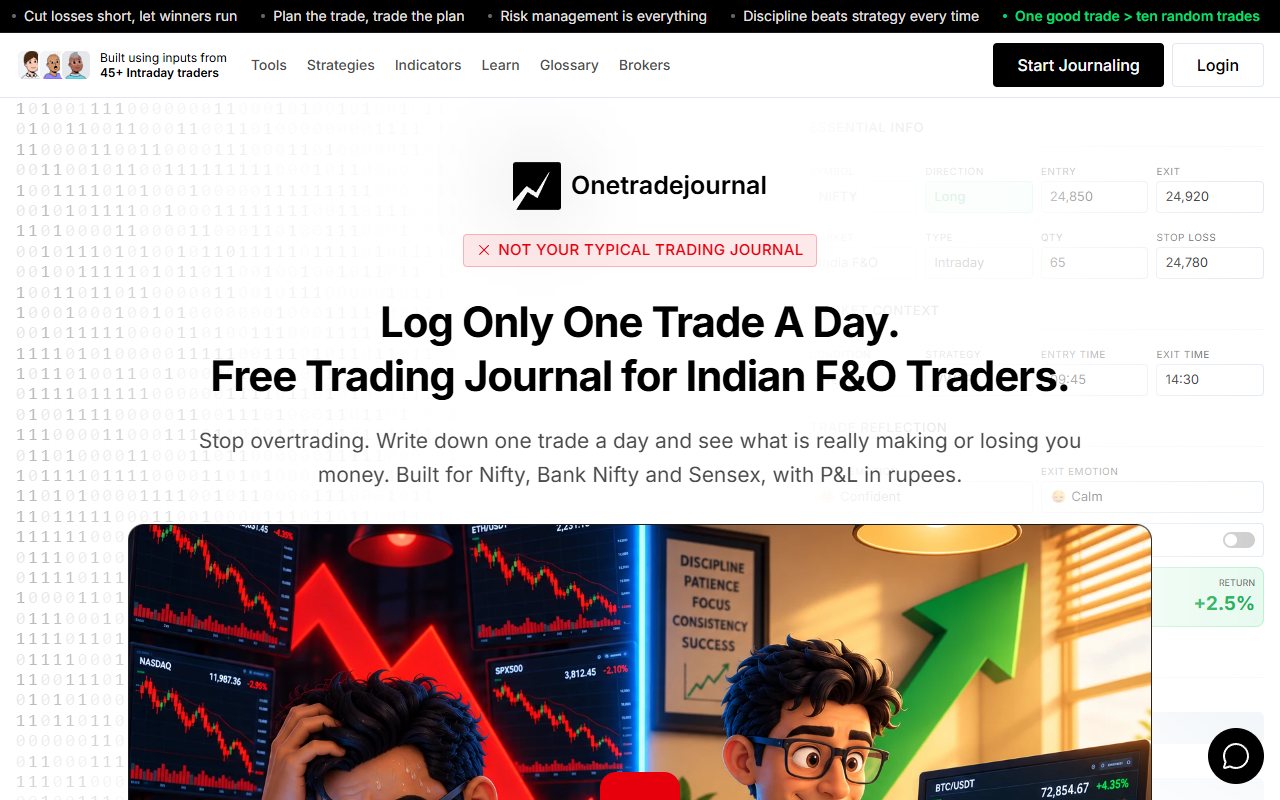
After a Nifty loss, another entry can feel urgent. Later, a useful-looking result may make that entry seem planned all along. OneTradeJournal's daily habit asks you to write the actual trade, the intended condition and the feeling behind a change before the later outcome takes over the story. The purpose is to recognise repeated rushed decisions and costly mistakes. Manual writing is deliberate. Free behaviour analytics let you return to the confidence, stress, feelings and habits in saved entries. They cannot know a private motive you did not write, diagnose the trader or block the next broker order. TradeLore already offers a thoughtful daily routine. Its homepage links preparation, trade notes, feelings, position size and chart review. Those are real reasons to consider it. Its imported facts can sit beside an honest explanation when you supply one; psychology is not exclusive to a manual journal. OTJ fits when writing one daily trade and answering separate questions helps you keep returning to that explanation. Free allows one trade per day per market, and paid plans add entries. There is no broker sync or CSV import, by design. A selected note still does not replace the full financial history. Keep the original broker records with either product. TradeLore's own Indian page says it does not replace broker reports. Your daily reflection explains the choice; the brokerage account records execution and money movements. ## Preserve the plan before the result changes the story
TradeLore advertises a linked routine from preparation to review. Its plans include market bias, levels, capital and news. Its later notes sit beside trades. This can help keep the original idea near the outcome. OTJ records the planned stop, target and strategy in its trade form. A note can hold the reason for entry. It also has a separate field for a change to the plan. Consider a made-up Bank Nifty entry taken before the planned confirmation. The trade wins. A later note saying “good read” could hide the early entry. Keep both facts: the direction worked, and the entry rule changed. Confidence and satisfaction can describe different things. You may have felt very sure at entry yet be unhappy with the process later. OTJ's separate prompts may help preserve that distinction. No form can ensure honest writing. Either journal can hold a flattering story written after the result. Use the original plan as the reference, and record changes even on winning days. ## A made-up late re-entry review
Imagine an Upstox trader studying Nifty option re-entries after an early loss. The trader wants to know whether later entries follow a fresh setup or mainly try to recover the loss. This is an example, not a customer result. Use the imported history to find the relevant days. Then inspect the time field. If it shows midnight for each trade, it does not establish which entry was late. Keep the day-level record, but leave the missing time unresolved until checked. For future trades, write the real time close to the event. Record the setup, planned stop and reason for entering again. In OTJ, the impulse and change-to-plan fields can keep those details separate from the final result. A planned later trade should not be called a mistake just because earlier later trades were rushed. The setup and note help preserve that difference. The time alone cannot tell whether the choice was sensible. TradeLore may support the same reflection through its plans, notes and available fields. OTJ's reason to consider is the daily pause of writing the intention and emotion yourself. Check the numbers and times, then preserve the personal reason rather than filling it from the result. ## Imports are a strong reason to consider TradeLore
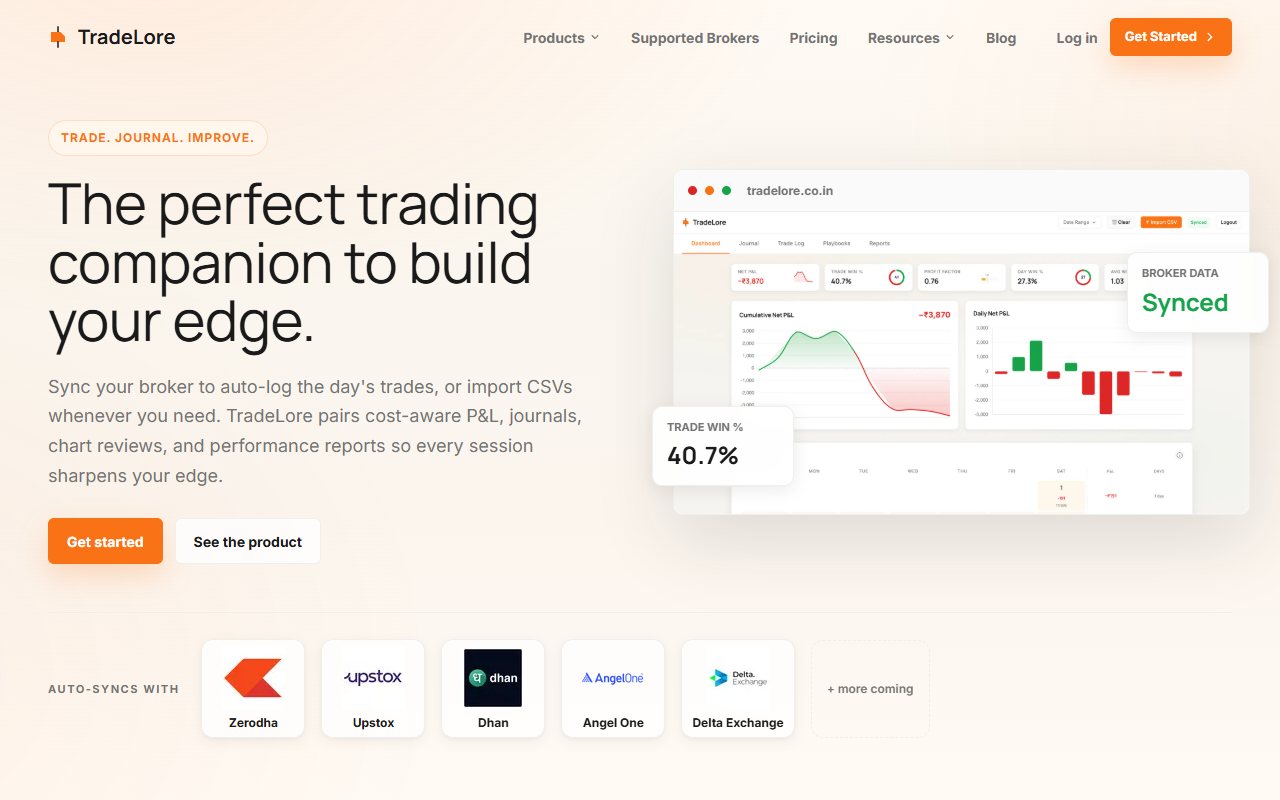
TradeLore's broker page names Zerodha, Upstox, Dhan, Angel One and Delta Exchange. It offers workflows for bringing trade data into the journal. Its homepage also advertises automatic sync and CSV files. CSV means a table saved as a text file. These are published product claims, not integrations we tested. A listed broker does not prove every contract, date or field works in your account. It is sensible to compare a small imported sample with the original broker record first. For a day with many fills, imports can save typing. A fill is an executed part of an order. Several fills may need to be joined into the trade you intend to review. Check the grouping as well as the total result. OTJ has no broker sync or CSV import. Paid voice fill can help enter details, but it cannot fetch your trading history. A TradeLore export is not a supported bulk route into OTJ either. TradeLore's imports can save substantial work on a busy history. OTJ deliberately starts with writing the daily reason yourself. Choose the routine you can maintain, including the human context that prices alone cannot provide. Do not treat the selected note as the whole day if other trades are missing. ## The time field needs special care
TradeLore's official Upstox import guide describes a specific problem. In that historical path, the input has a date rather than an intraday time. The guide says the stored time is set to midnight. This does not mean every TradeLore import lacks useful times. It is a limit stated for that documented Upstox path. Other sources or later versions may differ. Check the actual fields you receive before studying morning and afternoon entries. A date identifies the day. It cannot tell you whether an order was taken just after opening or near closing. A chart with an hourly label does not create that missing evidence. OTJ lets you enter entry and exit times. This helps only when you know and record the correct times. Use the broker execution history. Guessing from memory can produce a neat but unreliable pattern. For either journal, ask what the time means. Is it the order time, execution time or a default value? Are several fills joined? Those checks matter if your question depends on minutes rather than simply the trading date. ## Chart review is useful, but ask what replay means
TradeLore advertises trade replay and chart review. Its product tour describes direction, quantity, entry, exit, order legs and chart markers together. That is useful published support for studying execution. The word replay can mean different things. The page does not prove every form of market simulation, options-price history or backtesting. Check the working feature before buying for one of those needs. We did not test a replay. OTJ has no historical market replay or backtesting. You can keep a chart link in a trade. Paid Trading Mentor can review a chart image you supply, with use limits and the risk of errors. OTJ's exit-efficiency measure compares the exit with the recorded target. It does not track every price reached while the position was open. Do not use it as proof of the best or worst possible exit. For a question about order sequence on a chart, TradeLore may fit better. For a question about fear changing an exit, separate feelings and reasons may be useful. A complete review may need both kinds of evidence. ## Check costs against the original money records
TradeLore's India page clearly says it cannot replace broker reports. The journal adds notes and analysis to imported data. It does not become the official account statement. OTJ has the same boundary. Its Indian charges are estimates. Its contract details and lot-size hints help with entry, but you still need the correct contract and quantity. Keep the broker's notes and statements. If two totals differ, check the date range, joined trades and included costs first. Gross result means before charges. Net result means after the charges included. Different inputs can explain different net totals. Imagine several small option entries during one session. The money record can show the cost of that activity. The notes can explain whether each entry was planned or driven by frustration. Those are related but separate questions. A high trade count is not enough to prove a mistake. A lower count can still include a rushed decision. Neither a dashboard nor a flag should replace reading the actual plan and sequence. ## Read the habit before trusting an AI label
OTJ's paid Ask Your Journal can help ask questions of logged trades. Trading Mentor can review supplied material. Both have use limits. AI can give a wrong answer or misunderstand a note. The reviewed TradeLore pages do not settle every AI feature or plan allowance. We leave that point open. We do not turn silence on a public page into a claim that a product has no AI. A date-only import stays date-only evidence unless another source supplies the time. AI cannot safely fill in a guessed entry hour. The same applies to an unrecorded feeling or a missing planned stop. Ordinary OTJ behaviour analytics are free. Compare the feelings, stress, confidence and planned or impulsive entries you recorded. Paid AI behaviour review is separate from those views. OTJ's flags can suggest possible revenge trading, size spikes or too many entries. They use rules and patterns, not a full understanding of intent. They do not block broker orders. Use any suggestion to find the original record. Then check whether it supports the conclusion. A short answer is easier to trust when it points to a trade you can actually inspect. ## The displayed launch offer is old
TradeLore's homepage still shows a launch offer ending on August 31. It displays ₹199 a month beside a crossed ₹299, and a one-month demo message. This review is dated 12 October 2026, after the displayed deadline. The current public page does not settle which price you can pay now. It also does not confirm that the demo still applies. Treat those messages as dated offers until the service confirms current terms. OTJ's Indian paid plans are ₹499 for one month, ₹1,299 for three months and ₹3,499 for one year. Its free plan allows one trade a day per market. Paid access permits extra entries; it does not add imports. This is not a claim that OTJ is cheaper. TradeLore's imported workflow may save time that matters more than a price difference. First confirm the current offer, then compare the features you will use. We did not sign up or test either checkout. A clear public plan is useful evidence, but it is not a certificate that your own purchase or trial will work exactly as expected. ## Make the daily reflection worth returning to
OTJ can export logged trades as CSV, JSON and TXT. These preserve a self-entered record. They are not certified tax statements, and a shared file format does not guarantee another journal can import every field. If you move from a large imported history to new manual notes, mark the start date. The samples may cover different trades. Comparing their win rate or worst losing period without checking scope can be misleading. TradeLore deserves attention if imports, plans and chart review are central to your routine. Check the broker path, sample timestamps and current purchase terms. Its own notes and feelings deserve credit. OTJ suits a daily writing routine where named prompts help you recognise the urge after a loss or a changed exit plan. Write one actual trade, its intended condition and the feeling at the time. Return to that note with similar entries, including rushed wins and planned losses. Free behaviour review supports the reading; it does not establish a profitable rule. TradeLore's planning, feelings and linked chart review may already keep this routine together. Check the current offer and the exact import fields before relying on those wider tools. Keep the broker evidence and all actual trades alongside the personal reflection. Neither journal controls your next order or certifies the money record.
Sources and limits
We checked these public product pages and OneTradeJournal’s current product on 12 October 2026. We did not test a private TradeLore account, broker import, payment or AI answer. Check current plans and limits before paying.
- TradeLore features and dated offer · Checked 12 October 2026
- TradeLore broker imports · Checked 12 October 2026
- TradeLore Upstox import guide · Checked 12 October 2026
- TradeLore Indian journal · Checked 12 October 2026
- OTJ journal features · Checked 12 October 2026
- OTJ paid plans · Checked 12 October 2026
A journal cannot promise trading profits. AI answers and fee estimates can be wrong. Check trades and charges against broker records. This page does not give trading, investment or tax advice. Competitor names and website pictures do not imply a partnership or endorsement. Any example is an explanation, not a private account screenshot or a real customer result.