The detailed comparison
A closer look at the daily routine, the tools and the limits of each product.
Choose a section
Feeling confident does not settle the size decision
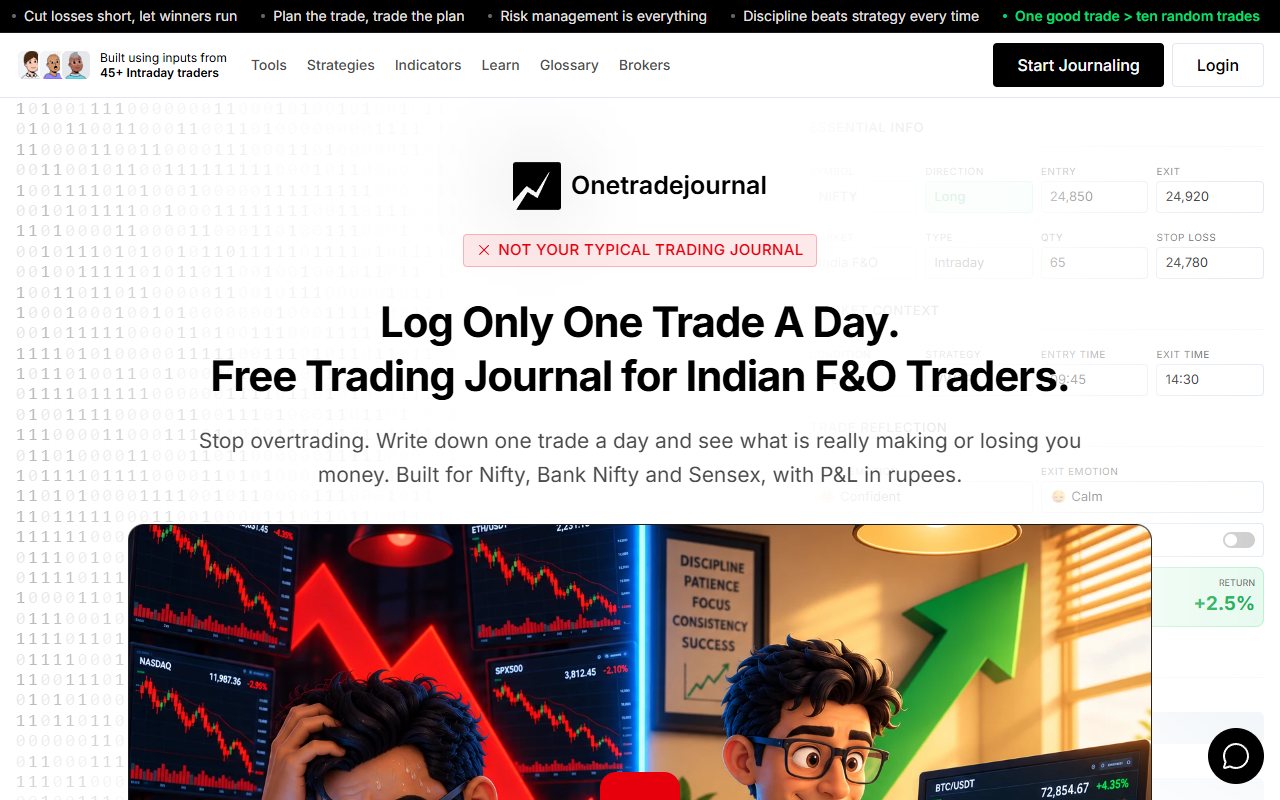
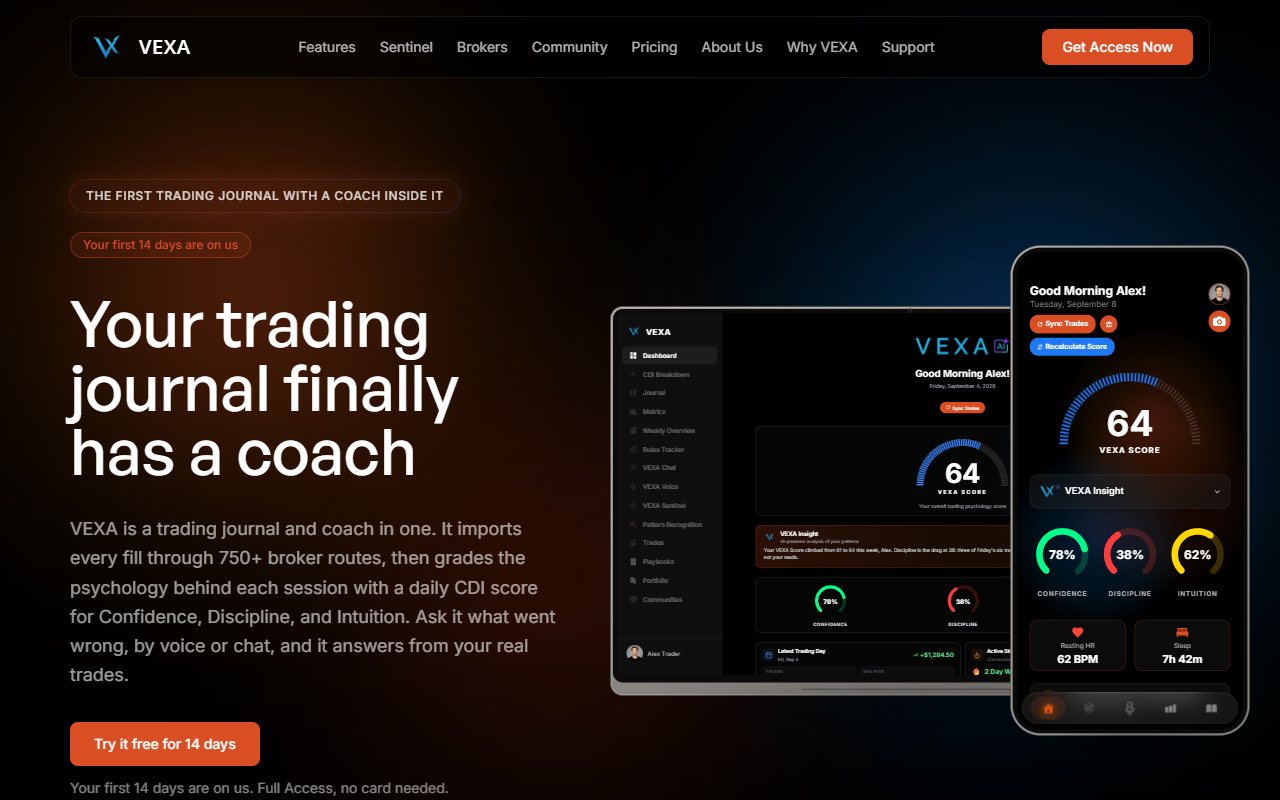
You feel confident before a planned Bank Nifty trade. You feel confident again when taking a larger position after a loss. The feeling is the same, but the risk rule may be very different. A useful daily reflection preserves that difference. OTJ puts one planned trade at the centre of a manual writing habit. Record the size, planned stop and reason for acting. Then describe the urge to recover or change the rule. The pause is deliberate, with the aim of helping you recognise overtrading and repeated costly mistakes. Free allows one trade per day per market and includes Behaviour analytics. Paid plans allow more entries. The daily focus is voluntary. It does not diagnose your state of mind, enforce a broker limit or promise that a planned trade will win. VEXA also puts psychology and routine at the centre of its homepage. It offers daily journal review, tags, chat and voice coaching, alongside Confidence, Discipline and Intuition scores. Its Upstox route uses files. OTJ's appeal is a clear daily explanation of the trade you chose, while VEXA adds broader collection and spoken review. ## Return from the score to the action you wrote
VEXA describes its Confidence, Discipline and Intuition score as part of the product. The homepage says the score uses trading history, habit patterns and emotional details. This review did not test whether the score measures a person's state of mind. It also did not test a link to future results. Scores can help you find a day in a long history. A changing number may prompt the trader to inspect a session they would otherwise overlook. Read the actual actions behind it. The number is not a full description of the person. OTJ encourages a different starting point: record what happened. “I entered before the setup completed” gives you more to check than “I felt undisciplined.” The plan change field, impulse reason and notes can keep that specific action beside the trade. Imagine a made-up trader who rates confidence highly on both a careful planned entry and an oversized recovery trade. Confidence alone cannot separate those choices. Adding the planned stop, position size, reason and recorded plan change gives the review more context. At the end of the week, check whether you raised size after a loss. You could also check whether high-stress exits missed the planned target. Free OTJ Behaviour analytics and habit flags can draw attention to recorded patterns. Paid AI behaviour review is separate. These flags use simple rules to spot recorded habits. They cannot diagnose a health condition. Check the records behind a coaching score too. Read the trades that differ from the pattern and choose one action to watch. The score can point you towards a note. It does not supply the reason. Write the daily note before turning the win or loss into an explanation. Did the larger size follow a fresh risk plan, or did the first loss make normal size feel too small? A short sentence about that moment is more useful than a confident label applied to the whole session. VEXA's journal, tags and conversations can hold personal context too. Raw execution data alone does not establish a private motive, and a heart-rate rise can have several causes. OTJ asks you to write the reason yourself, then return to it in free Behaviour review. Neither a review flag nor a score proves that an emotion caused the result. ## Two forms of voice assistance
The app offers conversational voice coaching. The Pro plan lists 300 voice minutes and 900 chat messages per month. That is meaningfully different from OTJ's paid voice assistance for filling a manual trade form. OTJ also has paid Ask Your Journal and Trading Mentor. These tools can answer questions about saved trades, review a chart image and point out recorded patterns. A trader can ask questions about saved choices and use responses to organize a review. Neither product has been tested head to head here, so there is no basis for claiming better AI accuracy. Consider a made-up trader who finds writing difficult after a tiring Indian session. A spoken coaching conversation could help them explain what happened. Another trader may prefer to dictate form values, check the numbers, then review the saved trade later. Those are different routines, both potentially useful. In either case, distinguish a helpful question from a verified claim. AI can produce a reason that fits the outcome without adequate evidence. It cannot know the intention behind a trade unless that intention is available in the records or conversation. Use the response to identify specific trades, missing details and a practical next step. Check any quantities, fees and contract details yourself. A larger allowance lets you talk for longer. It does not make every answer correct. ## Wearables add a different kind of input
The app's Sentinel page describes heart-rate monitoring, coaching nudges and an overlay of wearable readings with intraday P&L. It documents Apple Watch, Wear OS and supported Bluetooth heart-rate devices, and identifies Sentinel as a Pro feature. These tools may fit someone who already has a supported device and wants its readings beside a session review. OTJ does not claim a wearable integration or a live biometric overlay. Its stress and feelings are entered by the trader. A watch reading and a written note can answer different questions. The reading may help locate a moment to inspect. The note can say whether the position made you anxious. You might have been distracted by something else. You might have felt an urge to act. This comparison does not treat a heart-rate change as proof of a particular trading mistake. There are also practical steps before relying on the workflow. The Sentinel setup section says live Bluetooth pairing needs an iPhone or Android phone. The web and tablet views share the session. They do not make a second heart-rate connection. Check the actual device and intended screen. Do not buy a wearable solely because a product example looks persuasive. First show whether this extra input helps answer your review question and whether you are comfortable keeping the setup. A clear written note may be enough if you keep dropping a rule you already know. ## Upstox support is a file route today
The official Upstox page says to upload a file. It lists auto-sync, a direct broker connection, as coming soon. Its instructions tell users to export separate segment reports and upload CSV files. A broad homepage claim about broker routes should not be read as a live Upstox connection. This still provides a useful advantage over OTJ. A supported file can avoid typing each execution. OTJ has no CSV import or broker connection. Moving an old Upstox history into it means manual entry. The import process also needs deliberate scope. If a trader exports only equity while trading F&O as well, the missing derivatives cannot contribute to the review. The app's own segment instructions specifically warn about this omission. In this made-up trial, an Upstox user picks a short, complete reporting period. They export every traded segment, then match a few imported trades to broker records. This is a suggested check process, not a claim that the importer was tested or passed an accuracy audit. With OTJ, the comparable discipline is to record every relevant trade using the same method. Manual entry is part of OTJ's deliberate reflection, while omitted trades and typing errors still need care. The journal needs an honest record whether you type the numbers or bring in a file. ## A trade record does not guarantee an Indian price chart
The Upstox FAQ says there is no price-data provider for NSE, BSE or MCX. An Indian trade's chart can therefore be empty. This is a useful disclosure for someone expecting an imported Nifty option to appear against historical candles. Imported fills and historical market prices are different datasets. An entry and exit show what the trader did. A fill is a completed part of an order. A complete price path can answer additional questions about movement while the position was open. One does not automatically supply the other. OTJ also should not be chosen as a historical replay service. It has no backtesting or market replay. Its exit-efficiency measure checks the entered exit against the logged target. It does not rebuild past prices. MAE and MFE measure the worst and best price moves during a trade. OTJ does not calculate those from a past market-price feed. In a made-up example, a Bank Nifty trader wants to know why an early exit occurred. OTJ can save the target, exit price, stress and exit feeling, plus a note about the choice. That supports a useful process discussion without pretending to know every price reached afterward. If the real question is how far that exact option premium moved after the exit, obtain suitable historical evidence separately. Neither an empty imported chart nor a manually entered target is enough to show the answer. Choose the evidence you need before judging the chart. ## Free VEXA access is a meaningful strength
The app's pricing page describes a free Edge plan with imports, trade records, reports and playbooks. It includes five chat messages and five voice minutes per month. New accounts receive 14 days of full Pro access without a card before continuing on Edge. That is not the same as saying the entire product becomes unusable after the trial. The free journal remains available, with its listed features. It is also not the same as unlimited free coaching: the continuing AI allowance is explicitly small. OTJ's ongoing Free limit is one trade per day per market. Paid Indian plans cost ₹499 monthly, ₹1,299 quarterly or ₹3,499 yearly. There is no claim here that its paid features have a free trial. The app lists Pro at $29.99 monthly on its pricing page. The article does not turn that amount into a rupee total or assume a checkout tax. For a budget-focused trader satisfied by Edge, OTJ cannot claim to be cheaper than free. Choose paid tools only when their detail or coaching fits the review you will keep. If the free imported journal already saves everything needed, a paid alternative needs a specific reason. If OTJ's Indian form and habit fields produce records you actually use, those may justify its paid plan for your routine. ## Choose the daily note or the spoken coaching routine
OTJ fits an Indian F&O trader who wants a daily pause to name the urge behind larger size, a changed stop or another unplanned entry. Its contract fields and separate emotion questions give that note a clear place. Behaviour analytics is free, and paid AI is a separate optional review channel. VEXA is worth considering for its free imported journal, tags, mobile apps and voice conversations. Sentinel adds device readings for a compatible paid setup. Those are real differences in scope. Check the current Upstox file route and Indian chart limit before expecting a full price history. Start with a trade you already took. Write the plan, feeling and action in plain words, including a winning rule break. There is no need to place a trade to keep the daily habit. A planned entry can still lose, and a score does not make the risk safe. If your daily reflection selects one trade from a busier account, keep the full money record too. OTJ Free is one trade per day per market; paid access permits more entries. Use the next review to recognise one repeated moment, with no claim that writing, a voice nudge or a wearable can guarantee a better outcome.
Sources and limits
We checked these public product pages and OneTradeJournal’s current product on 12 October 2026. We did not test a private VEXA Trade account, broker import, payment or AI answer. Check current plans and limits before paying.
- VEXA coaching and apps · Checked 12 October 2026
- Upstox file steps and Indian chart limits · Checked 12 October 2026
- VEXA Free and Pro plans · Checked 12 October 2026
- Sentinel watch and phone setup · Checked 12 October 2026
A journal cannot promise trading profits. AI answers and fee estimates can be wrong. Check trades and charges against broker records. This page does not give trading, investment or tax advice. Competitor names and website pictures do not imply a partnership or endorsement. Any example is an explanation, not a private account screenshot or a real customer result.